Mexico
Flag of Mexico
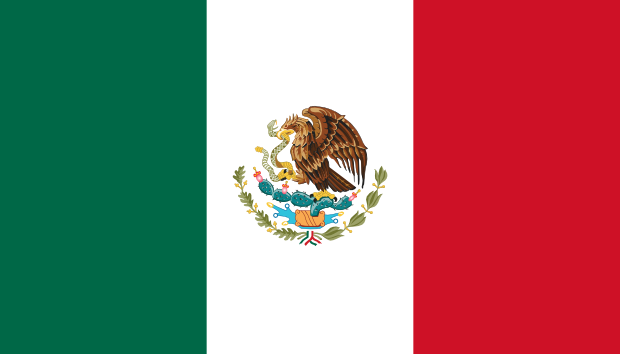
Flag is available in resolutions
| Icon 88x50 |  |
| Icon 32x18 |  |
Mexico
Mexico: A Tapestry of Ancient Civilizations, Vibrant Culture, and Economic Dynamism
Mexico, officially the United Mexican States, is a country of immense geographical diversity, rich historical depth, and a pulsating cultural heartbeat that resonates across the globe. Situated in the southern portion of North America, it shares a lengthy border with the United States to its north and Guatemala and Belize to its south. Its western coastline is caressed by the Pacific Ocean, while its eastern shores are lapped by the Gulf of Mexico and the Caribbean Sea. This strategic location has profoundly shaped its history, influencing its interactions with indigenous peoples, European colonizers, and its powerful northern neighbor. The sheer scale of Mexico is impressive; it is the fifth-largest country in the Americas by total area and the thirteenth-largest independent nation in the world. Its varied landscapes range from arid deserts in the north and west to lush tropical rainforests in the south and southeast, encompassing towering mountain ranges, active volcanoes, and extensive coastlines that are a magnet for tourism.
The population of Mexico is a vibrant mosaic, reflecting centuries of intermingling between indigenous peoples and European settlers, primarily from Spain. This blend has created a unique cultural identity, known as Mestizo, which forms the majority of the population. However, Mexico is also home to a significant number of indigenous groups, each with their own distinct languages, traditions, and customs. These include the Nahua, Maya, Zapotec, Mixtec, and many others, whose heritage is deeply woven into the fabric of Mexican society. The official language is Spanish, but indigenous languages are still spoken by millions, serving as a testament to the enduring strength of pre-Hispanic cultures. Mexican society is characterized by strong family ties, a profound sense of community, and a deep appreciation for its rich artistic and culinary heritage. Catholicism is the predominant religion, a legacy of the Spanish conquest, but syncretism with indigenous beliefs is also common. The country’s demographic profile is relatively young, with a significant portion of its population under the age of 30, presenting both opportunities and challenges for its future development. Urbanization has been a significant trend, with large metropolises like Mexico City, Guadalajara, and Monterrey serving as economic and cultural hubs.
Mexico’s history is a captivating narrative of rise and fall, conquest and resilience, innovation and tradition. The land was once home to some of the most sophisticated ancient civilizations in the world, most notably the Olmecs, Maya, and Aztecs. These civilizations left behind awe-inspiring architectural wonders, intricate art, and advanced understanding of astronomy and mathematics. The Maya, for instance, developed a complex writing system, a sophisticated calendar, and built monumental cities like Chichen Itza and Palenque. The Aztecs, with their capital at Tenochtitlan (modern-day Mexico City), established a vast empire that dominated Mesoamerica before the arrival of the Spanish. The Spanish conquest, led by Hernán Cortés in the early 16th century, marked a brutal but transformative period. It resulted in the fall of the Aztec empire, the imposition of Spanish rule, and the introduction of new languages, religions, and social structures. This colonial era, lasting for three centuries, saw the exploitation of resources and labor, but also the fusion of Spanish and indigenous cultures, giving birth to the unique Mexican identity. In the early 19th century, Mexico fought for and gained its independence from Spain, a struggle marked by revolutionary fervor and periods of political instability. The 20th century brought further upheaval, including the Mexican Revolution, a complex and bloody conflict that reshaped the nation’s political and social landscape, leading to land reforms and the establishment of a more inclusive government. The latter half of the 20th century and the early 21st century have seen Mexico navigate economic liberalization, political democratization, and the challenges of globalization, all while striving to preserve its cultural heritage and address social inequalities.
The Mexican economy is a dynamic and multifaceted entity, driven by a diverse range of sectors. For decades, oil has been a significant contributor to its GDP, with PEMEX (Petróleos Mexicanos) being a state-owned oil giant. However, the country has actively diversified its economic base. Manufacturing plays a crucial role, particularly in the automotive sector, with numerous international car manufacturers establishing production facilities in Mexico, taking advantage of its strategic location and skilled workforce. The aerospace industry is also growing, as is the electronics sector. Trade is a cornerstone of the Mexican economy, heavily influenced by its proximity to the United States. The North American Free Trade Agreement (NAFTA), and its successor the United States-Mexico-Canada Agreement (USMCA), have fostered significant trade and investment between the three countries. Remittances from Mexicans working abroad, particularly in the United States, are another vital source of income for many families and a significant contributor to the national economy. Agriculture remains important, with Mexico being a major producer of corn, beans, avocados, tomatoes, and chilies, many of which are exported globally. The tourism industry is a powerhouse, drawing millions of visitors annually to its stunning beaches, ancient ruins, and vibrant cities, generating substantial revenue and employment. The service sector as a whole is a growing contributor to the Mexican GDP.
Mexico’s tourist attractions are as diverse and captivating as its history and geography. The Riviera Maya, with its pristine white-sand beaches, turquoise waters, and ancient Mayan ruins like Tulum and Coba, is a world-renowned destination for sun-seekers and history buffs alike. The Yucatan Peninsula, beyond its famous beaches, offers the unparalleled wonder of Chichen Itza, one of the New Seven Wonders of the World, and the ecological marvel of the Sian Ka’an Biosphere Reserve. For those interested in ancient civilizations, Teotihuacan, the “City of the Gods” near Mexico City, with its colossal pyramids of the Sun and Moon, is an absolute must-see. Mexico City itself is a sprawling metropolis brimming with cultural treasures. The historic Zocalo, the second-largest city square in the world, is flanked by the Metropolitan Cathedral and the National Palace, which houses Diego Rivera’s iconic murals depicting Mexican history. The city also boasts world-class museums, such as the National Museum of Anthropology, which provides an unparalleled journey through Mexico’s pre-Hispanic past. Beyond the major historical sites, Mexico offers charming colonial cities like San Miguel de Allende, Guanajuato, and Oaxaca, each with its own unique architectural beauty, vibrant arts scene, and delicious regional cuisine. The Copper Canyon in Chihuahua offers breathtaking natural scenery and the opportunity to ride the Chepe train, traversing dramatic gorges. For adventure enthusiasts, activities like scuba diving in cenotes, exploring the Monarch Butterfly reserves in Michoacán, or hiking in the Sierra Madre mountains provide unforgettable experiences. The vibrant festivals, such as Día de Muertos (Day of the Dead), are a testament to Mexico’s unique approach to life and death, a profound cultural spectacle that draws global attention. From the bustling markets to the serene beaches, Mexico offers a truly immersive and unforgettable travel experience.
Information about Mexico
The information comes from the publication CIA The World Factbook.
Automated text translation, excuse errors, please!
Country Mexico is situated in a location / continent North America. Mexico has an area of 1 964 375 km2 and 114 975 406 residents. The highest point has a height 5 700 above sea level. and it is called Volcan Pico de Orizaba. The lowest point is located at the level of -10 above sea level and it is named Laguna Salada. System of government is Federal Republic and the date of independence 16th September 1810. The capital city is Mexico (Distrito Federal). Mexico has the international abbreviation MX.
Mexico - economy
Total gross domestic product (GDP) is 1 683 000 000 000 $. Total gross domestic product per capita in purchasing power parity is 14 800 $. GDP grows by 4.00 % a year. Inflation (consumer price index) is equal to 3.40 % a year. Mexico have 49 170 000 working-age population (from a total population 114 975 406 people). Unemployment is at 5.20 %. Mexico issued 13.80 % GDP to healt care and 0,50 % GDP to army. The public debt of the country is 35.40 % GDP. The total amount of foreign debt is 210 800 000 000 USD.
Mexico - demography
As suggested above, Mexico has 114 975 406 people. Population growth is in the amount 1.09 % per year. Number of children born per 1000 population per year is 18.87.Every mother has average 2.27 children. The infant mortality rate is 16.77 and maternal mortality 50.00 deaths per 100,000 births. Average estimated life expectancy makes 76.66 years. Mortality is 4.90 people per 1000 population per year.
Mexico - transport and telecommunications
Mexico has 366 095 km of roads, 17 166 km of railway lines and 1 724 airports. The total length of waterways (navigable rivers, canals, etc.) is 2 900 km. There is registered 52 ships.
Number of active mobile phones (sim card) in the country Mexico is 94 565 000. Number of active fixed telephone lines is 19 684 000. Mexico has 31 020 000 internet users, who have the available 15 165 000 Internet connections. Mexico has been assigned a domain first Choose range .mx.
Mexico - energetics
Mexico consumes a year 203 800 000 000 kWh of electricity. Annual electricity production is 254 400 000 000 kWh in power plants with a total installed electrical capacity 59 330 000 kW. Mexico exports 1 320 000 000 kWh and imports 624 500 000 kWh of electricity per year Energy mix of power generation is as follows: fossil fuels: 75 %, nuclear energy: 2.3 %, renewable: 3.3 %, hydropower: 19.4 %. The country Mexico is harvested annually 2 934 000 barrels of oil.
Keywords: national flags, list of flags, Flags of countries, flag, Flag of Mexico, Mexico, flag states, telecommunications, transport, list of countries, economy, all flags, information, demography, energetics, world countries, flags of countries in the world, politic.