Kazakhstan
Flag of Kazakhstan
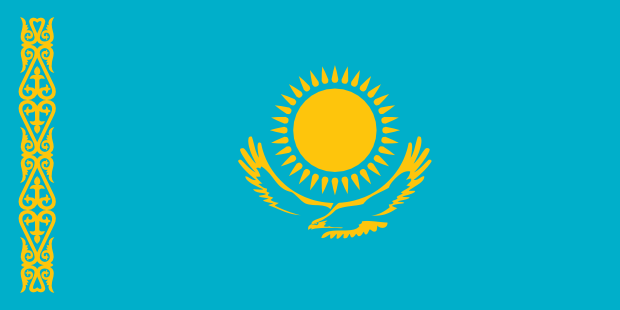
Flag is available in resolutions
| Icon 88x44 |  |
| Icon 32x16 |  |
Kazakhstan
Kazakhstan: A Land of Vast Horizons and Enduring Spirit
Kazakhstan, the ninth-largest country in the world by land area, is a nation of immense scale and profound historical significance. Straddling the crossroads of Europe and Asia, it is a land of stark contrasts, from the windswept steppes and majestic Tien Shan mountains to the burgeoning modern cities and the remnants of ancient Silk Road civilizations. Its rich tapestry is woven from the threads of nomadic traditions, Soviet legacy, and a vibrant, forward-looking national identity. Understanding Kazakhstan requires delving into its vast geography, its complex and often tumultuous history, its diverse population, and its evolving economic landscape.
The geography of Kazakhstan is one of its most defining characteristics. Covering an area of nearly 2.7 million square kilometers, it is a landlocked behemoth, sharing borders with Russia, China, Kyrgyzstan, Uzbekistan, and Turkmenistan, and boasting a significant coastline along the Caspian Sea. The sheer expanse of the country is breathtaking. The dominant feature is the vast, fertile steppe, a seemingly endless expanse of grasslands that has historically been home to nomadic peoples. These steppes are not monotonous; they are punctuated by rolling hills, river valleys, and vast desert regions like the Kyzylkum and Moyunkum. In the south and southeast, the dramatic peaks of the Tien Shan mountain range rise majestically, offering stunning vistas, alpine meadows, and a source of vital water for the nation. The northern regions are characterized by extensive agricultural lands, while the west is dominated by arid plains and the immense, saline expanse of the Caspian Sea, the worlds largest inland body of water. This diverse topography influences everything from the climate, which ranges from continental in the interior to more temperate in the south, to the distribution of its population and the types of industries that thrive within its borders. The country is also home to some of the most unique geological formations and natural wonders, including the Singing Dunes of Altyn Emel National Park and the Charyn Canyon, often referred to as the Grand Canyon of Central Asia. The presence of the Baikonur Cosmodrome, leased to Russia, further highlights Kazakhstans strategic location and its unique role in global endeavors.
The history of Kazakhstan is a long and intricate saga, shaped by centuries of migration, empire-building, and profound geopolitical shifts. For millennia, the region was inhabited by nomadic Turkic peoples, whose equestrian skills and pastoral lifestyles defined their existence. These nomadic tribes, including the Kazakhs themselves, were renowned for their resilience and adaptability in the harsh steppe environment. The Great Silk Road, the ancient network of trade routes connecting East and West, passed through parts of what is now Kazakhstan, leaving behind a legacy of cultural exchange and the ruins of ancient trading posts and cities. The region later fell under the influence of various empires, including the Mongol Empire under Genghis Khan, and subsequently the successor states. In the 18th and 19th centuries, the Russian Empire gradually expanded its control over the Kazakh lands, incorporating them into its vast dominion. This period brought significant changes, including the imposition of new administrative structures, the settlement of Slavic populations, and the disruption of traditional nomadic life. The Soviet era, from 1922 to 1991, marked another transformative and often traumatic chapter. Kazakhstan became the Kazakh Soviet Socialist Republic, and its resources were heavily exploited for industrial development and agricultural collectivization. This period witnessed forced collectivization, mass deportations, and the devastating Aral Sea ecological disaster, a stark reminder of the environmental consequences of Soviet-era policies. The country also played a crucial role in the Soviet nuclear program, with the Semipalatinsk test site becoming one of the worlds largest nuclear testing grounds. Following the dissolution of the Soviet Union in 1991, Kazakhstan declared its independence, embarking on a new era of nation-building. This transition was not without its challenges, but under the leadership of Nursultan Nazarbayev, the country has striven to establish a stable and prosperous independent state, navigating the complexities of a post-Soviet world.
The population of Kazakhstan is as diverse as its landscape, a vibrant mosaic of ethnicities and cultures. While Kazakhs form the titular ethnic group, constituting a majority of the population, the country is home to a significant number of Russians, along with substantial Uzbek, Ukrainian, Uighur, Tatar, and German minorities, among others. This ethnic diversity is a direct legacy of historical migrations, Soviet settlement policies, and the countrys strategic position. The official language is Kazakh, a Turkic language, but Russian remains widely spoken and understood, particularly in urban centers and among the older generation. The majority of the population adheres to Islam, primarily Sunni Islam, while there is a significant Orthodox Christian minority, as well as smaller communities of other faiths. The demographic landscape has evolved over time, with a notable out-migration of some ethnic groups following independence, but the country has worked to foster inter-ethnic harmony and national unity. The urban centers, such as Almaty, the former capital and largest city, and Nur-Sultan (formerly Astana), the current capital, are melting pots of different cultures, where traditional customs blend with modern lifestyles. The younger generation, in particular, is increasingly embracing global trends while retaining a strong sense of national pride and cultural identity. The countrys population density is relatively low, a consequence of its vast landmass, with a significant portion of the population concentrated in the northern agricultural regions and the southern urban areas.
Kazakhstans economy is heavily reliant on its abundant natural resources, particularly oil, natural gas, and minerals. The discovery and extraction of these resources have been the engine of its economic growth since independence. The country is a major global producer and exporter of oil, with significant reserves located in its western regions. This reliance on commodities, however, makes the economy vulnerable to fluctuations in global prices. Beyond hydrocarbons, Kazakhstan is also a significant producer of uranium, coal, copper, zinc, and other metals. The agricultural sector remains important, particularly in the northern steppes, where wheat, barley, and livestock are cultivated. The government has been actively pursuing economic diversification, seeking to develop other sectors such as manufacturing, transportation, and tourism, and to attract foreign investment. The Belt and Road Initiative, Chinas ambitious infrastructure development strategy, has also presented new opportunities for Kazakhstan, positioning it as a key transit hub for trade between Asia and Europe. The development of modern infrastructure, including railways, roads, and airports, is a priority for the government. The country is also investing in renewable energy sources and technological innovation, aiming to reduce its dependence on fossil fuels and foster a more sustainable economy. The transition from a centrally planned economy to a market economy has been a complex process, marked by reforms aimed at creating a more favorable business environment.
Kazakhstan offers a wealth of tourist attractions, ranging from breathtaking natural landscapes to historical and cultural sites. The Tien Shan mountains provide unparalleled opportunities for trekking, mountaineering, and skiing, with destinations like Medeu and Shymbulak near Almaty attracting both local and international visitors. The Charyn Canyon, with its striking red sandstone formations, offers a dramatic and awe-inspiring experience. The Singing Dunes of Altyn Emel National Park, a unique natural phenomenon, create an ethereal sound when the wind blows. For those interested in history and culture, the ancient cities along the Silk Road, such as Taraz and Turkestan, offer glimpses into Kazakhstans rich past. The Mausoleum of Khoja Ahmed Yasawi in Turkestan, a UNESCO World Heritage site, is a magnificent example of Timurid architecture and a significant pilgrimage destination. The capital city, Nur-Sultan, is a showcase of modern architectural ambition, with its futuristic skyline featuring iconic structures like the Bayterek Tower and the Palace of Peace and Reconciliation. Almaty, nestled at the foot of the Tien Shan mountains, offers a blend of Soviet-era architecture, vibrant bazaars, and a lively cultural scene. The vastness of the country also offers opportunities for unique experiences, such as exploring the remote steppes, visiting traditional nomadic settlements, or even experiencing the launch of a rocket from the Baikonur Cosmodrome. As Kazakhstan continues to develop its tourism infrastructure, it is increasingly recognized as a destination that offers both adventure and cultural immersion, a land where ancient traditions meet modern aspirations against a backdrop of unparalleled natural beauty.
Information about Kazakhstan
The information comes from the publication CIA The World Factbook.
Automated text translation, excuse errors, please!
Country Kazakhstan is situated in a location / continent Central Asia. Kazakhstan has an area of 2 724 900 km2 and 17 522 010 residents. The highest point has a height 6 995 above sea level. and it is called Khan Tangiri Shyngy (Pik Khan-Tengri). The lowest point is located at the level of -132 above sea level and it is named Vpadina Kaunda. System of government is republic and the date of independence 16th December 1991. The capital city is Astana. Kazakhstan has the international abbreviation KZ.
Kazakhstan - economy
Total gross domestic product (GDP) is 219 600 000 000 $. Total gross domestic product per capita in purchasing power parity is 13 200 $. GDP grows by 7.50 % a year. Inflation (consumer price index) is equal to 8.40 % a year. Kazakhstan have 8 777 000 working-age population (from a total population 17 522 010 people). Unemployment is at 5.40 %. Kazakhstan issued 4.30 % GDP to healt care and 1,10 % GDP to army. The public debt of the country is 12.40 % GDP. The total amount of foreign debt is 122 900 000 000 USD.
Kazakhstan - demography
As suggested above, Kazakhstan has 17 522 010 people. Population growth is in the amount 1.24 % per year. Number of children born per 1000 population per year is 20.44.Every mother has average 2.41 children. The infant mortality rate is 23.06 and maternal mortality 51.00 deaths per 100,000 births. Average estimated life expectancy makes 69.63 years. Mortality is 8.52 people per 1000 population per year.
Kazakhstan - transport and telecommunications
Kazakhstan has 93 612 km of roads, 15 079 km of railway lines and 97 airports. The total length of waterways (navigable rivers, canals, etc.) is 4 000 km. There is registered 11 ships.
Number of active mobile phones (sim card) in the country Kazakhstan is 23 103 000. Number of active fixed telephone lines is 4 237 000. Kazakhstan has 5 299 000 internet users, who have the available 65 988 Internet connections. Kazakhstan has been assigned a domain first Choose range .kz.
Kazakhstan - energetics
Kazakhstan consumes a year 88 110 000 000 kWh of electricity. Annual electricity production is 86 200 000 000 kWh in power plants with a total installed electrical capacity 18 730 000 kW. Kazakhstan exports 1 800 000 000 kWh and imports 3 700 000 000 kWh of electricity per year Energy mix of power generation is as follows: fossil fuels: 88.2 %, nuclear energy: 0 %, renewable: 0.0 %, hydropower: 11.8 %. The country Kazakhstan is harvested annually 1 635 000 barrels of oil.
Keywords: economy, national flags, world countries, demography, flags of countries in the world, Flag of Kazakhstan, telecommunications, Flags of countries, Kazakhstan, transport, energetics, list of countries, information, flag states, flag, all flags, list of flags, politic.