Uzbekistan
Flag of Uzbekistan
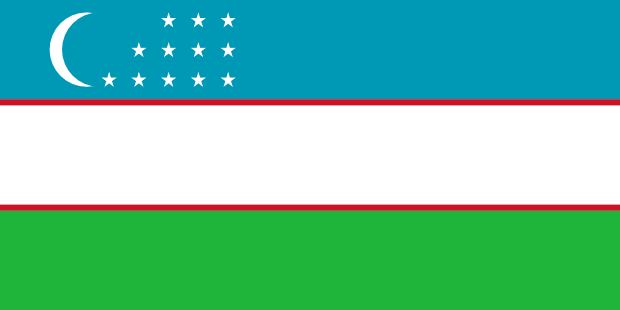
Flag is available in resolutions
| Icon 88x44 |  |
| Icon 32x16 |  |
Uzbekistan
Uzbekistan: A Jewel of Central Asia
Uzbekistan, a landlocked nation nestled in the heart of Central Asia, is a country that whispers tales of ancient empires, vibrant Silk Road trade, and a rich tapestry of cultures. Its name itself evokes images of bustling bazaars, majestic minarets, and vast, sun-drenched plains. For centuries, this region served as a crossroads of civilizations, a vital artery connecting the East and the West, and its legacy continues to shape its identity today. Understanding Uzbekistan requires delving into its diverse geography, its tumultuous yet fascinating history, the intricacies of its population, the backbone of its industry, and the breathtaking allure of its tourist attractions.
The geography of Uzbekistan is as varied as its history. The country is dominated by two major river basins, the Amu Darya and the Syr Darya, which have historically been crucial for agriculture in the arid landscape. The Fergana Valley, a fertile crescent in the east, is the most densely populated and agriculturally productive region, renowned for its cotton and silk production. To the west lies the vast Kyzylkum Desert, a formidable expanse of sand dunes and rocky plateaus that has shaped the lives and traditions of its inhabitants for millennia. The western part of the country also features the Aral Sea, or rather, what remains of it. Once the fourth largest lake in the world, the Aral Sea has shrunk dramatically due to Soviet-era irrigation projects, a stark environmental tragedy that has had profound socio-economic and ecological consequences for the region. The Tien Shan mountains form a natural boundary in the east and southeast, providing stunning landscapes and a source of water for the rivers. This geographical diversity has influenced settlement patterns, agricultural practices, and the very character of the Uzbek people.
The history of Uzbekistan is a grand narrative of empires rising and falling, of conquests and cultural exchanges. Its roots stretch back to ancient Sogdiana and Bactria, flourishing kingdoms that were integral to the Silk Road. Alexander the Great passed through this region, leaving his mark on its Hellenistic heritage. Later, it became a vital part of the Persian Achaemenid Empire and subsequently the vast empires of Genghis Khan and Timur (Tamerlane). Samarkand, Bukhara, and Khiva, now iconic tourist destinations, were once centers of learning, art, and commerce under these powerful rulers. The Timurid era, in particular, is considered a golden age, marked by architectural marvels and intellectual flourishing. Following the decline of these empires, the region was contested by various nomadic groups and later fell under the influence of the Khanates of Bukhara, Khiva, and Kokand. The 19th century saw the expansion of the Russian Empire into Central Asia, culminating in the incorporation of these territories into Russian Turkestan. The Soviet period brought significant political and economic changes, including the establishment of the Uzbek Soviet Socialist Republic. Independence was declared in 1991, marking a new chapter for the nation, one that navigates the complexities of its past while forging its future.
The population of Uzbekistan is predominantly Uzbek, comprising about 84% of the total. The Uzbeks are a Turkic people with a rich cultural heritage, known for their hospitality, strong family ties, and deep respect for tradition. Other significant ethnic groups include Tajiks, Russians, Kazakhs, Karakalpaks, and Tatars, reflecting the historical migrations and political boundaries of the region. This ethnic diversity has contributed to a vibrant mosaic of languages, customs, and cuisines. Uzbek is the official language, written in the Latin script since 1993, although the Cyrillic script is still widely used. Russian remains an important language, particularly in urban areas and for business. The majority of the population adheres to Islam, predominantly Sunni Islam, which plays a significant role in cultural life and social customs. Life in Uzbekistan is characterized by a blend of modern aspirations and enduring traditions, with a strong emphasis on education and family values. The younger generation is increasingly connected to the globalized world, yet the influence of ancestral customs remains palpable.
The industrial landscape of Uzbekistan is diverse, with agriculture playing a pivotal role, particularly cotton cultivation, which has historically been the backbone of its economy. However, the country is actively working to diversify its economic base. It is a major producer of gold, uranium, and natural gas, with significant reserves contributing to its export earnings. The mining sector is a key driver of the economy. Uzbekistan also possesses a substantial textile industry, leveraging its cotton production to create finished goods. The automotive industry is another growing sector, with joint ventures producing cars and trucks. Energy production, primarily from natural gas and hydroelectric power, is also crucial. In recent years, the government has been implementing reforms aimed at attracting foreign investment, privatizing state-owned enterprises, and fostering the growth of small and medium-sized businesses. Tourism is also increasingly recognized as a sector with significant potential for economic development, capitalizing on the country’s rich historical and cultural heritage.
The tourist attractions of Uzbekistan are truly world-class, drawing visitors with their historical grandeur and architectural splendor. The “Great Silk Road Cities” are the undisputed stars of the show. Samarkand, a name that echoes through history, boasts the awe-inspiring Registan Square, a breathtaking ensemble of three madrasahs adorned with intricate tilework and majestic domes. The Gur-e Amir Mausoleum, the final resting place of Timur, is another architectural masterpiece. Bukhara, with its labyrinthine alleys and ancient mosques, offers a glimpse into a medieval Islamic city that has been remarkably preserved. The Kalon Minaret, the Ark fortress, and the Lyab-i Hauz complex are just a few of its many treasures. Khiva, a UNESCO World Heritage site, is an open-air museum, its walled inner city, the Ichan Kala, transporting visitors back in time with its perfectly preserved mosques, minarets, and mausoleums. Beyond these iconic cities, Uzbekistan offers other compelling destinations. The ancient ruins of Termez showcase Buddhist and Hellenistic influences, while the stark beauty of the Chor Minor madrasah in Bukhara and the intricate tilework of the Shah-i-Zinda necropolis in Samarkand are testaments to the artistry of bygone eras. The natural beauty of the Tien Shan mountains offers opportunities for trekking and exploring remote villages. The country’s vibrant bazaars, with their array of spices, textiles, and handicrafts, provide an immersive cultural experience, allowing visitors to connect with the local people and their traditions. The hospitality of the Uzbek people, renowned for their warmth and generosity, further enhances the visitor experience, making a journey through Uzbekistan an unforgettable adventure.
Information about Uzbekistan
The information comes from the publication CIA The World Factbook.
Automated text translation, excuse errors, please!
Country Uzbekistan is situated in a location / continent Central Asia. Uzbekistan has an area of 447 400 km2 and 28 394 180 residents. The highest point has a height 4 301 above sea level. and it is called Adelunga Toghi. The lowest point is located at the level of -12 above sea level and it is named Sariqarnish Kuli. System of government is republic and the date of independence First September 1991. The capital city is Tashkent (Toshkent). Uzbekistan has the international abbreviation UZ.
Uzbekistan - economy
Total gross domestic product (GDP) is 96 460 000 000 $. Total gross domestic product per capita in purchasing power parity is 3 300 $. GDP grows by 8.30 % a year. Inflation (consumer price index) is equal to 13.50 % a year. Uzbekistan have 16 110 000 working-age population (from a total population 28 394 180 people). Unemployment is at 1.00 %. Uzbekistan issued 5.20 % GDP to healt care and 3,50 % GDP to army. The public debt of the country is 8.40 % GDP. The total amount of foreign debt is 8 570 000 000 USD.
Uzbekistan - demography
As suggested above, Uzbekistan has 28 394 180 people. Population growth is in the amount 0.94 % per year. Number of children born per 1000 population per year is 17.33.Every mother has average 1.86 children. The infant mortality rate is 21.20 and maternal mortality 28.00 deaths per 100,000 births. Average estimated life expectancy makes 72.77 years. Mortality is 5.29 people per 1000 population per year.
Uzbekistan - transport and telecommunications
Uzbekistan has 86 496 km of roads, 3 645 km of railway lines and 53 airports. The total length of waterways (navigable rivers, canals, etc.) is 1 100 km.
Number of active mobile phones (sim card) in the country Uzbekistan is 20 952 000. Number of active fixed telephone lines is 1 864 000. Uzbekistan has 4 689 000 internet users, who have the available 56 334 Internet connections. Uzbekistan has been assigned a domain first Choose range .uz.
Uzbekistan - energetics
Uzbekistan consumes a year 42 900 000 000 kWh of electricity. Annual electricity production is 47 370 000 000 kWh in power plants with a total installed electrical capacity 11 580 000 kW. Uzbekistan exports 11 660 000 000 kWh and imports 11 580 000 000 kWh of electricity per year Energy mix of power generation is as follows: fossil fuels: 85.2 %, nuclear energy: 0 %, renewable: 0.0 %, hydropower: 14.8 %. The country Uzbekistan is harvested annually 104 400 barrels of oil.
Keywords: flags of countries in the world, world countries, list of countries, transport, flag, telecommunications, Flags of countries, energetics, all flags, economy, Flag of Uzbekistan, national flags, flag states, Uzbekistan, information, list of flags, demography, politic.