Kyrgyzstan
Flag of Kyrgyzstan
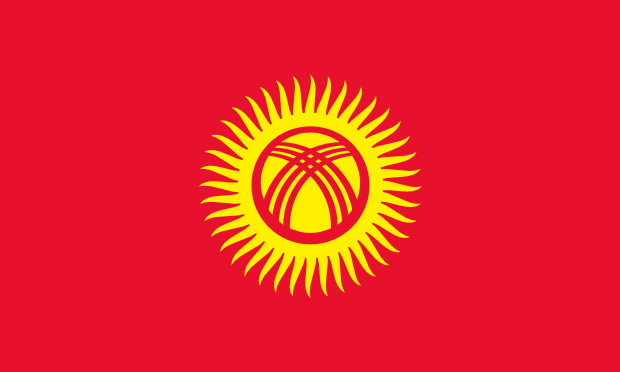
Flag is available in resolutions
| Icon 88x53 |  |
| Icon 32x19 |  |
Kyrgyzstan
Kyrgyzstan: A Land of Nomadic Heritage and Majestic Peaks
Nestled in the heart of Central Asia, Kyrgyzstan is a land of dramatic contrasts, a country where the echoes of ancient Silk Road caravans mingle with the vibrant pulse of modern life. Its geography is defined by soaring mountain ranges, vast alpine pastures, and crystal-clear lakes, creating a breathtaking canvas that has shaped its history, culture, and economy. This landlocked nation, bordering Kazakhstan, Uzbekistan, Tajikistan, and China, is a testament to resilience and adaptation, a place where nomadic traditions continue to thrive amidst a rapidly changing world. With a population that cherishes its heritage and a landscape that beckons adventurers, Kyrgyzstan offers a unique and unforgettable travel experience.
The demographic tapestry of Kyrgyzstan is rich and diverse, reflecting centuries of migration and cultural exchange. The majority of the population, around 73%, are ethnic Kyrgyz, descendants of Turkic tribes who have inhabited these lands for millennia. Their nomadic past is deeply ingrained in their identity, evident in their hospitality, their love for horseback riding, and their traditional yurts, portable felt dwellings that still dot the landscape. Alongside the Kyrgyz, significant minorities include Uzbeks (around 15%), who primarily reside in the southern regions, and Russians (around 6%), a legacy of the Soviet era. Smaller communities of Tajiks, Kazakhs, and Uighurs also contribute to the nations cultural mosaic. The official language is Kyrgyz, a Turkic language, but Russian remains widely spoken, particularly in urban areas and for business. The population is predominantly Muslim, with Islam playing a significant role in cultural practices and social norms. Despite the pressures of modernization and urbanization, many Kyrgyz people maintain a strong connection to their rural roots and the traditions that have sustained them for generations. This blend of modern aspirations and deep-seated cultural values creates a fascinating social dynamic, where ancient customs are often practiced alongside contemporary lifestyles.
The history of Kyrgyzstan is a long and often turbulent journey, marked by the rise and fall of empires and the enduring spirit of its people. The region has been a crossroads for millennia, traversed by traders, conquerors, and nomadic tribes. The ancient Silk Road, a vital artery of commerce and cultural exchange between East and West, passed through these lands, leaving behind a rich legacy of archaeological sites and historical narratives. In the 8th century, the region was influenced by the Turkic Khaganate, followed by various other powers, including the Karakhanids and the Mongol Empire. The 19th century saw the gradual incorporation of Kyrgyzstan into the Russian Empire, a period that brought both administrative changes and a significant influx of Russian settlers. The Soviet era, beginning in the early 20th century, brought about profound transformations. Kyrgyzstan, then known as the Kirghiz Soviet Socialist Republic, underwent collectivization, industrialization, and the imposition of a communist political system. While the Soviet period brought some advancements in infrastructure and education, it also suppressed religious practices and traditional lifestyles. Following the dissolution of the Soviet Union in 1991, Kyrgyzstan declared its independence, embarking on a new chapter in its history. The post-independence era has been characterized by political challenges, including periods of instability and protests, as the nation grapples with establishing a stable democracy and navigating its economic development. Yet, throughout these historical shifts, the Kyrgyz people have consistently demonstrated their resilience and their determination to preserve their unique cultural identity.
The geography of Kyrgyzstan is nothing short of spectacular, a land dominated by towering mountain ranges that comprise over 90% of its territory. The Tian Shan, a vast mountain system often referred to as the Celestial Mountains, forms the backbone of the country, with peaks soaring to over 7,000 meters, including the majestic Jengish Chokusu, the highest point in Kyrgyzstan. These mountains are not merely imposing geological features; they are the lifeblood of the nation, providing vital water resources that flow into rivers and irrigate the surrounding lands. The valleys and intermontane basins, though less extensive, are where the majority of the population resides and where agriculture is practiced. The country is also dotted with stunning alpine lakes, the most famous of which is Issyk-Kul, the second-largest high-altitude lake in the world. This vast, saline lake, surrounded by snow-capped peaks, is a natural wonder and a popular tourist destination. The climate varies significantly with altitude, from arid desert conditions in the lowlands to perpetual snow and ice in the highest reaches of the mountains. Summers are generally warm, while winters can be harsh, especially at higher elevations, with heavy snowfall. This dramatic topography has shaped not only the settlement patterns but also the traditional livelihoods of the Kyrgyz people, with pastoralism and animal husbandry being central to their way of life for centuries. The vast expanses of jailoos, or summer pastures, are a defining feature of the Kyrgyz landscape, providing grazing for sheep, goats, and horses.
The economy of Kyrgyzstan is largely based on agriculture and natural resources, with a growing emphasis on tourism. Agriculture remains a cornerstone, with the cultivation of wheat, cotton, sugar beets, and tobacco being significant. However, it is the livestock sector that truly embodies the countrys nomadic heritage. Sheep, goats, and horses are raised on the vast mountain pastures, providing meat, dairy products, and wool. The country is also rich in mineral resources, including gold, coal, and uranium, though their exploitation has faced environmental and economic challenges. The Kumtor Gold Mine, one of the largest gold mines in Central Asia, is a major contributor to the national economy, though its operations have also been a source of controversy. In recent years, Kyrgyzstan has been increasingly looking to its stunning natural beauty to boost its economy through tourism. The development of trekking routes, yurt camps, and adventure tourism has attracted international visitors seeking to experience the countrys pristine landscapes and unique culture. However, the nations economy still faces challenges, including a reliance on remittances from Kyrgyz citizens working abroad, particularly in Russia, and the need for further diversification and investment. Infrastructure development, particularly in transportation and energy, remains a priority for sustainable economic growth.
Kyrgyzstan is a treasure trove of tourist attractions, offering a diverse range of experiences for every kind of traveler. The undisputed jewel is Issyk-Kul Lake, a vast, azure expanse often referred to as the Pearl of Central Asia. Its shores are lined with resorts and beaches, offering a refreshing escape during the warm summer months. The lakes unique saline properties are believed to have therapeutic benefits, drawing visitors seeking relaxation and wellness. Beyond Issyk-Kul, the countrys mountainous interior beckons adventurers. The Tian Shan mountains offer unparalleled opportunities for trekking, mountaineering, and horseback riding. Trails wind through dramatic gorges, past turquoise glacial lakes, and over high mountain passes, providing breathtaking vistas at every turn. Popular trekking destinations include the Ala-Archa National Park, with its dramatic glaciers and alpine meadows, and the pristine Jyrgalan Valley, a paradise for hikers and nature enthusiasts. The ancient city of Osh, located in the Fergana Valley, is one of the oldest cities in Central Asia and a UNESCO World Heritage site. Its Sulayman-Too Sacred Mountain is a place of pilgrimage and offers panoramic views of the surrounding region. The vibrant Osh Bazaar is a sensory overload of sights, sounds, and smells, offering a glimpse into local life and a chance to haggle for spices, textiles, and traditional crafts. For those interested in experiencing nomadic culture firsthand, staying in a yurt camp is an essential experience. These traditional portable dwellings offer a comfortable and authentic way to immerse oneself in the Kyrgyz way of life, complete with traditional meals, music, and the warm hospitality of local families. The Karakol region, near the eastern end of Issyk-Kul, is a hub for adventure tourism, offering access to stunning hiking trails, hot springs, and opportunities to explore the local Dungan and Uighur communities. The countrys rich history is also evident in its numerous archaeological sites and ancient ruins, remnants of the Silk Road era, which offer a glimpse into the regions past as a vital trade and cultural nexus. The rugged beauty and the deep-seated cultural traditions of Kyrgyzstan combine to create a destination that is both awe-inspiring and deeply authentic.
Information about Kyrgyzstan
The information comes from the publication CIA The World Factbook.
Automated text translation, excuse errors, please!
Country Kyrgyzstan is situated in a location / continent Central Asia. Kyrgyzstan has an area of 199 951 km2 and 5 496 737 residents. The highest point has a height 7 439 above sea level. and it is called Jengish Chokusu (Pik Pobedy). The lowest point is located at the level of 132 above sea level. System of government is republic and the date of independence 31st August 1991. The capital city is Bishkek. Kyrgyzstan has the international abbreviation KG.
Kyrgyzstan - economy
Total gross domestic product (GDP) is 13 290 000 000 $. Total gross domestic product per capita in purchasing power parity is 2 400 $. GDP grows by 5.70 % a year. Inflation (consumer price index) is equal to 16.60 % a year. Kyrgyzstan have 2 344 000 working-age population (from a total population 5 496 737 people). Unemployment is at 8.60 %. Kyrgyzstan issued 4.10 % GDP to healt care and 0,50 % GDP to army. The total amount of foreign debt is 3 601 000 000 USD.
Kyrgyzstan - demography
As suggested above, Kyrgyzstan has 5 496 737 people. Population growth is in the amount 0.89 % per year. Number of children born per 1000 population per year is 23.90.Every mother has average 2.73 children. The infant mortality rate is 30.78 and maternal mortality 71.00 deaths per 100,000 births. Average estimated life expectancy makes 69.45 years. Mortality is 6.93 people per 1000 population per year.
Kyrgyzstan - transport and telecommunications
Kyrgyzstan has 34 000 km of roads, 470 km of railway lines and 28 airports. The total length of waterways (navigable rivers, canals, etc.) is 600 km.
Number of active mobile phones (sim card) in the country Kyrgyzstan is 5 653 000. Number of active fixed telephone lines is 480 000. Kyrgyzstan has 2 195 000 internet users, who have the available 116 586 Internet connections. Kyrgyzstan has been assigned a domain first Choose range .kg.
Kyrgyzstan - energetics
Kyrgyzstan consumes a year 7 290 000 000 kWh of electricity. Annual electricity production is 14 900 000 000 kWh in power plants with a total installed electrical capacity 3 640 000 kW. Kyrgyzstan exports 2 620 000 000 kWh and imports 535 000 000 kWh of electricity per year Energy mix of power generation is as follows: fossil fuels: 20.1 %, nuclear energy: 0 %, renewable: 0.0 %, hydropower: 79.9 %. The country Kyrgyzstan is harvested annually 1 000 barrels of oil.
Keywords: economy, demography, world countries, transport, list of countries, Kyrgyzstan, list of flags, flags of countries in the world, information, Flags of countries, energetics, telecommunications, national flags, flag, all flags, Flag of Kyrgyzstan, flag states, politic.