Turkmenistan
Flag of Turkmenistan
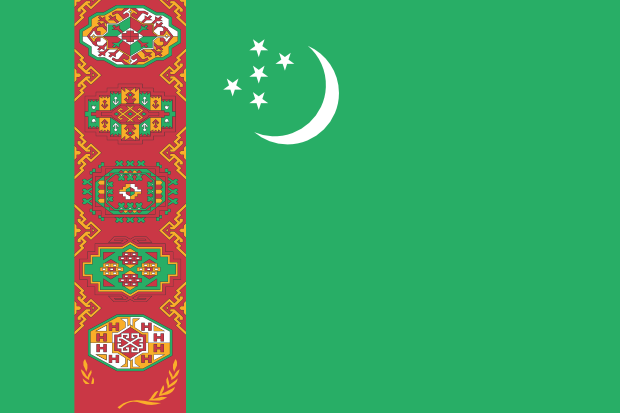
Flag is available in resolutions
| Icon 88x59 |  |
| Icon 32x21 |  |
Turkmenistan
Turkmenistan: A Glimpse into the Land of the Eternal Flame
Turkmenistan, a nation nestled in the heart of Central Asia, remains one of the most enigmatic and least-visited countries on Earth. Its vast deserts, rich history, and unique political landscape paint a picture of a land largely untouched by the frenetic pace of the modern world. For those who venture beyond its borders, Turkmenistan offers a profound journey into a culture shaped by ancient traditions, Soviet legacies, and an insatiable thirst for national identity. The countrys abundant natural resources, particularly its vast reserves of natural gas, have profoundly influenced its economic trajectory and its relationship with the international community, often positioning it as a strategic player in regional energy politics. Yet, beneath the surface of resource wealth lies a society grappling with the complexities of autocratic rule, economic diversification, and the preservation of its unique cultural heritage in an increasingly globalized era. The very name Turkmenistan evokes images of nomadic tribes, intricate carpets, and the shimmering heat of the Karakum Desert, a landscape that dominates a significant portion of the country. Its relative isolation, both geographically and politically, has contributed to its mystique, making it a destination that promises discovery and a stark departure from the familiar.
The population of Turkmenistan, estimated to be around 6 million people, is predominantly composed of ethnic Turkmen, who constitute the vast majority. Other significant ethnic groups include Uzbeks, Russians, Kazakhs, and a smattering of smaller minorities, remnants of historical migrations and Soviet-era policies. The Turkmen people themselves are known for their hospitality, a deeply ingrained cultural trait that often surprises visitors who have been exposed to the countrys more austere public image. Family and community ties are exceptionally strong, forming the bedrock of Turkmen society. Traditional values remain highly respected, with elders holding a place of honor and influence. While the official language is Turkmen, Russian is still widely understood and spoken, particularly in urban centers and among older generations, a testament to the countrys Soviet past. Islam, primarily Sunni, is the dominant religion, and its influence is visible in daily life, though often in a more syncretic form that blends with pre-Islamic beliefs and practices. The demographic landscape is relatively young, with a significant proportion of the population under the age of 30, presenting both opportunities and challenges for the nations future development. The governments emphasis on education has led to a generally literate population, with a growing number of educated professionals, though opportunities for their full engagement within the national economy can be limited. Understanding the nuances of Turkmen society requires an appreciation for its deeply rooted traditions, its historical experiences, and the aspirations of its people in the contemporary world.
Turkmenistans history is a tapestry woven with threads of ancient empires, nomadic migrations, and the imposition of foreign rule. The land has been a crossroads of civilizations for millennia, with evidence of human settlement dating back to the Stone Age. The region was once part of the vast Persian Empires, and later experienced the influence of Alexander the Great and the Hellenistic world. The arrival of Turkic tribes in the Middle Ages marked a pivotal moment, leading to the formation of distinct Turkmen identity and the establishment of powerful khanates. The Silk Road, that legendary network of trade routes connecting East and West, traversed through Turkmen lands, fostering cultural exchange and economic prosperity. However, this period of relative autonomy was eventually shattered by the expansion of the Russian Empire in the 19th century. The subjugation of the Turkmen tribes was a protracted and often brutal affair, culminating in the establishment of Russian Turkestan. The Soviet era, which began in the early 20th century, brought about profound changes. Turkmenistan became a Soviet Socialist Republic, and its economy was reoriented to serve the needs of the Soviet Union, with a strong emphasis on cotton cultivation and, later, the exploitation of its vast natural gas reserves. The collapse of the Soviet Union in 1991 ushered in a new era of independence, but also a period of intense nation-building under the leadership of its first president, Saparmurat Niyazov, who cultivated a pervasive personality cult and implemented a highly centralized political system. His successor, Gurbanguly Berdimuhamedow, has largely continued this legacy, maintaining a strong presidential system and an emphasis on national pride and self-reliance. The historical narrative in Turkmenistan is carefully curated, often emphasizing the glorious past and the achievements of the independent state, while downplaying or omitting less favorable chapters. This historical consciousness plays a crucial role in shaping the national identity and the collective memory of the Turkmen people.
Geographically, Turkmenistan is a land of stark contrasts and immense scale. It is the fourth largest country in Central Asia by area, with a substantial portion of its territory dominated by the Karakum Desert, one of the largest sand deserts in the world. The desert is not a barren wasteland; it is a dynamic landscape sculpted by wind and sand, supporting a unique ecosystem of hardy flora and fauna. The iconic Darvaza Gas Crater, often referred to as the Door to Hell, is a testament to the geological activity beneath the surface and a bizarre, yet captivating, tourist attraction. To the west, the Caspian Sea forms a natural border, offering a vital resource and a potential gateway to international trade, though its salinity and fluctuating water levels present environmental challenges. The Kopet Dag mountains form the southern border with Iran, providing a more temperate climate and supporting agricultural activities. The Amu Darya River, one of the great rivers of Central Asia, flows through the eastern part of the country, providing a crucial source of water for irrigation, though its flow has been significantly impacted by upstream diversions. Turkmenistans climate is predominantly arid to semi-arid, characterized by scorching summers and cold winters, with significant temperature fluctuations. The country is prone to dust storms and sandstorms, which can significantly impact visibility and daily life. The vastness of the landscape, coupled with its harsh climate, has historically shaped the nomadic lifestyle of the Turkmen people and continues to influence their relationship with the land. The countrys natural resources, particularly its vast reserves of oil and natural gas, are inextricably linked to its geography, forming the backbone of its economy and its international standing.
The industrial landscape of Turkmenistan is heavily dominated by its vast hydrocarbon reserves. Natural gas is the undisputed king, with Turkmenistan boasting some of the worlds largest proven reserves. This has made energy production and export the primary engine of the Turkmen economy. State-owned enterprises manage the extraction, processing, and distribution of these resources, with the government exerting tight control over the sector. While natural gas has provided significant revenue, it has also led to a heavy reliance on this single commodity, making the economy vulnerable to fluctuations in global energy prices. Beyond hydrocarbons, Turkmenistan has also been investing in the development of its petrochemical industry, aiming to add value to its raw materials by producing fertilizers, polymers, and other chemical products. Cotton cultivation remains a significant agricultural sector, with Turkmenistan being a major global producer of cotton fiber. However, this industry has faced criticism for its reliance on forced labor in the past. Efforts are also being made to diversify the economy into sectors such as textiles, food processing, and tourism, though these sectors are still in their nascent stages of development. The countrys industrial infrastructure, much of it inherited from the Soviet era, is undergoing modernization, with significant investments in new pipelines, power plants, and manufacturing facilities. The governments economic policies are characterized by a strong emphasis on state control and a gradual, often cautious, approach to market reforms. The industrial sector, therefore, presents a complex picture of immense resource wealth intertwined with the challenges of economic diversification and the need to create a more sustainable and resilient economic model.
Turkmenistans tourist attractions, while not as widely publicized as those in neighboring countries, offer a unique and unforgettable experience for the adventurous traveler. The capital city, Ashgabat, is a surreal metropolis often described as a city of white marble. Its grandiose architecture, adorned with gold and intricate designs, reflects the nations aspiration for grandeur and national pride. The Neutrality Arch, a towering monument topped by a golden statue of the first president, is a prominent landmark. The National Museum of Turkmenistan offers a comprehensive journey through the countrys rich history and cultural heritage, showcasing ancient artifacts, traditional crafts, and displays on the nations independence. For those seeking a glimpse into the countrys natural wonders, the Karakum Desert is an absolute must-see. The Darvaza Gas Crater, a perpetually burning crater in the desert, is an otherworldly spectacle that draws visitors from afar. The vastness and tranquility of the desert, punctuated by the nomadic lifestyle of the Turkmen people, offer a profound sense of isolation and connection to nature. The ancient ruins of Merv, a UNESCO World Heritage site, whisper tales of a glorious past as one of the great cities of the Silk Road. The well-preserved citadel of Erk Kala and the Sultan Sanjar Mausoleum are particularly impressive. The ancient city of Nisa, another UNESCO site, was the first capital of the Parthian Empire and offers insights into the regions early history. The Caspian Sea coast, particularly the resort town of Awaza, is being developed as a tourist destination, offering beaches and recreational activities. While Turkmenistan is not a mainstream tourist destination, its unique blend of ancient history, Soviet legacy, and stark natural beauty provides an unparalleled opportunity for exploration and discovery for those willing to venture off the beaten path. The governments approach to tourism is carefully managed, with visa requirements and guided tours being the norm, ensuring a controlled yet captivating experience for visitors.
Information about Turkmenistan
The information comes from the publication CIA The World Factbook.
Automated text translation, excuse errors, please!
Country Turkmenistan is situated in a location / continent Central Asia. Turkmenistan has an area of 488 100 km2 and 5 054 828 residents. The highest point has a height 3 139 above sea level. and it is called Gora Ayribaba. The lowest point is located at the level of -81 above sea level and it is named Vpadina Akchanaya. System of government is republic and the date of independence 27th October 1991. The capital city is Ashgabat (Ashkhabad). Turkmenistan has the international abbreviation TX.
Turkmenistan - economy
Total gross domestic product (GDP) is 43 910 000 000 $. Total gross domestic product per capita in purchasing power parity is 7 900 $. GDP grows by 14.70 % a year. Inflation (consumer price index) is equal to 12.00 % a year. Turkmenistan have 2 300 000 working-age population (from a total population 5 054 828 people). Unemployment is at 60.00 %. Turkmenistan issued 2.30 % GDP to healt care and 3,40 % GDP to army. The total amount of foreign debt is 524 700 000 USD.
Turkmenistan - demography
As suggested above, Turkmenistan has 5 054 828 people. Population growth is in the amount 1.14 % per year. Number of children born per 1000 population per year is 19.55.Every mother has average 2.14 children. The infant mortality rate is 40.89 and maternal mortality 67.00 deaths per 100,000 births. Average estimated life expectancy makes 68.84 years. Mortality is 6.21 people per 1000 population per year.
Turkmenistan - transport and telecommunications
Turkmenistan has 58 592 km of roads, 2 980 km of railway lines and 26 airports. The total length of waterways (navigable rivers, canals, etc.) is 1 300 km. There is registered 11 ships.
Number of active mobile phones (sim card) in the country Turkmenistan is 3 511 000. Number of active fixed telephone lines is 547 000. Turkmenistan has 80 400 internet users, who have the available 717 Internet connections. Turkmenistan has been assigned a domain first Choose range .tm.
Turkmenistan - energetics
Turkmenistan consumes a year 11 220 000 000 kWh of electricity. Annual electricity production is 15 020 000 000 kWh in power plants with a total installed electrical capacity 2 852 000 kW. Turkmenistan exports 1 568 000 000 kWh and imports 0 kWh of electricity per year Energy mix of power generation is as follows: fossil fuels: 100 %, nuclear energy: 0 %, renewable: 0.0 %, hydropower: 0.0 %. The country Turkmenistan is harvested annually 222 200 barrels of oil.
Keywords: flag, Turkmenistan, world countries, national flags, telecommunications, flag states, list of countries, demography, all flags, economy, information, list of flags, energetics, transport, Flag of Turkmenistan, flags of countries in the world, Flags of countries, politic.