Argentina
Flag of Argentina
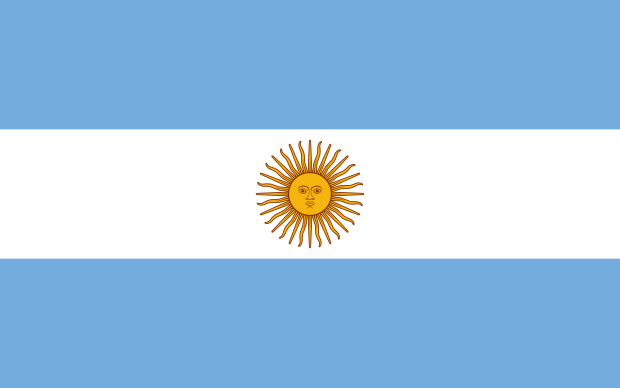
Flag is available in resolutions
| Icon 88x55 |  |
| Icon 32x20 |  |
Argentina
Argentina: A Tapestry of Contrasts and Grandeur
Argentina, a vast South American nation, is a land of breathtaking contrasts, from the icy peaks of the Andes to the sun-drenched Pampas, and from the cosmopolitan buzz of Buenos Aires to the untamed wilderness of Patagonia. Its name, derived from the Latin word for silver, “argentum,” hints at its historical allure and the wealth that has shaped its destiny. This sprawling country, the second-largest in South America and eighth-largest in the world by land area, is a vibrant mosaic of cultures, landscapes, and economic pursuits, offering a compelling study for any observer of global affairs and human endeavor.
The demographic landscape of Argentina is a fascinating reflection of its history, primarily shaped by waves of European immigration, particularly from Spain and Italy, in the late 19th and early 20th centuries. This influx of peoples significantly influenced the nation’s language, cuisine, architecture, and social customs, imbuing it with a distinctly European flavor that sets it apart from many of its Latin American neighbors. While indigenous populations, such as the Mapuche, Guaraní, and Colla, have contributed to Argentina’s rich cultural heritage, their presence and influence are more pronounced in specific regions. The majority of Argentinians reside in urban centers, with Buenos Aires, the capital, being a megacity of over 15 million people, a pulsating heart of culture, commerce, and political life. The population is predominantly of European descent, with a significant mestizo population, and smaller communities of Asian and African ancestry. This diverse heritage contributes to a unique national identity, characterized by a passion for football, tango, and a strong sense of community. The official language is Spanish, with a distinctive Rioplatense dialect that incorporates Italian intonations and vocabulary.
Argentina’s history is a dramatic narrative of colonial rule, independence, economic booms and busts, and periods of political upheaval. The Spanish arrived in the 16th century, establishing settlements and exploiting the region’s resources. Buenos Aires was founded in 1580, though it remained a relatively minor port compared to other Spanish colonial centers. The struggle for independence from Spain began in 1810, culminating in the declaration of independence in 1816. The 19th century was a period of nation-building, marked by internal conflicts between federalists and unitarians, and the consolidation of power. The late 19th and early 20th centuries witnessed an era of unprecedented economic prosperity, fueled by agricultural exports, particularly beef and grain, and a massive influx of European immigrants. This period is often referred to as Argentina’s “Golden Age.” However, the mid-20th century brought significant political instability, including the rise of Juan Perón and his populist movement, which had a profound and lasting impact on the country. Subsequent decades were characterized by military dictatorships, periods of democratic rule, and recurring economic crises. The Falklands War in 1982, a conflict with the United Kingdom, was a particularly significant and painful event in recent Argentine history. Despite these challenges, Argentina has consistently strived to uphold its democratic institutions and rebuild its economy, a testament to the resilience of its people.
The geography of Argentina is as diverse as its people and history. Stretching over 3,800 kilometers from north to south, it encompasses a wide range of climates and landscapes. In the north, the subtropical Chaco region gives way to the fertile Mesopotamian plains between the Paraná and Uruguay rivers. Central Argentina is dominated by the vast, fertile plains of the Pampas, the agricultural heartland of the nation, renowned for its cattle ranches and wheat fields. To the west, the mighty Andes Mountains form a formidable natural border with Chile, boasting some of the highest peaks in the Americas, including Mount Aconcagua, the highest mountain outside of Asia. These mountains are a source of precious minerals and a magnet for mountaineers and skiers. Further south lies Patagonia, a wild and windswept region of dramatic glaciers, fjords, and steppe landscapes. This sparsely populated area is a haven for wildlife, including penguins, whales, and guanacos, and a popular destination for ecotourism. The eastern coastline is defined by the Atlantic Ocean, with numerous bays and estuaries. Argentina also boasts impressive waterfalls, such as the Iguazú Falls, a UNESCO World Heritage site and one of the most spectacular natural wonders in the world, a thundering cascade of over 275 individual falls. The country’s varied topography influences its climate, ranging from the hot and humid subtropical north to the cold and arid Patagonian south.
Argentina’s economy has historically been driven by its vast agricultural resources. The Pampas region is a global powerhouse in beef and grain production, with exports of soybeans, corn, wheat, and high-quality beef forming the backbone of its trade. The country is also a significant producer of wine, particularly from the Mendoza region, known for its Malbec. Beyond agriculture, Argentina possesses considerable mineral wealth, including silver, gold, copper, and lithium, the latter becoming increasingly important in the global transition to electric vehicles. The industrial sector is diverse, with significant manufacturing capabilities in automotive, aerospace, textiles, and food processing. However, Argentina’s economic history is also marked by periods of high inflation, currency devaluation, and external debt, presenting ongoing challenges for sustainable growth. The service sector, particularly tourism and finance, plays an increasingly vital role in the economy. The country has also made strides in renewable energy, with investments in wind and solar power.
Argentina offers an astonishing array of tourist attractions, catering to every kind of traveler. Buenos Aires, the “Paris of South America,” captivates with its European-style architecture, vibrant street life, and world-class museums and theaters. The iconic Recoleta Cemetery, the colorful La Boca neighborhood with its tango dancers, and the grand Avenida 9 de Julio are must-see landmarks. For lovers of nature, Patagonia is an unparalleled destination. El Calafate is the gateway to the Perito Moreno Glacier, a colossal ice formation that calves icebergs with thunderous roars. Ushuaia, the southernmost city in the world, offers access to the Beagle Channel and the stunning landscapes of Tierra del Fuego National Park. The Iguazú Falls, straddling the border with Brazil, are a breathtaking spectacle of nature’s power. Mendoza, nestled at the foothills of the Andes, is a paradise for wine enthusiasts, offering vineyard tours and tastings. For those seeking adventure, the Andes provide opportunities for hiking, climbing, and skiing. The north of Argentina, with its colonial towns like Salta and Jujuy, offers a glimpse into a different cultural and historical past, with stunning desert landscapes and indigenous traditions. The Argentine culture itself is a major draw, with the passionate rhythms of tango, the exhilarating drama of football matches, and the delicious flavors of its cuisine, from succulent asado (barbecue) to empanadas and dulce de leche.
In conclusion, Argentina is a land of profound beauty, complex history, and enduring spirit. Its vast and varied landscapes, from the majestic Andes to the fertile Pampas and the wild expanse of Patagonia, provide a stunning backdrop to a nation shaped by immigration, resilience, and a vibrant cultural identity. Despite facing economic and political challenges throughout its history, Argentina continues to captivate the world with its passion, its natural wonders, and its unique blend of European and Latin American influences. It is a country that invites exploration, discovery, and a deep appreciation for the tapestry of life that unfolds across its extraordinary territory.
Information about Argentina
The information comes from the publication CIA The World Factbook.
Automated text translation, excuse errors, please!
Country Argentina is situated in a location / continent South America. Argentina has an area of 2 780 400 km2 and 42 192 494 residents. The highest point has a height 6 960 above sea level. and it is called Cerro Aconcagua. The lowest point is located at the level of -105 above sea level and it is named Laguna del Carbon. System of government is republic and the date of independence July 9, 1816. The capital city is Buenos Aires. Argentina has the international abbreviation AR.
Argentina - economy
Total gross domestic product (GDP) is 725 600 000 000 $. Total gross domestic product per capita in purchasing power parity is 17 700 $. GDP grows by 8.90 % a year. Inflation (consumer price index) is equal to 22.00 % a year. Argentina have 16 760 000 working-age population (from a total population 42 192 494 people). Unemployment is at 7.20 %. Argentina issued 9.50 % GDP to healt care and 0,80 % GDP to army. The public debt of the country is 41.40 % GDP. The total amount of foreign debt is 136 800 000 000 USD.
Argentina - demography
As suggested above, Argentina has 42 192 494 people. Population growth is in the amount 1.00 % per year. Number of children born per 1000 population per year is 17.34.Every mother has average 2.29 children. The infant mortality rate is 10.52 and maternal mortality 77.00 deaths per 100,000 births. Average estimated life expectancy makes 77.14 years. Mortality is 7.36 people per 1000 population per year.
Argentina - transport and telecommunications
Argentina has 231 374 km of roads, 36 966 km of railway lines and 1 149 airports. The total length of waterways (navigable rivers, canals, etc.) is 11 000 km. There is registered 36 ships.
Number of active mobile phones (sim card) in the country Argentina is 55 000 000. Number of active fixed telephone lines is 10 140 000. Argentina has 13 694 000 internet users, who have the available 10 928 000 Internet connections. Argentina has been assigned a domain first Choose range .ar.
Argentina - energetics
Argentina consumes a year 104 200 000 000 kWh of electricity. Annual electricity production is 116 000 000 000 kWh in power plants with a total installed electrical capacity 32 070 000 kW. Argentina exports 1 701 000 000 kWh and imports 10 300 000 000 kWh of electricity per year Energy mix of power generation is as follows: fossil fuels: 65.4 %, nuclear energy: 3.2 %, renewable: 0.1 %, hydropower: 28.3 %. The country Argentina is harvested annually 734 000 barrels of oil.
Keywords: list of flags, flags of countries in the world, Flag of Argentina, all flags, transport, information, economy, world countries, national flags, Argentina, demography, telecommunications, list of countries, energetics, flag states, flag, Flags of countries, politic.