Uruguay
Flag of Uruguay
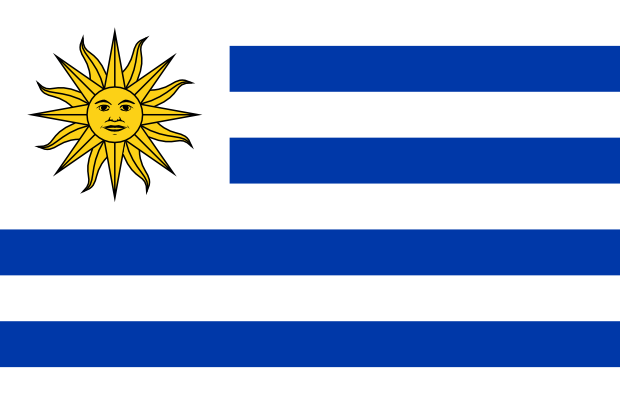
Flag is available in resolutions
| Icon 88x59 |  |
| Icon 32x21 |  |
Uruguay
Uruguay: A Land of Rolling Plains and Coastal Charm
Nestled between the titans of Brazil and Argentina, Uruguay, officially the Oriental Republic of Uruguay (República Oriental del Uruguay), is a South American gem often overlooked by the larger, more boisterous nations surrounding it. Yet, this compact country, the second smallest in South America by land area, possesses a unique charm, a rich history, and a distinct cultural identity that makes it a captivating destination. Its moniker, La República Oriental del Uruguay, translates to The Eastern Republic of the Uruguay River, a nod to the significant waterway that forms its western border with Argentina. This geographical positioning has profoundly shaped its development, influencing its culture, economy, and historical trajectory. Uruguay is characterized by its vast, rolling plains, known as *pampas*, interspersed with low-lying hills and a beautiful Atlantic coastline. This landscape fosters a strong agricultural tradition, particularly cattle ranching, which is deeply ingrained in the national identity. The country’s relatively small size belies its significant contributions to the region’s cultural tapestry and its commitment to democratic ideals.
The population of Uruguay is remarkably homogeneous, with over 88% of its inhabitants of European descent, primarily from Spain and Italy. This demographic reality is a direct consequence of intensive European immigration during the 19th and early 20th centuries, which significantly shaped the nation’s language, customs, and social fabric. The official language is Spanish, spoken with a distinct Rioplatense accent, often blended with Italian intonations. Montevidea, the capital and largest city, is the cultural and economic heart of the nation, home to over a third of the country’s population. The remaining population is spread across smaller cities and rural areas, where life often revolves around the rhythm of agriculture and the strong sense of community. Uruguay boasts one of the highest literacy rates in Latin America, a testament to its historical investment in education. The social structure is generally egalitarian, with a strong emphasis on social welfare and a progressive stance on many social issues, including the legalization of same-sex marriage and cannabis. This forward-thinking approach, coupled with a relatively stable economy and political system, has earned Uruguay a reputation as a progressive and peaceful nation. The Uruguayan people are known for their friendly and laid-back demeanor, their love of *mate* (a traditional infused drink), and their passion for football, which is more than just a sport; it’s a national obsession that unites the country.
Uruguay’s history is a narrative of colonial struggles, independence movements, and periods of political upheaval, ultimately leading to its establishment as a stable, democratic republic. The territory was initially inhabited by indigenous peoples, primarily the Charrúa. European exploration began in the early 16th century, with Spanish and Portuguese vying for control of the region. The Spanish established the first permanent settlement in 1680 at Colonia del Sacramento, a strategic port on the Río de la Plata. The area was a constant point of contention between the Spanish and Portuguese empires for over a century, with its strategic location making it a valuable prize. The early 19th century witnessed the burgeoning desire for independence throughout South America. Uruguay, then known as the Banda Oriental, became a focal point in the struggle for self-determination. Figures like José Gervasio Artigas, a national hero, emerged as leaders of the independence movement. However, the path to sovereignty was fraught with challenges, including interventions by Brazil and Argentina. After a period of Brazilian rule, Uruguay finally declared its independence in 1828, with the Treaty of Montevideo, brokered by Great Britain, recognizing its sovereignty. The subsequent decades were marked by political instability, civil wars, and periods of authoritarian rule, often influenced by neighboring powers. However, by the early 20th century, Uruguay began to emerge as a model of democracy and social progress in Latin America. The country implemented pioneering social welfare programs, including pensions, healthcare, and education, earning it the nickname the Switzerland of South America. The latter half of the 20th century saw a period of military dictatorship from 1973 to 1985, a dark chapter in its history. However, democracy was restored, and Uruguay has since solidified its position as a stable and respected nation in the global arena.
Geographically, Uruguay is characterized by its gentle topography and its extensive coastline along the Atlantic Ocean. The country is predominantly composed of rolling plains and low hills, with the highest point, Cerro Catedral, reaching only 514 meters above sea level. This landscape is ideal for agriculture, particularly cattle ranching, which has been a cornerstone of the Uruguayan economy for centuries. The fertile *pampas* are crisscrossed by numerous rivers, the most significant being the Uruguay River, which forms its western border and serves as a vital waterway for trade and transportation, and the Río de la Plata, a massive estuary that separates Uruguay from Argentina. The coastline stretches for approximately 660 kilometers and is dotted with numerous beaches, bays, and lagoons, making it a popular destination for both domestic and international tourists. The climate is temperate, with warm summers and mild winters, making it pleasant for outdoor activities year-round. The country experiences distinct seasons, with rainfall distributed relatively evenly throughout the year. The eastern part of the country is more influenced by the Atlantic Ocean, leading to slightly cooler temperatures and higher humidity, while the interior experiences greater temperature fluctuations. Natural resources are primarily agricultural, with vast tracts of land dedicated to livestock and crop cultivation. While mineral resources are not abundant, the country does have some deposits of granite and marble. The natural beauty of Uruguay, with its open landscapes and pristine beaches, is a significant asset, attracting visitors seeking tranquility and natural splendor.
The Uruguayan economy has historically been driven by agriculture, with cattle ranching and the production of beef being paramount. The country is a major exporter of beef, wool, and dairy products, leveraging its vast fertile plains. However, in recent decades, Uruguay has diversified its economy, with significant growth in the services sector, particularly in information technology, software development, and tourism. The government has actively promoted foreign investment and implemented policies to foster innovation and technological advancement. The country has also become a significant player in renewable energy, particularly wind power, with a substantial portion of its electricity generated from wind farms. This commitment to sustainability is a growing aspect of its economic identity. The industrial sector, while not as dominant as agriculture or services, includes food processing, textiles, and the manufacturing of cement and tires. The countrys stable political environment, educated workforce, and business-friendly policies have attracted both domestic and international companies. Uruguay’s strategic location on the Río de la Plata also facilitates trade with neighboring countries, particularly Argentina and Brazil. The tourism sector has seen a steady increase in popularity, with visitors drawn to its beaches, historical sites, and natural landscapes. The country’s commitment to environmental protection and its progressive social policies also contribute to its appeal as a destination. The economic resilience and adaptability of Uruguay are key factors in its continued development and its reputation as a stable and prosperous nation.
Uruguay offers a diverse range of tourist attractions, catering to various interests. The capital city, Montevideo, is a vibrant hub of culture and history. Its historic center, Ciudad Vieja, boasts colonial architecture, charming plazas like Plaza Independencia with its imposing Artigas Mausoleum, and the Palacio Salvo, an iconic skyscraper. The Rambla, a picturesque waterfront promenade, stretches for kilometers along the Río de la Plata, offering stunning views, recreational spaces, and a glimpse into the daily life of Montevideans. The Mercado del Puerto, a bustling market, is a must-visit for its fresh seafood and traditional Uruguayan parrilla (barbecue). Further afield, the coastal town of Punta del Este is a renowned international resort destination, famous for its luxurious beaches, upscale hotels, and vibrant nightlife. It attracts a sophisticated crowd and offers a stark contrast to the more tranquil interior. For those seeking historical immersion, Colonia del Sacramento, a UNESCO World Heritage site, is a perfectly preserved Portuguese colonial town with cobblestone streets, historic buildings, and a charming, timeless atmosphere. The interior of Uruguay, with its rolling *pampas*, offers opportunities for *estancia* tourism, where visitors can experience traditional gaucho culture, horseback riding, and the serene beauty of the countryside. Natural parks like the Santa Teresa National Park, with its fortress and diverse flora and fauna, and the Quebrada de los Cuervos offer opportunities for hiking and exploring Uruguay’s natural landscapes. The country’s numerous beaches, from the popular stretches near Montevideo like Pocitos and Carrasco to the wilder, more secluded coves along the Atlantic coast, provide ample opportunities for relaxation and water sports. Uruguay’s cultural scene is rich, with numerous museums, theaters, and art galleries, particularly in Montevideo, showcasing its artistic heritage and contemporary expressions. The annual Carnival, the longest in the world, is a spectacular celebration of music, dance, and vibrant costumes, offering a truly immersive cultural experience.
In conclusion, Uruguay is a country that punches above its weight. Its compact size belies its significant cultural contributions, its progressive social policies, and its enduring commitment to democracy. From the vast, cattle-grazing *pampas* to the sun-drenched beaches of its Atlantic coast, Uruguay offers a unique blend of natural beauty, rich history, and a warm, welcoming populace. Its homogeneous population, shaped by European immigration, has fostered a strong sense of national identity and a culture that values community and egalitarianism. The nations economic evolution from an agrarian powerhouse to a diversified economy embracing technology and renewable energy showcases its adaptability and forward-thinking approach. For the traveler, Uruguay presents a captivating tapestry of experiences, from the historic charm of Colonia del Sacramento to the sophisticated allure of Punta del Este, and the cultural vibrancy of Montevideo. It is a land where the rhythm of life is often set by the gentle breeze rustling through the grasslands and the soothing sound of waves lapping against its shores, a testament to its enduring appeal as a tranquil yet dynamic corner of South America.
Information about Uruguay
The information comes from the publication CIA The World Factbook.
Automated text translation, excuse errors, please!
Country Uruguay is situated in a location / continent South America. Uruguay has an area of 176 215 km2 and 3 316 328 residents. The highest point has a height 514 above sea level. and it is called Cerro Catedral. The lowest point is located at the level of 0 above sea level and it is named Atlantic Ocean. System of government is republic and the date of independence 25th August 1825. The capital city is Montevideo. Uruguay has the international abbreviation UY.
Uruguay - economy
Total gross domestic product (GDP) is 51 560 000 000 $. Total gross domestic product per capita in purchasing power parity is 15 300 $. GDP grows by 5.70 % a year. Inflation (consumer price index) is equal to 8.10 % a year. Uruguay have 1 677 000 working-age population (from a total population 3 316 328 people). Unemployment is at 6.00 %. Uruguay issued 7.40 % GDP to healt care and 1,60 % GDP to army. The public debt of the country is 51.00 % GDP. The total amount of foreign debt is 15 400 000 000 USD.
Uruguay - demography
As suggested above, Uruguay has 3 316 328 people. Population growth is in the amount 0.24 % per year. Number of children born per 1000 population per year is 13.40.Every mother has average 1.87 children. The infant mortality rate is 9.44 and maternal mortality 29.00 deaths per 100,000 births. Average estimated life expectancy makes 76.41 years. Mortality is 9.55 people per 1000 population per year.
Uruguay - transport and telecommunications
Uruguay has 77 732 km of roads, 1 641 km of railway lines and 94 airports. The total length of waterways (navigable rivers, canals, etc.) is 1 600 km. There is registered 16 ships.
Number of active mobile phones (sim card) in the country Uruguay is 4 437 000. Number of active fixed telephone lines is 962 200. Uruguay has 1 405 000 internet users, who have the available 945 826 Internet connections. Uruguay has been assigned a domain first Choose range .uy.
Uruguay - energetics
Uruguay consumes a year 7 960 000 000 kWh of electricity. Annual electricity production is 9 500 000 000 kWh in power plants with a total installed electrical capacity 2 516 000 kW. Uruguay exports 18 900 000 kWh and imports 470 000 000 kWh of electricity per year Energy mix of power generation is as follows: fossil fuels: 38.5 %, nuclear energy: 0 %, renewable: 0.4 %, hydropower: 61.1 %.
Keywords: Uruguay, flags of countries in the world, transport, Flags of countries, flag states, list of flags, economy, world countries, national flags, energetics, Flag of Uruguay, information, all flags, list of countries, flag, demography, telecommunications, politic.