Ecuador
Flag of Ecuador
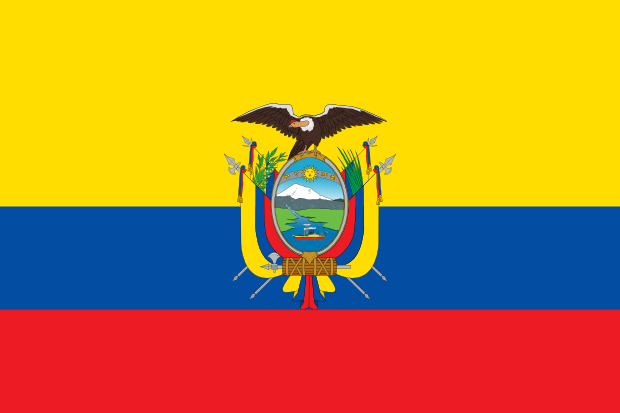
Flag is available in resolutions
| Icon 88x59 |  |
| Icon 32x21 |  |
Ecuador
Ecuador: A Land of Remarkable Diversity
Nestled on the equator, Ecuador is a South American nation that punches well above its weight in terms of biodiversity, cultural richness, and historical significance. Its compact size belies an astonishing array of landscapes, from the Pacific coast and the Andean highlands to the Amazon rainforest and the unique Galapagos Islands. This geographical diversity directly translates into a vibrant tapestry of life and human experience, making Ecuador a truly captivating destination.
The population of Ecuador is a fascinating blend of indigenous peoples, descendants of Spanish colonizers, and a smaller but significant Afro-Ecuadorian community. The largest ethnic group is the Mestizos, who are of mixed European and indigenous ancestry, forming the majority of the population. Indigenous communities, such as the Kichwa, Shuar, and Achuar, maintain their distinct languages, traditions, and cultural practices, particularly in the Amazonian regions and the highlands. The Spanish influence is evident in the official language, Spanish, and in the country’s predominantly Roman Catholic faith. This cultural mosaic is a source of national pride and contributes to Ecuador’s unique identity, evident in its colorful festivals, traditional music, and diverse cuisine. The capital city, Quito, is a UNESCO World Heritage site, renowned for its remarkably well-preserved colonial architecture, bustling plazas, and the stunning backdrop of the Andes mountains. Guayaquil, the largest city and a major port, is a vibrant commercial hub with a more modern feel, showcasing the countrys dynamic economic activity.
Ecuador’s history is a long and complex narrative, stretching back to ancient indigenous civilizations like the Valdivia culture, one of the oldest in the Americas. Later, the region was incorporated into the vast Inca Empire, leaving behind impressive archaeological sites that speak to a sophisticated pre-Columbian society. The arrival of the Spanish conquistadors in the 16th century marked a turning point, leading to the subjugation of indigenous peoples and the establishment of a colonial administration. For centuries, Ecuador, then known as the Royal Audience of Quito, was part of the Viceroyalty of Peru and later the Viceroyalty of New Granada. The struggle for independence from Spain was a protracted affair, culminating in key battles in the early 19th century, most notably the Battle of Pichincha in 1822, which secured Ecuador’s freedom. The post-independence period was characterized by political instability and territorial disputes, particularly with Peru. The 20th century saw periods of both democratic rule and military dictatorships, alongside significant economic development and social change. In recent decades, Ecuador has strived to consolidate its democracy and address socio-economic inequalities, while also championing its rich natural heritage.
Geographically, Ecuador is defined by its three principal regions, each possessing a distinct character and ecosystem. The Costa (Coast) is the westernmost region, characterized by tropical rainforests, fertile agricultural lands, and a long Pacific coastline dotted with beaches and fishing villages. This region is the economic heartland of the country, with Guayaquil serving as its primary port and commercial center. The Sierra (Highlands) is dominated by the majestic Andes Mountains, which form a natural spine running north to south through the country. This region is home to volcanoes, high-altitude plains known as *páramos*, and fertile inter-Andean valleys where much of Ecuador’s agriculture, including potatoes, corn, and coffee, is cultivated. Quito, the capital, is situated in the Sierra, offering breathtaking views and a cooler climate. Finally, the Oriente (East), also known as the Amazon Basin, is a vast expanse of dense rainforest teeming with unparalleled biodiversity. This region is home to numerous indigenous communities and is a critical area for conservation efforts, as well as for oil extraction, which has been a significant, albeit controversial, part of Ecuador’s economy. The unique Galapagos Islands, an archipelago of volcanic islands located about 1,000 kilometers west of the mainland, form a fourth distinct region and are a global icon of natural history and evolutionary science, famously inspiring Charles Darwin’s theory of evolution.
Ecuador’s economy is diverse, with key sectors including oil, agriculture, and tourism. Oil has historically been the country’s primary export, providing a significant source of revenue, though its fluctuating global prices have made the economy vulnerable. Agriculture remains a vital component, with exports of bananas, shrimp, flowers, coffee, and cocoa contributing substantially to the national income. Ecuador is the world’s largest exporter of bananas, a testament to its favorable climate and fertile lands. The manufacturing sector is growing, particularly in sectors like food processing and textiles. Tourism has emerged as an increasingly important industry, driven by the country’s extraordinary natural beauty and cultural heritage. The Galapagos Islands, the Amazon rainforest, and the colonial cities of Quito and Cuenca attract visitors from around the globe, generating revenue and employment. Efforts are underway to diversify the economy and reduce its reliance on oil, with a focus on sustainable development and value-added products.
Ecuador boasts an incredible array of tourist attractions, catering to a wide range of interests. The Galapagos Islands are arguably the most famous, offering unparalleled opportunities for wildlife viewing, snorkeling, and diving. Visitors can witness iconic species like giant tortoises, marine iguanas, blue-footed boobies, and sea lions in their natural habitat. The islands’ unique ecosystem is a living laboratory of evolution. Back on the mainland, Quito, the capital, captivates with its UNESCO-listed historic center, featuring stunning colonial churches, convents, and vibrant plazas. The equator monument, Mitad del Mundo, is a popular spot for tourists to stand with one foot in each hemisphere. The Avenue of the Volcanoes in the Andes offers dramatic landscapes and the chance to hike or climb some of Ecuador’s most impressive peaks, including Cotopaxi, a perfectly conical active volcano. Baos de Agua Santa is a popular adventure tourism hub, known for its hot springs, waterfalls, and the Swing at the End of the World. The Amazon basin, accessible from cities like Coca or Tena, provides opportunities for jungle treks, wildlife spotting, and cultural immersion with indigenous communities. The coastal city of Montaita is a renowned surf destination and a lively beach town. The colonial city of Cuenca, also a UNESCO World Heritage site, is celebrated for its beautiful architecture, canals, and the nearby Cajas National Park, a high-altitude lake district.
In conclusion, Ecuador is a country of extraordinary contrasts and captivating beauty. From the snow-capped Andean peaks to the lush Amazonian rainforest and the unique wildlife of the Galapagos, its natural wonders are simply breathtaking. Its rich history, shaped by indigenous civilizations and Spanish colonialism, has left an indelible mark on its vibrant culture and traditions. The warmth and resilience of its people, coupled with its diverse economy and burgeoning tourism sector, position Ecuador as a compelling and unforgettable destination on the world stage. It is a land that truly embodies the spirit of its namesake, straddling the very center of our planet, offering a microcosm of the world’s immense diversity.
Information about Ecuador
The information comes from the publication CIA The World Factbook.
Automated text translation, excuse errors, please!
Country Ecuador is situated in a location / continent South America. Ecuador has an area of 283 561 km2 and 15 223 680 residents. The highest point has a height 6 267 above sea level. and it is called Chimborazo. The lowest point is located at the level of 0 above sea level and it is named Pacific Ocean. System of government is republic and the date of independence 24th May 1822. The capital city is Quito. Ecuador has the international abbreviation EC.
Ecuador - economy
Total gross domestic product (GDP) is 129 100 000 000 $. Total gross domestic product per capita in purchasing power parity is 8 600 $. GDP grows by 7.80 % a year. Inflation (consumer price index) is equal to 4.50 % a year. Ecuador have 4 682 000 working-age population (from a total population 15 223 680 people). Unemployment is at 4.20 %. Ecuador issued 5.00 % GDP to healt care and 0,90 % GDP to army. The public debt of the country is 22.10 % GDP. The total amount of foreign debt is 10 050 000 000 USD.
Ecuador - demography
As suggested above, Ecuador has 15 223 680 people. Population growth is in the amount 1.42 % per year. Number of children born per 1000 population per year is 19.60.Every mother has average 2.38 children. The infant mortality rate is 19.06 and maternal mortality 110.00 deaths per 100,000 births. Average estimated life expectancy makes 75.94 years. Mortality is 5.01 people per 1000 population per year.
Ecuador - transport and telecommunications
Ecuador has 43 670 km of roads, 965 km of railway lines and 431 airports. The total length of waterways (navigable rivers, canals, etc.) is 1 500 km. There is registered 44 ships.
Number of active mobile phones (sim card) in the country Ecuador is 15 333 000. Number of active fixed telephone lines is 2 211 000. Ecuador has 3 352 000 internet users, who have the available 162 281 Internet connections. Ecuador has been assigned a domain first Choose range .ec.
Ecuador - energetics
Ecuador consumes a year 14 920 000 000 kWh of electricity. Annual electricity production is 16 880 000 000 kWh in power plants with a total installed electrical capacity 4 939 000 kW. Ecuador exports 14 100 000 kWh and imports 1 300 000 000 kWh of electricity per year Energy mix of power generation is as follows: fossil fuels: 56.2 %, nuclear energy: 0 %, renewable: 2.1 %, hydropower: 41.7 %. The country Ecuador is harvested annually 500 700 barrels of oil.
Keywords: energetics, Flag of Ecuador, transport, world countries, demography, flags of countries in the world, flag, information, Ecuador, flag states, list of countries, Flags of countries, national flags, all flags, telecommunications, economy, list of flags, politic.