Nepal
Flag of Nepal
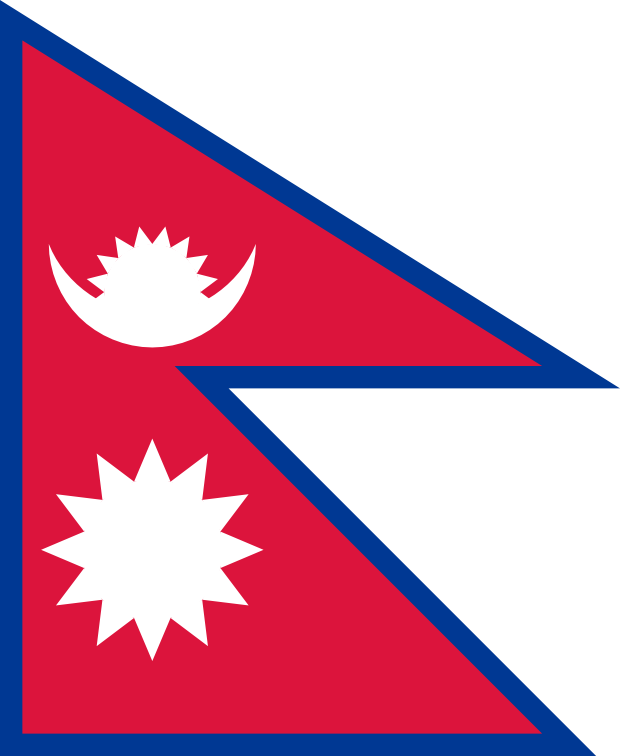
Flag is available in resolutions
| Icon 88x107 |  |
| Icon 32x39 |  |
Nepal
Nepal: A Land of Peaks, Culture, and Resilience
Nestled high in the Himalayas, Nepal is a land of breathtaking natural beauty, profound spiritual significance, and a rich, complex history. Bordered by China to the north and India to the south, east, and west, it is a country that defies simple categorization, a place where towering snow-capped mountains meet lush, fertile valleys, and where ancient traditions intertwine with the modern world. Its very name evokes images of Mount Everest, the world’s highest peak, but Nepal is far more than just its famous summit. It is a vibrant tapestry woven from diverse ethnic groups, a cradle of ancient religions, and a testament to the enduring spirit of its people.
The geography of Nepal is its most defining characteristic, a dramatic and awe-inspiring landscape sculpted by the mighty Himalayas. The country can be broadly divided into three distinct ecological zones. The northern region, dominated by the Great Himalayas, is home to eight of the world’s fourteen highest peaks, including Everest, Kanchenjunga, Lhotse, and Makalu. This rugged terrain, characterized by extreme altitudes, glaciers, and sparse vegetation, is a mecca for mountaineers and trekkers from around the globe. The central region, known as the Mahabharat Lekh or the Lesser Himalayas, is a more temperate zone with rolling hills and fertile valleys, including the renowned Kathmandu Valley. This area is the most densely populated and agriculturally productive part of the country. Finally, the southern Terai plains, a fertile belt bordering India, are characterized by subtropical forests, grasslands, and a warmer climate. This region is also a vital agricultural heartland, producing a significant portion of Nepal’s food crops. The country is crisscrossed by numerous rivers, many originating from the Himalayan glaciers, which not only provide water for irrigation but also pose a constant threat of floods and landslides during the monsoon season. The sheer topographical diversity within such a relatively small landlocked country is remarkable, influencing everything from its climate and biodiversity to its settlement patterns and economic activities.
Nepal’s history is as layered and intricate as its mountainous terrain. For centuries, it was a collection of small kingdoms and principalities, each with its own distinct culture and traditions. The unification of Nepal under the Shah dynasty in the mid-18th century marked a pivotal moment, laying the foundation for the modern nation-state. The Rana regime, which followed, brought a period of isolation and autocratic rule, but also significant infrastructural development. The mid-20th century witnessed a dramatic shift with the end of the Rana rule and the re-establishment of the monarchy. However, the country’s journey towards democracy has been tumultuous, marked by periods of political instability, civil unrest, and a protracted Maoist insurgency that lasted for a decade. In 2008, Nepal transitioned from a monarchy to a federal democratic republic, a monumental step that promised a new era of governance and stability. This recent history, though challenging, has forged a strong sense of national identity and a deep-seated desire for peace and progress among the Nepali people. The legacy of ancient kingdoms, the impact of foreign influences, and the struggle for self-determination have all contributed to the unique character of contemporary Nepal.
The population of Nepal is characterized by its immense diversity, reflecting centuries of migration and interaction between various ethnic and linguistic groups. The country is home to over 100 distinct ethnic communities, each with its own language, customs, and traditions. Among the major ethnic groups are the *Chhetris*, *Bahuns* (Brahmins), *Magars*, *Tharus*, *Tamangs*, *Newars*, *Khamis*, and *Rai*. The *Sherpas*, renowned for their mountaineering skills, are perhaps the most globally recognized ethnic group, primarily residing in the high-altitude regions. Nepali, the official language, is spoken by a majority, but numerous other languages and dialects are spoken across the country, contributing to its rich linguistic mosaic. Hinduism is the predominant religion, practiced by a significant portion of the population, followed closely by Buddhism, with many Nepalis adhering to both faiths, a unique testament to religious tolerance and syncretism. This religious harmony is a cornerstone of Nepali society. The population is predominantly rural, with agriculture being the primary occupation for the vast majority. However, urbanization is on the rise, particularly in cities like Kathmandu, Pokhara, and Biratnagar, as people seek economic opportunities. The demographic profile is relatively young, with a significant proportion of the population under the age of 30, presenting both opportunities and challenges for future development.
Nepal’s economy, while still largely agrarian, is gradually diversifying, with tourism and remittances playing increasingly vital roles. Agriculture remains the backbone of the economy, employing a large percentage of the workforce and contributing significantly to the GDP. Rice, maize, wheat, and millet are the staple crops, while cash crops like tea, coffee, and cardamom are important for export. The country’s vast hydropower potential is another significant economic asset, with numerous rivers offering opportunities for hydroelectric power generation, which not only meets domestic energy needs but also has the potential for export. The tourism industry is a major foreign exchange earner and a significant source of employment. The allure of the Himalayas, with its trekking routes and mountaineering expeditions, attracts hundreds of thousands of visitors annually. Beyond the mountains, Nepal offers a wealth of cultural and historical sites, from ancient temples and palaces to vibrant festivals, drawing tourists interested in its unique heritage. Remittances from Nepalis working abroad, particularly in India, the Gulf countries, and Southeast Asia, are a crucial source of income for many households and a significant contributor to the national economy, helping to alleviate poverty and boost consumption. However, the country faces challenges such as underdeveloped infrastructure, political instability, and vulnerability to natural disasters, which can hinder economic growth and development.
Nepal is an unparalleled destination for tourists, offering a diverse range of experiences that cater to every kind of traveler. The most iconic attraction, of course, is Mount Everest, the undisputed king of the Himalayas. Trekking to Everest Base Camp is a dream for many, a challenging yet immensely rewarding journey through stunning mountain vistas and Sherpa villages. Beyond Everest, the Annapurna Circuit and the Annapurna Base Camp trek are equally popular, offering diverse landscapes, from subtropical forests to high alpine deserts, and showcasing the rich cultural heritage of the region. For those seeking adventure without the extreme altitudes, the Pokhara Valley offers a serene escape with its picturesque lakes, including Phewa Lake, where one can enjoy boating and admire the reflection of the Annapurna range. Pokhara also serves as a gateway to paragliding, zip-lining, and ultralight flights, providing a bird’s-eye view of the majestic landscape. The Kathmandu Valley, a UNESCO World Heritage Site, is the cultural heart of Nepal. It is home to three ancient cities: Kathmandu, Patan, and Bhaktapur, each adorned with magnificent palaces, temples, and stupas. Pashupatinath Temple, a sacred Hindu shrine on the banks of the Bagmati River, is a site of great religious significance and a place where pilgrims and mourners gather. Boudhanath Stupa and Swayambhunath Stupa (the Monkey Temple) are prominent Buddhist pilgrimage sites, radiating an aura of peace and spirituality. The ancient city of Bhaktapur transports visitors back in time with its well-preserved medieval architecture and vibrant artisan workshops. For wildlife enthusiasts, Chitwan National Park and Bardia National Park in the Terai region offer opportunities to spot rhinoceroses, tigers, elephants, and a variety of bird species, often from the back of an elephant or during a jungle safari. The cultural richness extends to the numerous festivals celebrated throughout the year, such as *Dashain*, *Tihar*, and *Indra Jatra*, which offer a glimpse into the vibrant traditions and deep-rooted spirituality of the Nepali people.
In conclusion, Nepal is a land of extraordinary contrasts and enduring allure. Its towering mountains are not just geographical landmarks but also spiritual anchors, drawing pilgrims and adventurers alike. Its diverse population, a mosaic of ethnicities and faiths, creates a rich cultural tapestry that is both unique and deeply welcoming. Despite facing numerous challenges, the resilience and spirit of the Nepali people shine through, evident in their unwavering hospitality and their commitment to preserving their heritage while embracing the future. Nepal is a destination that touches the soul, leaving an indelible mark on all who have the privilege to experience its magic.
Information about Nepal
The information comes from the publication CIA The World Factbook.
Automated text translation, excuse errors, please!
Country Nepal is situated in a location / continent South Asia. Nepal has an area of 147 181 km2 and 29 890 686 residents. The highest point has a height 8 850 above sea level. and it is called Mount Everest. The lowest point is located at the level of 70 above sea level and it is named Kanchan Kalan. System of government is Federal Republic.The capital city is Kathmandu. Nepal has the international abbreviation NP.
Nepal - economy
Total gross domestic product (GDP) is 38 280 000 000 $. Total gross domestic product per capita in purchasing power parity is 1 300 $. GDP grows by 3.50 % a year. Inflation (consumer price index) is equal to 9.10 % a year. Nepal have 18 000 000 working-age population (from a total population 29 890 686 people). Unemployment is at 46.00 %. Nepal issued 5.80 % GDP to healt care and 1,60 % GDP to army. The total amount of foreign debt is 3 777 000 000 USD.
Nepal - demography
As suggested above, Nepal has 29 890 686 people. Population growth is in the amount 1.77 % per year. Number of children born per 1000 population per year is 21.85.Every mother has average 2.41 children. The infant mortality rate is 43.13 and maternal mortality 170.00 deaths per 100,000 births. Average estimated life expectancy makes 66.51 years. Mortality is 6.75 people per 1000 population per year.
Nepal - transport and telecommunications
Nepal has 17 282 km of roads, 59 km of railway lines and 47 airports.
Number of active mobile phones (sim card) in the country Nepal is 13 355 000. Number of active fixed telephone lines is 845 500. Nepal has 577 800 internet users, who have the available 41 532 Internet connections. Nepal has been assigned a domain first Choose range .np.
Nepal - energetics
Nepal consumes a year 4 833 000 000 kWh of electricity. Annual electricity production is 3 156 000 000 kWh in power plants with a total installed electrical capacity 717 000 kW. Nepal exports 0 kWh and imports 70 000 000 kWh of electricity per year Energy mix of power generation is as follows: fossil fuels: 7.9 %, nuclear energy: 0 %, renewable: 0.0 %, hydropower: 92.1 %.
Keywords: Flag of Nepal, all flags, list of flags, Nepal, telecommunications, flags of countries in the world, Flags of countries, information, demography, transport, flag states, national flags, economy, flag, world countries, energetics, list of countries, politic.