Bhutan
Flag of Bhutan
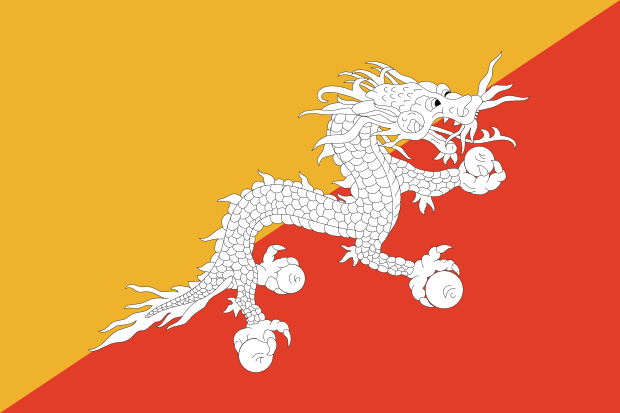
Flag is available in resolutions
| Icon 88x59 |  |
| Icon 32x21 |  |
Bhutan
Bhutan: The Land of the Thunder Dragon
Nestled in the eastern Himalayas, a land of breathtaking landscapes, ancient traditions, and a unique philosophy of Gross National Happiness, lies the Kingdom of Bhutan. Often referred to as Druk Yul or the Land of the Thunder Dragon in its native Dzongkha language, Bhutan has managed to preserve its rich cultural heritage and pristine natural environment in a world increasingly dominated by rapid modernization. This secluded kingdom, bordered by China to the north and India to the south, east, and west, offers a glimpse into a different way of life, one that prioritizes spiritual well-being, environmental stewardship, and the preservation of its distinct identity. Its isolation, both geographical and deliberate, has played a crucial role in shaping its unique trajectory, allowing it to avoid many of the pitfalls of unchecked development and maintain a harmonious balance between tradition and progress.
The population of Bhutan is relatively small, estimated to be around 770,000 people. The majority of Bhutanese are of Tibetan origin, with the Ngalops forming the dominant ethnic group in the western regions, and the Sharchops inhabiting the eastern parts of the country. In the southern plains, there is also a significant population of Lhotshampas, who are of Nepalese descent, though their integration into Bhutanese society has been a complex and sometimes fraught issue. The Bhutanese people are known for their deep spirituality, with Buddhism, specifically the Drukpa Kagyu school of Tibetan Buddhism, profoundly influencing every aspect of their lives. This spiritual foundation is not merely a personal belief system but is woven into the fabric of society, evident in the ubiquitous presence of monasteries, prayer flags fluttering in the wind, and the daily rituals that punctuate life. The government actively promotes Buddhist values, encouraging compassion, mindfulness, and respect for all living beings. This emphasis on spiritual well-being extends to the national policy, famously encapsulated in the concept of Gross National Happiness (GNH), which prioritizes the holistic well-being of its citizens over purely economic growth. GNH is measured through four pillars: sustainable and equitable socio-economic development, environmental conservation, preservation and promotion of culture, and good governance. This progressive approach sets Bhutan apart on the global stage, demonstrating a commitment to a more meaningful and fulfilling existence for its people.
Bhutans history is a tapestry woven with threads of spiritual leaders, unification, and a gradual opening to the outside world. The countrys recorded history begins in the 7th century with the arrival of Buddhism, brought by Tibetan monks. However, it was the 17th century that saw a pivotal moment with the arrival of Shabdrung Ngawang Namgyal, a Tibetan lama and statesman. He is credited with unifying Bhutan, establishing a dual system of government (spiritual and temporal), and building numerous impressive dzongs (fortress-monasteries) that still stand today as architectural marvels and administrative centers. The dzongs, strategically located on hillsides and riverbanks, served as both religious and administrative hubs, defending the country from invasions and solidifying Shabdrungs authority. For centuries, Bhutan remained largely isolated, fending off incursions from its neighbors and maintaining a policy of non-interference in foreign affairs. The 19th century saw increasing contact with the British Empire, leading to a series of treaties that gradually defined Bhutans borders and its relationship with India. In 1907, Ugyen Wangchuck, a prominent leader, was elected the first hereditary King of Bhutan, establishing the monarchy that continues to rule the country today. The 20th century marked a slow but steady process of modernization, with the establishment of a national assembly, the introduction of a constitution, and the gradual opening of the country to limited tourism. The current King, Jigme Khesar Namgyel Wangchuck, has continued his fathers legacy of progressive leadership, overseeing democratic reforms and further strengthening Bhutans international relations while steadfastly upholding the nations unique cultural identity.
Geographically, Bhutan is a land of dramatic contrasts, a testament to its location in the heart of the Himalayas. The country is characterized by steep mountain ranges, deep valleys, and fast-flowing rivers. Its northern frontier is dominated by the Great Himalayan Range, with peaks soaring over 7,000 meters, including the sacred Gangkhar Puensum, often cited as the worlds highest unclimbed mountain. These towering mountains are the source of numerous rivers that carve their way through the country, creating fertile valleys where most of the population resides and agriculture thrives. The central and southern regions feature lower mountain ranges, foothills, and subtropical plains, offering a diverse range of ecosystems. Bhutan is renowned for its commitment to environmental conservation, a principle deeply ingrained in its culture and enshrined in its constitution. A remarkable 70% of the country is under forest cover, and a significant portion is designated as protected areas, including national parks and wildlife sanctuaries. This dedication to preserving its natural heritage has resulted in a rich biodiversity, with numerous species of flora and fauna, including the Bengal tiger, snow leopard, red panda, and the national bird, the raven. The pristine environment is not just a matter of national pride but is also seen as vital for the spiritual and physical well-being of its citizens. The country’s commitment to environmental protection is further exemplified by its status as the worlds only carbon-negative country, meaning it absorbs more greenhouse gases than it produces.
Bhutans economy is primarily agrarian, with rice, maize, and potatoes being the main crops. However, in recent decades, the country has made significant strides in diversifying its economy, with a growing emphasis on hydropower, tourism, and handicrafts. The abundant rivers provide immense potential for hydroelectric power generation, and Bhutan exports a substantial amount of electricity to its neighbors, particularly India, which has become a crucial source of revenue. Tourism, while carefully managed to prevent over-tourism and preserve cultural integrity, is another significant contributor to the economy. Bhutan follows a policy of High Value, Low Impact tourism, requiring visitors to pay a daily Sustainable Development Fee, which goes towards funding social programs, infrastructure development, and environmental conservation. This approach ensures that tourism benefits the country without overwhelming its resources or diluting its unique culture. Handicrafts, including textiles, wood carvings, and thangkas (religious paintings), are also an important part of the economy, providing employment and preserving traditional skills. The government actively supports these industries through various initiatives, aiming to create sustainable economic growth that aligns with the principles of Gross National Happiness. While industrial development is present, it is carefully regulated to minimize environmental impact, with a strong focus on eco-friendly practices and sustainable resource management.
Bhutan offers a wealth of tourist attractions that appeal to a wide range of interests, from the culturally curious to the adventurous trekker. The iconic Tigers Nest Monastery (Paro Taktsang), precariously perched on a cliff face 900 meters above the Paro Valley, is perhaps the most famous landmark. The arduous but rewarding hike to this sacred site offers breathtaking views and a profound spiritual experience. The capital city, Thimphu, is a unique blend of tradition and modernity, with its impressive Tashichho Dzong, the National Memorial Chorten, and the Folk Heritage Museum, offering insights into Bhutanese life. Punakha, the former capital, is renowned for its stunning Punakha Dzong, situated at the confluence of two rivers, and its beautiful rice paddies. For those seeking adventure, Bhutan offers incredible trekking opportunities through its pristine mountain landscapes, ranging from gentle day hikes to challenging multi-day expeditions. The ancient capital of Bumthang, often referred to as the spiritual heartland of Bhutan, is dotted with numerous ancient temples and monasteries, each with its own unique history and significance. Festivals, known as tshechus, are vibrant celebrations of Bhutanese culture, featuring masked dances, religious performances, and traditional music, providing a captivating glimpse into the countrys living traditions. The emphasis on cultural preservation means that visitors can experience an authentic Bhutan, one that has resisted the homogenizing forces of globalization. The limited number of tourists allowed into the country ensures that each visitor has a more intimate and meaningful experience, fostering a deeper appreciation for Bhutans unique charm.
In conclusion, Bhutan stands as a remarkable example of a nation that has successfully navigated the complexities of the modern world while remaining true to its core values. Its commitment to Gross National Happiness, environmental conservation, and the preservation of its rich cultural heritage makes it a truly unique destination. From its majestic mountains and pristine forests to its ancient monasteries and vibrant traditions, Bhutan offers a journey that is not just geographical but also deeply spiritual and transformative. It is a land where the thunder dragon roars, not in conquest, but in harmony with nature and the profound wisdom of its people, offering a beacon of hope for a more balanced and fulfilling future.
Information about Bhutan
The information comes from the publication CIA The World Factbook.
Automated text translation, excuse errors, please!
Country Bhutan is situated in a location / continent South Asia. Bhutan has an area of 38 394 km2 and 716 896 residents. The highest point has a height 7 553 above sea level. and it is called Kula Kangri. The lowest point is located at the level of 97 above sea level and it is named Drangme Chhu. System of government is constitutional monarchy.The capital city is Thimphu. Bhutan has the international abbreviation BT.
Bhutan - economy
Total gross domestic product (GDP) is 4 342 000 000 $. Total gross domestic product per capita in purchasing power parity is 6 200 $. GDP grows by 5.90 % a year. Inflation (consumer price index) is equal to 7.70 % a year. Bhutan have 299 900 working-age population (from a total population 716 896 people). Unemployment is at 4.00 %. Bhutan issued 5.50 % GDP to healt care and 1,00 % GDP to army. The public debt of the country is 78.90 % GDP. The total amount of foreign debt is 1 275 000 000 USD.
Bhutan - demography
As suggested above, Bhutan has 716 896 people. Population growth is in the amount 1.18 % per year. Number of children born per 1000 population per year is 18.75.Every mother has average 2.13 children. The infant mortality rate is 42.17 and maternal mortality 180.00 deaths per 100,000 births. Average estimated life expectancy makes 67.88 years. Mortality is 6.99 people per 1000 population per year.
Bhutan - transport and telecommunications
Bhutan has 8 050 km of roads and 2 airports.
Number of active mobile phones (sim card) in the country Bhutan is 484 200. Number of active fixed telephone lines is 27 500. Bhutan has 50 000 internet users, who have the available 14 714 Internet connections. Bhutan has been assigned a domain first Choose range .bt.
Bhutan - energetics
Bhutan consumes a year 1 161 000 000 kWh of electricity. Annual electricity production is 6 826 000 000 kWh in power plants with a total installed electrical capacity 1 505 000 kW. Bhutan exports 5 500 000 000 kWh and imports 20 000 000 kWh of electricity per year Energy mix of power generation is as follows: fossil fuels: 1.1 %, nuclear energy: 0 %, renewable: 0.0 %, hydropower: 98.9 %.
Keywords: transport, list of countries, all flags, economy, Bhutan, national flags, flag, information, telecommunications, Flag of Bhutan, Flags of countries, flags of countries in the world, flag states, energetics, world countries, list of flags, demography, politic.