India
Flag of India
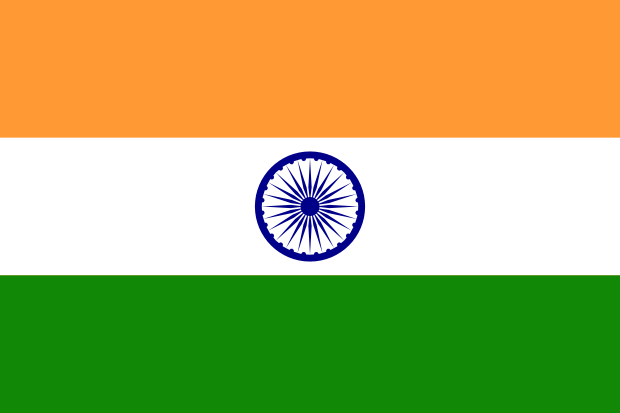
Flag is available in resolutions
| Icon 88x59 |  |
| Icon 32x21 |  |
India
India, officially the Republic of India, is a vast and diverse country located in South Asia. It is the seventh-largest country by area, the second-most populous country, and the most populous democracy in the world. India is a land of incredible contrasts, from the snow-capped Himalayas in the north to the tropical beaches of the south, from the arid deserts of the west to the lush rainforests of the east. Its rich history, vibrant culture, and burgeoning economy make it a fascinating and significant global player.
The population of India is staggering, exceeding 1.4 billion people. This immense demographic is characterized by an extraordinary diversity of ethnicities, languages, religions, and cultures. Hindi and English are the official languages, but there are 22 scheduled languages and hundreds of other dialects spoken across the country. This linguistic mosaic reflects the historical migrations and cultural exchanges that have shaped India over millennia. The religious landscape is equally varied, with Hinduism being the predominant religion, followed by Islam, Christianity, Sikhism, Buddhism, and Jainism. This religious pluralism has often been a source of both cultural richness and, at times, social tension. The Indian society is traditionally structured around a caste system, although its influence has diminished in modern times, it continues to play a role in social dynamics, particularly in rural areas. The sheer scale of India’s population presents both opportunities and challenges, from a vast workforce and a large consumer market to immense pressure on resources and infrastructure. The demographic dividend, with a large young population, is often cited as a key driver of India’s economic growth, but it also necessitates significant investment in education, healthcare, and job creation.
India’s history is one of the longest and most complex in the world, stretching back to the Indus Valley Civilization, one of the world’s earliest urban cultures, which flourished around 2500 BCE. Over the millennia, India has been a cradle of major religions, a crossroads of trade, and a battleground for empires. From the Mauryan and Gupta empires, which saw golden ages of art, science, and philosophy, to the arrival of Islamic rulers who established the Delhi Sultanate and the Mughal Empire, India has experienced periods of great prosperity and cultural flourishing. The Mughal era, in particular, left an indelible mark on Indian architecture, cuisine, and art. The arrival of European colonial powers in the 17th century eventually led to British rule, which lasted for nearly two centuries. The Indian independence movement, a long and arduous struggle, culminated in India gaining independence on August 15, 1947. This period was marked by the partition of India and Pakistan, a traumatic event that led to widespread violence and displacement. Post-independence, India has navigated the challenges of nation-building, economic development, and maintaining its democratic institutions amidst immense diversity. The legacy of colonialism, the complexities of partition, and the ongoing quest for social justice and equitable development continue to shape India’s present and future.
Geographically, India is a subcontinent of immense diversity. In the north, the mighty Himalayas form a natural barrier, home to some of the world’s highest peaks and a source of major rivers like the Ganges and Brahmaputra. South of the Himalayas lies the vast Indo-Gangetic Plain, a fertile region that is the agricultural heartland of India and home to a significant portion of its population. To the west, the Thar Desert stretches across Rajasthan, characterized by sand dunes and arid landscapes. The Deccan Plateau dominates central India, a vast elevated region with a varied topography. The eastern and western Ghats are mountain ranges that flank the Deccan Plateau, leading to the coastal plains. India has a long coastline along the Arabian Sea, the Indian Ocean, and the Bay of Bengal, dotted with numerous islands, including the Lakshadweep Islands in the Arabian Sea and the Andaman and Nicobar Islands in the Bay of Bengal. The country’s diverse geography influences its climate, which ranges from alpine in the Himalayas to tropical in the south, with distinct monsoon seasons that are crucial for agriculture. This geographical variety also contributes to India’s rich biodiversity, with numerous national parks and wildlife sanctuaries protecting a wide array of flora and fauna.
India’s economy has undergone a remarkable transformation since its independence. Initially a predominantly agrarian economy, it has rapidly industrialized and diversified, becoming one of the fastest-growing major economies in the world. The service sector, particularly information technology (IT) and business process outsourcing (BPO), has become a major driver of growth, earning India the title of “Silicon Valley of Asia.” The IT industry has not only created millions of jobs but has also positioned India as a global leader in software development and IT services. Manufacturing also plays a significant role, with strong sectors in automobiles, pharmaceuticals, textiles, and heavy machinery. Agriculture, while still employing a large portion of the population, has seen technological advancements and has become more mechanized. India is a major producer of rice, wheat, sugarcane, cotton, and spices. The government has implemented various economic reforms to encourage foreign investment, liberalize trade, and improve the ease of doing business. However, challenges remain, including poverty, income inequality, infrastructure deficits, and the need for sustainable development. The vast informal sector continues to be a significant part of the economy, providing employment but often lacking social security and formal protections.
India is a treasure trove of tourist attractions, drawing millions of visitors each year with its unparalleled blend of historical monuments, natural beauty, and cultural experiences. The iconic Taj Mahal in Agra, a UNESCO World Heritage site, is a testament to Mughal architecture and a symbol of eternal love, attracting visitors from across the globe. The historic forts and palaces of Rajasthan, such as the Amber Fort in Jaipur and the Mehrangarh Fort in Jodhpur, offer a glimpse into the grandeur of India’s royal past. The spiritual heartland of Varanasi, on the banks of the sacred Ganges River, provides a profound cultural and religious experience. The backwaters of Kerala, with their serene network of canals and lagoons, offer a tranquil escape. The bustling metropolises of Delhi and Mumbai, with their vibrant street life, diverse cuisine, and modern attractions, provide a dynamic urban experience. The majestic Himalayas offer opportunities for trekking, adventure sports, and spiritual retreats in places like Rishikesh and Shimla. The southern states boast ancient temples, lush tea plantations, and pristine beaches. India’s cultural tapestry is woven with vibrant festivals, traditional music and dance forms, and a rich culinary heritage that varies significantly from region to region, making it an endlessly fascinating destination for travelers seeking authentic experiences. The diversity of landscapes, from snow-capped mountains to tropical beaches, from arid deserts to lush rainforests, ensures that there is something to captivate every visitor.
Information about India
The information comes from the publication CIA The World Factbook.
Automated text translation, excuse errors, please!
Country India is situated in a location / continent South Asia. India has an area of 3 287 263 km2 and 1 205 073 612 residents. The highest point has a height 8 598 above sea level. and it is called Kanchenjunga. The lowest point is located at the level of 0 above sea level and it is named Indian Ocean. System of government is Federal Republic and the date of independence 15th August 1947. The capital city is New Delhi. India has the international abbreviation IN.
India - economy
Total gross domestic product (GDP) is 4 515 000 000 000 $. Total gross domestic product per capita in purchasing power parity is 3 700 $. GDP grows by 7.20 % a year. Inflation (consumer price index) is equal to 8.90 % a year. India have 487 600 000 working-age population (from a total population 1 205 073 612 people). Unemployment is at 9.80 %. India issued 2.40 % GDP to healt care and 2,50 % GDP to army. The public debt of the country is 48.50 % GDP. The total amount of foreign debt is 289 700 000 000 USD.
India - demography
As suggested above, India has 1 205 073 612 people. Population growth is in the amount 1.31 % per year. Number of children born per 1000 population per year is 20.60.Every mother has average 2.58 children. The infant mortality rate is 46.07 and maternal mortality 200.00 deaths per 100,000 births. Average estimated life expectancy makes 67.14 years. Mortality is 7.43 people per 1000 population per year.
India - transport and telecommunications
India has 3 320 410 km of roads, 63 974 km of railway lines and 352 airports. The total length of waterways (navigable rivers, canals, etc.) is 14 500 km. There is registered 340 ships.
Number of active mobile phones (sim card) in the country India is 893 862 000. Number of active fixed telephone lines is 32 685 000. India has 61 338 000 internet users, who have the available 6 738 000 Internet connections. India has been assigned a domain first Choose range .in.
India - energetics
India consumes a year 637 600 000 000 kWh of electricity. Annual electricity production is 880 000 000 000 kWh in power plants with a total installed electrical capacity 189 300 000 kW. India exports 519 000 000 kWh and imports 10 530 000 000 kWh of electricity per year Energy mix of power generation is as follows: fossil fuels: 69.9 %, nuclear energy: 2.2 %, renewable: 7.0 %, hydropower: 20.9 %. The country India is harvested annually 897 300 barrels of oil.
Keywords: energetics, flag states, telecommunications, India, flags of countries in the world, Flag of India, list of flags, flag, transport, list of countries, Flags of countries, world countries, demography, economy, national flags, information, all flags, politic.