Pakistan
Flag of Pakistan
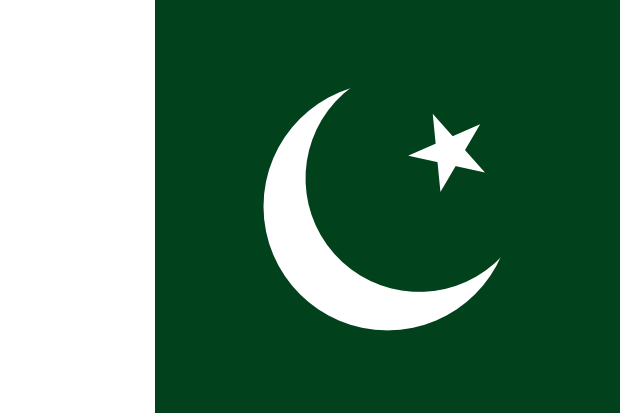
Flag is available in resolutions
| Icon 88x59 |  |
| Icon 32x21 |  |
Pakistan
Pakistan: A Land of Contrasts and Rich Heritage
Pakistan, officially the Islamic Republic of Pakistan, is a country that resonates with a profound sense of history, a vibrant tapestry of cultures, and a breathtaking diversity of landscapes. Situated in South Asia, it shares borders with India to the east, Afghanistan to the west, Iran to the southwest, and China to the northeast. Its coastline stretches along the Arabian Sea and the Gulf of Oman to the south. This strategic location has historically placed Pakistan at a crossroads of civilizations, influencing its rich cultural heritage and complex geopolitical dynamics. The sheer scale of Pakistan is impressive, encompassing a vast territory that ranges from the towering peaks of the Himalayas and Karakoram in the north to the fertile plains of the Indus River basin and the arid Balochistan plateau in the west and south. This geographical variety directly impacts its climate, flora, fauna, and the livelihoods of its people.
The population of Pakistan is a dynamic and multifaceted entity, currently standing as the worlds fifth-most populous country. With an estimated population exceeding 240 million people, it is a nation characterized by its youthfulness, with a significant portion of its citizens under the age of 30. This demographic dividend presents both opportunities and challenges, demanding robust strategies for education, employment, and healthcare. The ethnic composition of Pakistan is remarkably diverse, reflecting centuries of migration and settlement. The dominant ethnic groups include the Punjabis, who inhabit the fertile plains of Punjab, the Sindhis in the south, the Pashtuns in the northwest, the Baloch in the southwest, and various smaller communities such as the Saraikis, Muhajirs, and Kashmiris. This mosaic of ethnicities contributes to a rich array of languages, traditions, and customs, although it also presents complexities in national integration and governance. Urdu is the national language, serving as a lingua franca, while English holds official status and is widely used in government, business, and higher education. However, numerous regional languages, including Punjabi, Sindhi, Pashto, Balochi, and Saraiki, are spoken by millions, each carrying its own distinct cultural significance. Religious adherence is predominantly Islamic, with the vast majority of the population being Sunni Muslims, followed by a significant Shia minority and smaller communities of Christians, Hindus, Sikhs, and other faiths. Religious harmony and tolerance are aspirational goals, often tested by socio-political currents.
The history of Pakistan is a narrative deeply intertwined with the Indian subcontinent’s grand historical sweep. The region that constitutes modern-day Pakistan has been a cradle of ancient civilizations, most notably the Indus Valley Civilization, which flourished around 3300 to 1300 BCE, leaving behind sophisticated urban centers like Mohenjo-daro and Harappa. This ancient legacy speaks to a long history of organized societies, advanced urban planning, and intricate trade networks. Following the decline of the Indus Valley Civilization, the region experienced waves of invasions and rule by various empires, including the Persians, Greeks under Alexander the Great, and later the Mauryan and Kushan empires. The arrival of Islam in the 7th century CE marked a pivotal turning point, gradually transforming the cultural and religious landscape. The Sultanate of Delhi and the Mughal Empire, which followed, left an indelible mark on Pakistan’s architecture, art, cuisine, and administrative systems. The grand Mughal forts and mausoleums, such as the Badshahi Mosque and Shalimar Gardens in Lahore, stand as enduring testaments to this era. The British colonial period, beginning in the 18th century, further shaped the subcontinent’s destiny. While it brought about administrative and infrastructural changes, it also sowed the seeds of political and religious division. The demand for a separate homeland for Muslims in British India gained momentum in the early 20th century, culminating in the creation of Pakistan on August 14, 1947, following the partition of India. This momentous event, while fulfilling a long-cherished dream, was also accompanied by immense human suffering, mass migrations, and widespread violence. Since its inception, Pakistan has navigated a complex political journey, marked by periods of democratic rule interspersed with military interventions. It has faced numerous challenges, including regional conflicts, economic instability, and internal security issues, all of which have shaped its national identity and trajectory.
Pakistan’s geography is a defining characteristic, offering a spectacular array of natural wonders. The northern regions are dominated by the majestic peaks of the Karakoram, Hindu Kush, and Himalayan mountain ranges. This is home to K2, the worlds second-highest mountain, and a host of other formidable peaks that attract mountaineers and trekkers from across the globe. The Glacial region of the north, with its vast ice fields and dramatic valleys, is a testament to the raw power of nature. Moving southwards, the landscape transitions into the fertile plains of the Punjab and Sindh provinces, watered by the mighty Indus River and its tributaries. This vast agricultural heartland forms the backbone of Pakistan’s economy. Further west and south lie the arid and rugged plateaus of Balochistan, characterized by vast deserts, rocky mountains, and a long coastline along the Arabian Sea. The climate varies significantly across the country. The northern highlands experience harsh winters with heavy snowfall, while the southern plains endure hot summers and monsoon seasons. The coastal areas enjoy a more moderate maritime climate. This diverse geography supports a rich biodiversity, though many ecosystems are under pressure due to human activity and climate change.
The industrial sector in Pakistan is a crucial component of its economy, though it faces ongoing development and modernization challenges. Agriculture remains a significant contributor to employment and GDP, with crops like wheat, cotton, rice, and sugarcane forming the backbone of the agrarian economy. The textile industry is a major export earner, leveraging the countrys cotton production. Other key industries include cement, fertilizer, sugar, and automotive manufacturing. The government has been focusing on promoting industrial growth through various policies aimed at attracting foreign investment, improving infrastructure, and enhancing technological capabilities. The energy sector, particularly power generation, is a critical area of focus, with efforts underway to diversify the energy mix and address persistent shortages. The services sector, including telecommunications, banking, and information technology, has been experiencing steady growth, reflecting the countrys increasing integration into the global economy. However, challenges such as energy deficits, bureaucratic hurdles, and the need for skilled labor continue to impact the full potential of Pakistan’s industrial landscape.
Pakistan boasts a wealth of tourist attractions, appealing to a wide range of interests. For history enthusiasts, the ancient ruins of Mohenjo-daro and Harappa offer a glimpse into the sophisticated urban planning of the Indus Valley Civilization. Lahore, the cultural capital, is a treasure trove of Mughal architecture, with the majestic Lahore Fort, the Badshahi Mosque, and the enchanting Shalimar Gardens being must-visit sites. The Walled City of Lahore, with its narrow alleys and bustling bazaars, provides an immersive cultural experience. The northern areas, often referred to as “paradise on earth,” are a dream destination for nature lovers and adventurers. The picturesque valleys of Swat, Hunza, and Kalash are renowned for their stunning natural beauty, crystal-clear lakes, and unique cultural traditions. The Karakoram Highway, one of the highest paved international roads in the world, offers breathtaking vistas and an unforgettable driving experience. For those seeking spiritual solace, numerous Sufi shrines and mosques dot the landscape, attracting pilgrims from across the country and beyond. The coastal areas, though less explored, offer opportunities for beach resorts and water sports. Despite its immense tourism potential, Pakistan faces challenges in fully capitalizing on this sector, including the need for improved infrastructure, enhanced security, and effective marketing strategies to attract a larger international tourist base.
In conclusion, Pakistan is a nation of profound depth and enduring spirit. From its ancient roots to its modern aspirations, it is a land shaped by a rich history, a diverse population, and a spectacular geography. The challenges it faces are significant, but so too are its strengths and its potential. As it continues to evolve, Pakistan remains a country of immense fascination, a testament to the resilience of its people and the enduring allure of its heritage.
Information about Pakistan
The information comes from the publication CIA The World Factbook.
Automated text translation, excuse errors, please!
Country Pakistan is situated in a location / continent South Asia. Pakistan has an area of 796 095 km2 and 190 291 129 residents. The highest point has a height 8 611 above sea level. and it is called K2. The lowest point is located at the level of 0 above sea level and it is named Indian Ocean. System of government is Federal Republic and the date of independence 14th August 1947. The capital city is Islamabad. Pakistan has the international abbreviation PK.
Pakistan - economy
Total gross domestic product (GDP) is 494 800 000 000 $. Total gross domestic product per capita in purchasing power parity is 2 800 $. GDP grows by 2.40 % a year. Inflation (consumer price index) is equal to 11.90 % a year. Pakistan have 58 410 000 working-age population (from a total population 190 291 129 people). Unemployment is at 5.60 %. Pakistan issued 2.60 % GDP to healt care and 3,00 % GDP to army. The public debt of the country is 60.10 % GDP. The total amount of foreign debt is 61 830 000 000 USD.
Pakistan - demography
As suggested above, Pakistan has 190 291 129 people. Population growth is in the amount 1.55 % per year. Number of children born per 1000 population per year is 24.30.Every mother has average 3.07 children. The infant mortality rate is 61.27 and maternal mortality 260.00 deaths per 100,000 births. Average estimated life expectancy makes 66.35 years. Mortality is 6.80 people per 1000 population per year.
Pakistan - transport and telecommunications
Pakistan has 260 760 km of roads, 7 791 km of railway lines and 151 airports. There is registered 11 ships.
Number of active mobile phones (sim card) in the country Pakistan is 111 000 000. Number of active fixed telephone lines is 5 722 000. Pakistan has 20 431 000 internet users, who have the available 340 834 Internet connections. Pakistan has been assigned a domain first Choose range .pk.
Pakistan - energetics
Pakistan consumes a year 74 350 000 000 kWh of electricity. Annual electricity production is 93 350 000 000 kWh in power plants with a total installed electrical capacity 20 200 000 kW. Pakistan exports 0 kWh and imports 0 kWh of electricity per year Energy mix of power generation is as follows: fossil fuels: 65.2 %, nuclear energy: 2.3 %, renewable: 0.0 %, hydropower: 32.5 %. The country Pakistan is harvested annually 63 080 barrels of oil.
Keywords: national flags, telecommunications, information, list of flags, transport, energetics, flag, flag states, demography, flags of countries in the world, list of countries, Pakistan, world countries, Flags of countries, Flag of Pakistan, economy, all flags, politic.