Bangladesh
Flag of Bangladesh
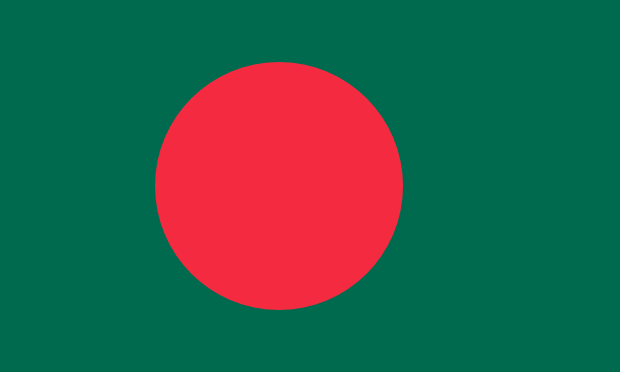
Flag is available in resolutions
| Icon 88x53 |  |
| Icon 32x19 |  |
Bangladesh
Bangladesh: A Land of Rivers, Resilience, and Rich Culture
Bangladesh, officially known as the People’s Republic of Bangladesh, is a South Asian country with a population exceeding 160 million, making it one of the most densely populated nations on Earth. Situated in the fertile delta formed by the Ganges, Brahmaputra, and Meghna rivers, the country is characterized by its lush green landscapes, intricate network of waterways, and a deeply rooted cultural heritage. This nation, born from a bloody liberation struggle in 1971, has navigated a complex history marked by both immense challenges and remarkable resilience. Its geography, dominated by alluvial plains and a vast coastline along the Bay of Bengal, has shaped its economy, its people, and its very identity.
The demographic landscape of Bangladesh is as vibrant as it is dense. The overwhelming majority of the population is Bengali, speaking Bangla as their mother tongue. Islam is the predominant religion, with a significant Hindu minority and smaller communities of Buddhists and Christians. This religious diversity has historically been a cornerstone of Bangladeshi society, although tensions have occasionally surfaced. The sheer density of population presents unique challenges, particularly in terms of resource management, infrastructure development, and providing adequate services for its citizens. Yet, it also fuels a dynamic and industrious society, driven by a strong sense of community and a shared history. The rural population still constitutes a significant portion, with life revolving around agriculture and the rhythms of the riverine landscape. Urban centers, however, are growing rapidly, with Dhaka, the capital, being a megacity teeming with life, commerce, and a constant hum of activity. The youth demographic is substantial, offering a promising future for innovation and development, but also requiring significant investment in education and employment opportunities.
The history of Bangladesh is a tapestry woven with threads of ancient civilizations, colonial rule, and the fervent pursuit of independence. The region, historically known as Bengal, has been inhabited for millennia, with evidence of early settlements dating back to the Neolithic period. Throughout its history, it was part of various empires, including the Maurya, Gupta, Pala, and Sena dynasties, each leaving their indelible mark on the region’s art, architecture, and administrative systems. The arrival of Muslim rulers in the 13th century brought significant cultural and religious shifts, leading to the gradual Islamization of the populace and the development of a distinct Indo-Islamic culture. The British East India Company’s expansion in the 18th century led to direct British rule, which continued until India’s independence in 1947. At the time of partition, Bengal was divided, with the Muslim-majority eastern part becoming East Pakistan and the Hindu-majority western part becoming India. This division, however, proved to be a source of immense friction and dissatisfaction for the people of East Pakistan. The geographical separation from West Pakistan, coupled with perceived political and economic marginalization, fueled a growing nationalist movement. The Bengali Language Movement of 1952, a pivotal moment, saw the sacrifice of lives for the recognition of Bangla as a state language, a testament to the deep-seated cultural pride of the Bengali people. The culmination of these grievances was the Liberation War of 1971, a brutal conflict that resulted in the birth of Bangladesh as an independent nation. The war, marked by widespread atrocities and immense human suffering, also showcased the extraordinary courage and determination of the Bangladeshi people. Since independence, the nation has been on a continuous journey of nation-building, facing political instability, natural disasters, and economic hurdles, yet consistently demonstrating remarkable resilience and a commitment to progress.
Bangladesh’s geography is intrinsically linked to its identity. The country is a vast river delta, a low-lying alluvial plain formed by the confluence of mighty rivers like the Ganges (known locally as Padma), Brahmaputra (Jamuna), and Meghna. This intricate network of rivers, canals, and tributaries is the lifeblood of the nation, shaping its agriculture, transportation, and livelihoods. The fertile delta land supports a predominantly agrarian economy, with rice being the staple crop. However, this low-lying terrain also makes Bangladesh highly vulnerable to natural disasters, particularly cyclones and floods. The Bay of Bengal coastline stretches for approximately 710 kilometers, encompassing the world’s largest mangrove forest, the Sundarbans, a UNESCO World Heritage Site teeming with unique biodiversity, including the iconic Bengal tiger. The climate is tropical monsoon, characterized by heavy rainfall during the monsoon season (June to October) and hot, humid summers. The ever-present threat of climate change, with rising sea levels and increased frequency of extreme weather events, poses a significant long-term challenge to the nation’s development and the safety of its people. The country’s geographical position also makes it a crucial transit point in South Asia, with its strategic location influencing its regional relationships and economic potential.
The Bangladeshi economy has undergone a significant transformation in recent decades, moving from a predominantly agrarian base to a more diversified model with a strong emphasis on the ready-made garment (RMG) industry. The RMG sector has become the backbone of the economy, employing millions, predominantly women, and contributing significantly to the country’s export earnings. This industry, while a source of economic growth and empowerment for many, has also faced scrutiny regarding working conditions and safety standards, leading to ongoing efforts for reform and improvement. Beyond garments, other key industries include jute and textiles, pharmaceuticals, ceramics, and leather goods. Agriculture, while still vital, is gradually being modernized, with increased use of technology and improved crop varieties. Remittances from Bangladeshi workers employed abroad also play a crucial role in the national economy, providing a significant source of foreign exchange. The government is actively promoting foreign investment and aiming to further diversify the export base, with a focus on developing sectors like information technology and light engineering. Despite its economic progress, Bangladesh still faces challenges such as poverty, income inequality, and the need for improved infrastructure. However, the nation’s entrepreneurial spirit and a young, growing workforce offer considerable potential for future economic development.
Bangladesh, despite its challenges, offers a wealth of tourist attractions that appeal to a diverse range of travelers. The historical and architectural grandeur of Dhaka, the capital city, is a major draw. Visitors can explore the majestic Lalbagh Fort, a 17th-century Mughal architectural marvel, and the historic Star Mosque, renowned for its intricate star-shaped patterns. The National Museum provides a fascinating glimpse into the country’s rich history and cultural heritage. Beyond the capital, the ancient city of Mahasthangarh, the oldest known archaeological site in Bangladesh, offers a journey back in time to the Maurya and Gupta periods. For those seeking natural beauty, the Sundarbans, the vast mangrove forest, is an unparalleled experience. Boat safaris through its labyrinthine waterways offer a chance to spot diverse wildlife, including the elusive Bengal tiger, deer, and a plethora of bird species. Cox’s Bazar, boasting the world’s longest natural sea beach, is a popular destination for relaxation and water sports. The hill districts of Chittagong, Bandarban, and Rangamati offer breathtaking landscapes, indigenous tribal cultures, and trekking opportunities. The historic city of Sonargaon, the former capital of Bengal, showcases well-preserved traditional architecture and a vibrant folk art museum. For a glimpse into religious heritage, the Buddhist monasteries of Paharpur, a UNESCO World Heritage Site, and the Hindu temples scattered across the country, offer spiritual and architectural insights. The warmth and hospitality of the Bangladeshi people are often cited as a highlight by visitors, making any journey through this captivating land a truly memorable experience.
Information about Bangladesh
The information comes from the publication CIA The World Factbook.
Automated text translation, excuse errors, please!
Country Bangladesh is situated in a location / continent South Asia. Bangladesh has an area of 143 998 km2 and 161 083 804 residents. The highest point has a height 1 230 above sea level. and it is called Keokradong. The lowest point is located at the level of 0 above sea level and it is named Indian Ocean. System of government is republic and the date of independence 16th December 1971. The capital city is Dhaka. Bangladesh has the international abbreviation BG.
Bangladesh - economy
Total gross domestic product (GDP) is 285 800 000 000 $. Total gross domestic product per capita in purchasing power parity is 1 700 $. GDP grows by 6.10 % a year. Inflation (consumer price index) is equal to 10.70 % a year. Bangladesh have 75 420 000 working-age population (from a total population 161 083 804 people). Unemployment is at 5.00 %. Bangladesh issued 3.40 % GDP to healt care and 1,30 % GDP to army. The public debt of the country is 35.20 % GDP. The total amount of foreign debt is 25 220 000 000 USD.
Bangladesh - demography
As suggested above, Bangladesh has 161 083 804 people. Population growth is in the amount 1.58 % per year. Number of children born per 1000 population per year is 22.53.Every mother has average 2.55 children. The infant mortality rate is 48.99 and maternal mortality 240.00 deaths per 100,000 births. Average estimated life expectancy makes 70.06 years. Mortality is 5.71 people per 1000 population per year.
Bangladesh - transport and telecommunications
Bangladesh has 239 226 km of roads, 2 622 km of railway lines and 18 airports. The total length of waterways (navigable rivers, canals, etc.) is 8 370 km. There is registered 62 ships.
Number of active mobile phones (sim card) in the country Bangladesh is 85 000 000. Number of active fixed telephone lines is 1 600 000. Bangladesh has 617 300 internet users, who have the available 69 285 Internet connections. Bangladesh has been assigned a domain first Choose range .bd.
Bangladesh - energetics
Bangladesh consumes a year 34 830 000 000 kWh of electricity. Annual electricity production is 35 700 000 000 kWh in power plants with a total installed electrical capacity 5 819 000 kW. Bangladesh exports 0 kWh and imports 0 kWh of electricity per year Energy mix of power generation is as follows: fossil fuels: 95.8 %, nuclear energy: 0 %, renewable: 0.3 %, hydropower: 4.0 %. The country Bangladesh is harvested annually 5 200 barrels of oil.
Keywords: national flags, flag, Flag of Bangladesh, information, flag states, list of countries, telecommunications, world countries, flags of countries in the world, list of flags, Flags of countries, demography, transport, economy, all flags, energetics, Bangladesh, politic.