Australia
Flag of Australia
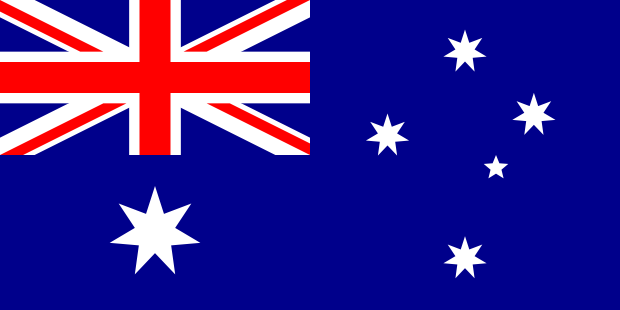
Flag is available in resolutions
| Icon 88x44 |  |
| Icon 32x16 |  |
Australia
Australia: A Continent of Contrasts and Wonders
Australia, officially the Commonwealth of Australia, is a continent and a country located in the Southern Hemisphere. It is the smallest continent by land area, yet it is the sixth-largest country in the world. This vast island nation is renowned for its unique wildlife, breathtaking landscapes, rich indigenous history, and vibrant multicultural society. From the arid Outback to the lush rainforests and the iconic Great Barrier Reef, Australia offers an unparalleled diversity of experiences that captivate travellers and residents alike.
The population of Australia is approximately 26 million people, with the majority concentrated in the coastal cities. Sydney, Melbourne, Brisbane, Perth, and Adelaide are the major urban centres, each boasting its own distinct character and attractions. The nation’s population is remarkably diverse, a testament to decades of immigration from all corners of the globe. While the indigenous peoples of Australia, the Aboriginal and Torres Strait Islander peoples, have inhabited the land for over 65,000 years, the modern Australian identity is a complex tapestry woven from the traditions and contributions of numerous cultures. English is the official language, but the multicultural makeup of the nation is reflected in the multitude of languages spoken daily.
The history of Australia is a fascinating narrative that spans millennia. For tens of thousands of years, Aboriginal Australians lived in harmony with the land, developing intricate social structures, spiritual beliefs, and profound connections to their ancestral territories. Their art, music, and storytelling are among the oldest continuous cultural traditions in the world. European colonisation began in the late 18th century with the arrival of the First Fleet in 1788, establishing a penal colony at Sydney Cove. This marked the beginning of a period of profound change, displacement, and conflict for the indigenous population. Over the following centuries, Australia evolved from a collection of British colonies into a self-governing dominion and eventually a federation in 1901. The 20th century saw significant waves of immigration, transforming Australia into the multicultural society it is today. Despite the challenges and injustices of the past, there is a growing recognition and reconciliation with the nation’s indigenous heritage, with efforts being made to preserve and celebrate the cultures of its First Peoples.
Geographically, Australia is a land of extremes and stunning contrasts. Its vast interior is dominated by the Outback, a semi-arid to arid region characterised by vast plains, ancient rock formations like Uluru (Ayers Rock), and unique desert flora and fauna. The Great Dividing Range, Australia’s most substantial mountain range, runs along the eastern coast, giving way to fertile agricultural lands and temperate forests. The northern tropical regions are home to dense rainforests and a monsoonal climate, while the south enjoys a more Mediterranean climate. Australia’s coastline stretches for over 25,000 kilometres, featuring golden beaches, dramatic cliffs, and the world-renowned Great Barrier Reef, the largest coral reef system on Earth. This immense natural wonder is a UNESCO World Heritage site and a vital ecosystem, teeming with marine life. The continent’s isolation has led to the evolution of many unique species, often referred to as marsupials, such as kangaroos, koalas, and wombats, which are found nowhere else on Earth.
The Australian economy is one of the most developed and diversified in the world. It is rich in natural resources, with significant exports including iron ore, coal, gold, and natural gas. The mining sector plays a crucial role, but Australia also boasts strong industries in agriculture, with vast sheep and cattle stations producing wool and meat, and extensive wheat farming. Services, particularly finance, tourism, and education, are increasingly important contributors to the nation’s GDP. The country’s stable political environment, skilled workforce, and strategic location in the Asia-Pacific region make it an attractive destination for international investment. Innovation and technological advancement are also key drivers of the Australian economy, with a growing focus on renewable energy and sustainable practices.
Australia is a treasure trove of tourist attractions, catering to every imaginable interest. The iconic Sydney Opera House and Harbour Bridge are must-see landmarks in the vibrant city of Sydney. Melbourne, known for its laneway culture, world-class dining, and sporting events, offers a different urban experience. Further afield, the Great Barrier Reef beckons with its unparalleled snorkelling and diving opportunities. The rugged beauty of Tasmania, the wild landscapes of the Northern Territory’s Kakadu National Park, and the wineries of the Barossa Valley are just a few of the diverse natural and cultural attractions that draw millions of visitors each year. For adventure seekers, opportunities abound for surfing on world-famous breaks, hiking through ancient rainforests, or exploring the vastness of the Outback. The laid-back lifestyle, friendly locals, and the sheer natural beauty make Australia an unforgettable travel destination.
In conclusion, Australia is a continent of profound beauty, rich history, and remarkable diversity. Its unique geography, captivating wildlife, and multicultural population create a nation unlike any other. From the ancient traditions of its indigenous peoples to the modern, dynamic society, Australia continues to evolve and impress. It is a land of opportunity, adventure, and unparalleled natural wonders, a true gem of the Southern Hemisphere.
Information about Australia
The information comes from the publication CIA The World Factbook.
Automated text translation, excuse errors, please!
Country Australia is situated in a location / continent Oceania. Australia has an area of 7 741 220 km2 and 22 015 576 residents. The highest point has a height 2 229 above sea level. and it is called Mount Kosciuszko. The lowest point is located at the level of -15 above sea level and it is named Lake Eyre. System of government is Federal Republic, Commonwealth member country and the date of independence First January 1901. The capital city is Canberra. Australia has the international abbreviation AS.
Australia - economy
Total gross domestic product (GDP) is 926 200 000 000 $. Total gross domestic product per capita in purchasing power parity is 40 800 $. GDP grows by 2.00 % a year. Inflation (consumer price index) is equal to 3.40 % a year. Australia have 12 050 000 working-age population (from a total population 22 015 576 people). Unemployment is at 5.10 %. Australia issued 8.50 % GDP to healt care and 3,00 % GDP to army. The public debt of the country is 26.80 % GDP. The total amount of foreign debt is 1 376 000 000 000 USD.
Australia - demography
As suggested above, Australia has 22 015 576 people. Population growth is in the amount 1.13 % per year. Number of children born per 1000 population per year is 12.28.Every mother has average 1.77 children. The infant mortality rate is 4.55 and maternal mortality 7.00 deaths per 100,000 births. Average estimated life expectancy makes 81.90 years. Mortality is 6.94 people per 1000 population per year.
Australia - transport and telecommunications
Australia has 818 356 km of roads, 38 445 km of railway lines and 467 airports. The total length of waterways (navigable rivers, canals, etc.) is 2 000 km. There is registered 41 ships.
Number of active mobile phones (sim card) in the country Australia is 24 490 000. Number of active fixed telephone lines is 10 540 000. Australia has 15 810 000 internet users, who have the available 16 952 000 Internet connections. Australia has been assigned a domain first Choose range .au.
Australia - energetics
Australia consumes a year 228 800 000 000 kWh of electricity. Annual electricity production is 241 500 000 000 kWh in power plants with a total installed electrical capacity 56 940 000 kW. Australia exports 0 kWh and imports 0 kWh of electricity per year Energy mix of power generation is as follows: fossil fuels: 79 %, nuclear energy: 0 %, renewable: 4.7 %, hydropower: 13.7 %. The country Australia is harvested annually 482 500 barrels of oil.
Keywords: Flags of countries, all flags, list of countries, world countries, information, national flags, flags of countries in the world, telecommunications, flag states, Australia, transport, Flag of Australia, flag, demography, list of flags, economy, energetics, politic.