New Caledonia
Flag of New Caledonia
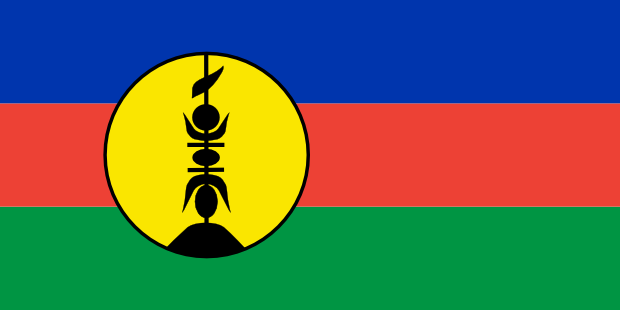
Flag is available in resolutions
| Icon 88x44 |  |
| Icon 32x16 |  |
New Caledonia
New Caledonia, a captivating archipelago nestled in the southwestern Pacific Ocean, is a land of extraordinary beauty and complex history. Located approximately 1,200 kilometers east of Australia and 2,000 kilometers north of New Zealand, this French overseas territory is renowned for its pristine lagoons, vibrant coral reefs, and unique Melanesian culture, interwoven with a significant French influence. The very name New Caledonia evokes images of lush tropical landscapes, a stark contrast to its often harsh and dramatic geological past. Its strategic location has made it a point of interest for various powers throughout history, shaping its present-day identity as a territory striving for its own destiny.
The population of New Caledonia is a fascinating mosaic of ethnicities and cultures, reflecting its colonial past and indigenous heritage. The largest group comprises the indigenous Melanesian people, known as the Kanak. The Kanak have a rich cultural tradition, deeply connected to the land and sea, with distinct languages, customs, and spiritual beliefs. Their history is one of resilience and adaptation, having inhabited these islands for millennia before European arrival. Alongside the Kanak, there is a substantial population of European descent, predominantly French, who have been living in New Caledonia for generations. These Caldoches, as they are often called, have established their own distinct identity and contribute significantly to the territorys economy and social fabric. Further adding to the demographic tapestry are smaller communities of Wallisians and Futunans, Polynesians who migrated to New Caledonia in search of work, as well as Asian communities, particularly Vietnamese and Chinese, whose ancestors arrived during the colonial era. This diverse mix of peoples has created a unique cultural environment, characterized by a blend of traditions and a dynamic intermingling of languages and lifestyles. The official language is French, but many Kanak languages are still spoken, particularly in rural areas, and a creole language, known as Tayo, also exists. The social dynamics between these groups are complex, marked by periods of both harmony and tension, particularly concerning issues of political representation and economic equality.
The history of New Caledonia is a long and multifaceted narrative, beginning with its settlement by the ancestors of the Kanak people thousands of years ago. These early inhabitants, skilled seafarers and navigators, arrived from Southeast Asia and established a complex society deeply intertwined with the natural environment. For centuries, the islands remained largely isolated from the rest of the world, developing their unique cultural practices and social structures. The first recorded European contact came in 1774 with the arrival of British explorer Captain James Cook, who named the islands New Caledonia after Scotland, which he saw as resembling the rugged terrain of the northern part of Grande Terre, the main island. However, it was France that ultimately claimed sovereignty over the archipelago in 1853, establishing a penal colony and later developing mining operations, particularly for nickel. This colonial period brought significant changes to the Kanak way of life, including land dispossession and the introduction of new diseases. The French administration imposed its laws and culture, leading to resistance from the indigenous population. Throughout the 20th century, the desire for self-determination grew among the Kanak people, culminating in a period of significant political activism and unrest in the 1980s. The Matignon Accords of 1988 and the Nouméa Agreement of 1998 marked pivotal moments, granting New Caledonia a high degree of autonomy and setting a path towards potential independence. This ongoing process of decolonization is a defining characteristic of contemporary New Caledonia, with referendums on independence being held periodically, reflecting the deeply divided opinions within the territory.
Geographically, New Caledonia is a land of dramatic contrasts and breathtaking natural beauty. The archipelago comprises the main island, Grande Terre, which is the largest island in the region, along with numerous smaller islands and atolls, most notably the Loyalty Islands (Ouvéa, Lifou, Maré, and Tiga) to the east, and the remote Chesterfield Islands to the west. Grande Terre itself is characterized by a rugged interior dominated by a central mountain range, the highest peak being Mont Panié, reaching 1,628 meters. This mountainous spine gives rise to numerous rivers and waterfalls, carving out fertile valleys and creating a diverse range of ecosystems. The coastline is a spectacle of white sandy beaches, dramatic cliffs, and sheltered bays. However, the true jewel of New Caledonias geography is its lagoon. The New Caledonian lagoon, a UNESCO World Heritage site, is one of the largest and most diverse marine ecosystems on the planet. It is protected by the worlds second-largest barrier reef, stretching for over 1,500 kilometers. This vibrant underwater world teems with an astonishing array of marine life, including thousands of species of fish, corals, and invertebrates, making it a paradise for divers and snorkelers. The islands experience a tropical climate, with high temperatures and humidity year-round, and distinct wet and dry seasons. The surrounding ocean currents also play a significant role in shaping the climate and marine life of the archipelago.
The economy of New Caledonia is heavily reliant on its natural resources, particularly nickel, and to a lesser extent, tourism. The territory possesses vast reserves of nickel ore, making it one of the worlds leading producers. The mining and processing of nickel have been a cornerstone of the economy for over a century, providing employment and significant export revenue. However, this reliance on a single commodity also makes the economy vulnerable to fluctuations in global market prices. Other important sectors include agriculture, with crops such as copra, coffee, and tropical fruits being cultivated, and fisheries. Tourism is a growing industry, attracted by the stunning natural beauty of the lagoons, reefs, and beaches, as well as the unique cultural experiences on offer. The capital city, Nouméa, is the administrative and economic hub, with a well-developed infrastructure catering to tourists. However, the economic disparities between the Kanak population and other communities remain a significant challenge, with efforts underway to promote more equitable development and opportunities. The ongoing political debate regarding independence also influences economic planning and investment.
New Caledonia offers a wealth of tourist attractions, catering to a wide range of interests. For nature lovers and adventure seekers, the New Caledonian Lagoon is an absolute must-see. Its crystal-clear waters and vibrant coral gardens provide unparalleled opportunities for diving and snorkeling, with sites like the Amedee Lighthouse and the Kuto Bay on Île des Pins being particularly famous. The Grande Terre offers opportunities for hiking in its lush interior, exploring waterfalls, and discovering endemic flora and fauna. The Jardin Botanique de Koumac is a testament to the islands rich biodiversity. Culturally, visitors can immerse themselves in the Kanak heritage by visiting traditional villages, attending cultural performances, and learning about their ancestral customs. The Musée de Nouvelle-Calédonie in Nouméa offers a fascinating insight into the history and culture of the islands. The Loyalty Islands, particularly Ouvéa with its pristine beaches and turquoise waters, and Lifou, known for its dramatic cliffs and caves, offer a more tranquil and authentic island experience. Nouméa itself is a charming city with a distinct French colonial feel, boasting a lively market, a beautiful waterfront promenade, and a range of restaurants and shops. The Citroën car brand is surprisingly popular and visible, a quirky detail that adds to the local character. For those interested in history, the remnants of the penal colony and the memorials to past conflicts offer poignant reminders of the territorys past. The overall experience of visiting New Caledonia is one of stepping into a world where natures grandeur meets a rich and evolving cultural tapestry, a destination that truly captivates the senses and inspires a deep appreciation for its unique identity.
Information about New Caledonia
The information comes from the publication CIA The World Factbook.
Automated text translation, excuse errors, please!
Country New Caledonia is situated in a location / continent Oceania. New Caledonia has an area of 18 575 km2 and 260 166 residents. The highest point has a height 1 628 above sea level. and it is called Mont Panie. The lowest point is located at the level of 0 above sea level and it is named Pacific Ocean. The capital city is Noumea. New Caledonia has the international abbreviation NC.
New Caledonia - economy
Total gross domestic product (GDP) is 3 158 000 000 $. Total gross domestic product per capita in purchasing power parity is 15 000 $. Inflation (consumer price index) is equal to 2.40 % a year. New Caledonia have 102 600 working-age population (from a total population 260 166 people). Unemployment is at 17.10 %. The total amount of foreign debt is 79 000 000 USD.
New Caledonia - demography
As suggested above, New Caledonia has 260 166 people. Population growth is in the amount 1.49 % per year. Number of children born per 1000 population per year is 16.05.Every mother has average 2.04 children. The infant mortality rate is 5.62 .Average estimated life expectancy makes 76.94 years. Mortality is 5.34 people per 1000 population per year.
New Caledonia - transport and telecommunications
New Caledonia has 5 622 km of roads and 25 airports. There is registered 3 ships.
Number of active mobile phones (sim card) in the country New Caledonia is 227 300. Number of active fixed telephone lines is 76 200. New Caledonia has 85 000 internet users, who have the available 33 904 Internet connections. New Caledonia has been assigned a domain first Choose range .nc.
New Caledonia - energetics
New Caledonia consumes a year 1 558 000 000 kWh of electricity. Annual electricity production is 1 675 000 000 kWh in power plants with a total installed electrical capacity 421 000 kW. New Caledonia exports 0 kWh and imports 0 kWh of electricity per year Energy mix of power generation is as follows: fossil fuels: 79.1 %, nuclear energy: 0 %, renewable: 2.4 %, hydropower: 18.5 %.
Keywords: national flags, information, flag states, all flags, list of countries, transport, demography, New Caledonia, energetics, world countries, economy, flag, flags of countries in the world, telecommunications, Flags of countries, list of flags, Flag of New Caledonia, politic.