Solomon Islands
Flag of Solomon Islands
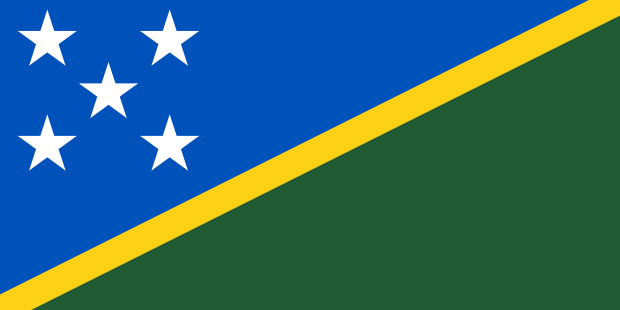
Flag is available in resolutions
| Icon 88x44 |  |
| Icon 32x16 |  |
Solomon Islands
The Solomon Islands: An Archipelago of Untamed Beauty and Rich History
The Solomon Islands, a sovereign state in Melanesia, an oceanic region of the Pacific Ocean, comprise six major islands and over 900 smaller islands. This archipelago, situated east of Papua New Guinea and northwest of Vanuatu, is a land of dramatic contrasts, from lush, volcanic mountain ranges cloaked in dense rainforest to pristine coral reefs teeming with marine life. Its isolation has preserved a unique cultural heritage and a breathtaking natural environment, making it a destination for those seeking adventure, cultural immersion, and a glimpse into a world largely untouched by mass tourism. The allure of the Solomon Islands lies not only in its stunning landscapes but also in its complex history, shaped by ancient migrations, colonial rule, and the fierce battles of World War II.
The population of the Solomon Islands is predominantly of Melanesian descent, with a diverse array of linguistic and cultural groups. Over 70 indigenous languages are spoken across the islands, a testament to the archipelago’s long history of settlement and the relative isolation of its communities. While the official language is English, Pijin, a creole language, is widely spoken and serves as a lingua franca, facilitating communication between different island groups. The social structure is largely based on kinship and traditional customs, with strong community ties and a deep respect for elders. Christianity is the dominant religion, introduced by missionaries during the colonial era, though traditional beliefs and practices continue to hold significance for many. The people of the Solomon Islands are known for their warmth, hospitality, and resilience, embodying a spirit shaped by their close connection to the land and sea. Their way of life, though increasingly influenced by globalization, retains a strong sense of tradition and a profound understanding of their natural surroundings.
The history of the Solomon Islands is a captivating narrative stretching back millennia. Archaeological evidence suggests that the islands were first settled by Austronesian peoples around 2,500 to 3,000 years ago. These early inhabitants, skilled seafarers and navigators, established complex societies and developed unique cultural traditions that have endured to this day. For centuries, the islands remained relatively isolated from the outside world, developing their own distinct social structures and belief systems. The arrival of Europeans marked a significant turning point. Spanish explorer Álvaro de Mendaa de Neira is credited with being the first European to sight the islands in 1568, naming them in the hope of finding the legendary riches of King Solomon. However, it was not until the late 19th century that European powers began to establish a more permanent presence. In 1893, Great Britain declared the southern islands a protectorate, and in 1900, Germany claimed the northern islands. This division, however, was short-lived. During World War I, Australia seized the German-controlled islands, and after the war, they were administered under a League of Nations mandate. The most dramatic chapter in the Solomon Islands’ history, however, unfolded during World War II. The islands became a crucial theater of operations for the Allied forces in their campaign against Japan. The Battle of Guadalcanal, fought from August 1942 to February 1943, was one of the bloodiest land battles of the Pacific War. The strategic importance of the islands meant they were heavily fortified and witnessed intense fighting, leaving behind a legacy of sunken ships, aircraft wrecks, and military relics that now lie scattered across the archipelago, attracting divers and history enthusiasts from around the globe. Following the war, the islands gradually moved towards independence. The Solomon Islands gained full independence from the United Kingdom on July 7, 1978, becoming a constitutional monarchy with the British monarch as head of state. Since independence, the nation has faced numerous challenges, including economic development, political stability, and the impact of natural disasters.
Geographically, the Solomon Islands are a marvel of volcanic origins and coral formations. The archipelago is characterized by a chain of mountainous islands, many of which are volcanic, with lush tropical rainforests blanketing their slopes. The highest peak, Mount Popomanaseu on Guadalcanal, reaches an elevation of 2,335 meters. The islands are situated on the Pacific Ring of Fire, making them geologically active with frequent seismic activity and occasional volcanic eruptions. The coastline is often rugged, with steep cliffs and sheltered bays, interspersed with sandy beaches. Surrounding many of the islands are extensive coral reefs, which form vibrant underwater ecosystems. These reefs are home to an incredible diversity of marine life, making the Solomon Islands a world-renowned destination for diving and snorkeling. The climate is tropical, characterized by high temperatures and humidity year-round, with distinct wet and dry seasons. The wet season, typically from November to April, brings heavy rainfall and is influenced by the northwest monsoon, while the dry season, from May to October, is influenced by the southeast trade winds. The archipelago’s rich biodiversity extends beyond its marine environments. The dense rainforests harbor a remarkable array of flora and fauna, including many endemic species. Birdlife is particularly abundant, with numerous species of parrots, kingfishers, and seabirds gracing the skies. However, the islands also face significant environmental challenges, including deforestation due to logging, coastal erosion, and the impacts of climate change, which threaten these precious ecosystems.
The economy of the Solomon Islands is primarily based on agriculture, fisheries, and forestry, with tourism playing an increasingly important role. Traditional subsistence farming and fishing remain vital for a large portion of the population, providing food security and a source of livelihood. Cash crops such as palm oil, copra, and cocoa are significant export commodities. The rich marine resources of the Solomon Islands support a substantial fishing industry, with tuna being a major export. Forestry has historically been a significant contributor to the economy, but concerns over sustainable logging practices and deforestation have led to a greater focus on responsible forest management. The government is actively seeking to diversify the economy and attract foreign investment, particularly in sectors such as tourism and renewable energy. The development of the tourism sector holds significant potential for job creation and economic growth, leveraging the islands’ natural beauty and cultural attractions. However, infrastructure development, including transportation and telecommunications, remains a key challenge in realizing this potential. The country’s reliance on a few primary commodities also makes its economy vulnerable to global price fluctuations and external economic shocks.
The Solomon Islands offer a wealth of tourist attractions, catering to a diverse range of interests. For history buffs, the remnants of World War II are a major draw. Guadalcanal, in particular, is dotted with historical sites, including the American Memorial, the Japanese Peace Memorial, and numerous battle sites and shipwrecks. The sunken wrecks off the coast of Tulagi and around the Russell Islands are legendary among divers, offering a unique opportunity to explore underwater museums filled with military history. For nature lovers and adventurers, the islands provide unparalleled opportunities for exploration. Hiking through the dense rainforests, discovering hidden waterfalls, and observing endemic wildlife are popular activities. The vibrant coral reefs are a paradise for divers and snorkelers, with world-class dive sites such as Mborokua (Mary Island) and the Florida Islands offering encounters with sharks, rays, turtles, and a dazzling array of reef fish. Cultural tourism is also a significant attraction. Visitors can experience the rich traditions of the Melanesian people by visiting local villages, witnessing traditional ceremonies, and learning about ancient customs and crafts. The weekly market in Honiara, the capital, is a bustling hub of activity where locals sell fresh produce, handicrafts, and traditional medicines. The annual Land Diving ceremony on Pentecost Island (though more famously associated with Vanuatu, similar traditions exist or have influenced cultural practices in parts of the Solomons) or the vibrant festivals that celebrate harvest or significant cultural events offer immersive cultural experiences. Beyond Guadalcanal, islands like Malaita, known for its traditional shell money and the fascinating rock art of the Taniwha caves, and the stunning natural beauty of the Russell Islands, offer distinct experiences. The pristine beaches, crystal-clear waters, and the opportunity to disconnect from the modern world make the Solomon Islands a truly unique and unforgettable destination.
In conclusion, the Solomon Islands are a land of remarkable natural beauty, rich cultural heritage, and a compelling history. From the echoes of World War II battles to the vibrant coral reefs and the warm hospitality of its people, this archipelago offers a journey into a world that is both captivating and profoundly authentic. As the nation continues to navigate the complexities of development and preservation, its unique charm and untamed spirit remain its most valuable assets.
Information about Solomon Islands
The information comes from the publication CIA The World Factbook.
Automated text translation, excuse errors, please!
Country Solomon Islands is situated in a location / continent Oceania. Solomon Islands has an area of 28 896 km2 and 584 578 residents. The highest point has a height 2 447 above sea level. and it is called Mount Makarakomburu. The lowest point is located at the level of 0 above sea level and it is named Pacific Ocean. System of government is Republic, Commonwealth member country and the date of independence July 7, 1978. The capital city is Honiara. Solomon Islands has the international abbreviation BP.
Solomon Islands - economy
Total gross domestic product (GDP) is 1 747 000 000 $. Total gross domestic product per capita in purchasing power parity is 3 200 $. GDP grows by 9.30 % a year. Inflation (consumer price index) is equal to 7.40 % a year. Solomon Islands have 202 500 working-age population (from a total population 584 578 people). Solomon Islands issued 5.40 % GDP to healt care .The total amount of foreign debt is 166 000 000 USD.
Solomon Islands - demography
As suggested above, Solomon Islands has 584 578 people. Population growth is in the amount 2.17 % per year. Number of children born per 1000 population per year is 27.46.Every mother has average 3.51 children. The infant mortality rate is 17.25 and maternal mortality 93.00 deaths per 100,000 births. Average estimated life expectancy makes 74.42 years. Mortality is 3.91 people per 1000 population per year.
Solomon Islands - transport and telecommunications
Solomon Islands has 1 360 km of roads and 36 airports.
Number of active mobile phones (sim card) in the country Solomon Islands is 274 900. Number of active fixed telephone lines is 8 400. Solomon Islands has 10 000 internet users, who have the available 4 354 Internet connections. Solomon Islands has been assigned a domain first Choose range .sb.
Solomon Islands - energetics
Solomon Islands consumes a year 76 260 000 kWh of electricity. Annual electricity production is 82 000 000 kWh in power plants with a total installed electrical capacity 14 000 kW. Solomon Islands exports 0 kWh and imports 0 kWh of electricity per year Energy mix of power generation is as follows: fossil fuels: 100 %, nuclear energy: 0 %, renewable: 0.0 %, hydropower: 0.0 %.
Keywords: demography, economy, information, Solomon Islands, telecommunications, world countries, all flags, energetics, Flags of countries, flags of countries in the world, list of countries, Flag of Solomon Islands, flag, list of flags, flag states, transport, national flags, politic.