Thailand
Flag of Thailand
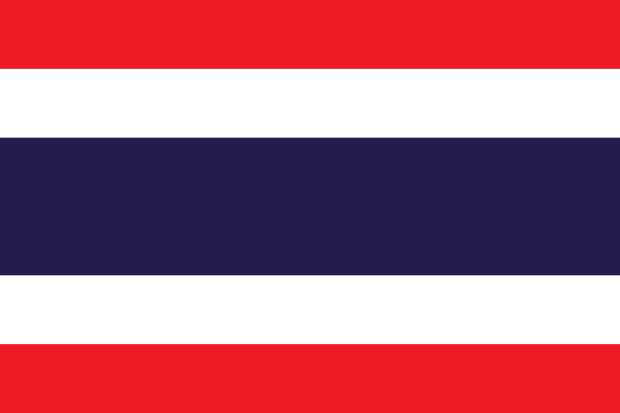
Flag is available in resolutions
| Icon 88x59 |  |
| Icon 32x21 |  |
Thailand
Thailand: Land of Smiles and Rich Heritage
Thailand, officially known as the Kingdom of Thailand, is a captivating Southeast Asian nation that effortlessly blends ancient traditions with modern dynamism. Nestled in the heart of the Indochinese Peninsula, it is a country that has long enchanted visitors with its vibrant culture, breathtaking landscapes, and the famously warm hospitality of its people. Often referred to as the „Land of Smiles,“ this moniker perfectly encapsulates the welcoming spirit that permeates Thai society, making it a truly unforgettable destination for travelers seeking both adventure and serenity. The nation’s strategic location has historically positioned it as a crossroads of trade and cultural exchange, a legacy that is richly evident in its diverse traditions, architecture, and culinary arts. From the bustling metropolis of Bangkok to the serene islands in the south and the verdant mountains in the north, Thailand offers a kaleidoscope of experiences that cater to every kind of traveler.
The population of Thailand is a vibrant tapestry of ethnic groups, with the ethnic Thai forming the majority. However, significant minority populations, including the Chinese, Malay, Khmer, and various hill tribes such as the Hmong, Karen, and Akha, contribute to the nation’s rich cultural mosaic. This diversity is reflected in the country’s languages, customs, and traditions. The official language is Thai, a tonal language with a unique script, though English is widely spoken in tourist areas and business circles. The primary religion is Buddhism, specifically Theravada Buddhism, which profoundly influences Thai culture, art, and daily life. Buddhist temples, or „wats,“ are ubiquitous and serve as centers of spiritual and community life, often adorned with intricate carvings and gilded statues. The concept of „sanuk,“ meaning fun or enjoyment, is deeply ingrained in the Thai psyche, encouraging a lighthearted approach to life and fostering a positive social environment. This emphasis on harmony and respect, known as „kreng jai,“ also shapes social interactions, leading to a culture that values politeness and avoiding direct confrontation. The demographic makeup has seen a gradual aging of the population, a trend common in many developed and developing nations, alongside a significant rural-to-urban migration, particularly towards the capital, Bangkok.
Thailand’s history is a long and complex narrative, stretching back millennia. Archaeological evidence suggests human habitation in the region dating back to the Neolithic period. The Sukhothai Kingdom (13th-15th centuries) is often considered the first great Thai kingdom, marking a golden age of Thai art, literature, and the development of the Thai alphabet. Following Sukhothai, the Ayutthaya Kingdom (14th-18th centuries) rose to prominence, becoming a major regional power and a vibrant center of international trade. Ayutthaya’s impressive city, with its grand palaces and numerous temples, was a testament to its wealth and influence. The kingdom eventually fell to Burmese invaders in 1767, leading to a period of disarray. King Taksin managed to rally the Thai forces and establish a new capital at Thonburi, before his reign was succeeded by King Rama I, who founded the Chakri Dynasty and moved the capital to Bangkok in 1782. This dynasty continues to reign today. Throughout the 19th and early 20th centuries, Thailand, uniquely among Southeast Asian nations, managed to avoid direct colonization by European powers, skillfully navigating diplomatic relations and implementing modernization reforms under monarchs like King Mongkut (Rama IV) and King Chulalongkorn (Rama V). The country transitioned from an absolute monarchy to a constitutional monarchy in 1932, a pivotal moment in its modern political history. The latter half of the 20th century saw periods of political instability, including military coups, interspersed with periods of democratic rule. Despite these challenges, Thailand has maintained its sovereignty and cultivated a distinct national identity.
Geographically, Thailand is a land of striking contrasts. It is divided into four main regions: the North, characterized by its mountainous terrain, lush forests, and cooler climate; the Northeast (Isan), a vast plateau with a drier climate, known for its distinct cultural traditions and agricultural output; the Central Plains, a fertile river basin dominated by the Chao Phraya River, serving as the nation’s agricultural heartland and home to the bustling capital; and the South, a peninsula stretching towards Malaysia, renowned for its stunning tropical beaches, islands, and rich marine life. Thailand’s coastline is extensive, bordering the Andaman Sea to the west and the Gulf of Thailand to the east. The country’s diverse topography supports a rich biodiversity, with extensive rainforests, mangrove swamps, and coral reefs. The climate is tropical, with three distinct seasons: a hot season from March to May, a rainy season from June to October, and a cool season from November to February, though the cooler season is less pronounced in the south. The Mekong River forms part of Thailand’s eastern border, a vital artery for trade and transportation in the region.
The Thai economy is one of the most dynamic in Southeast Asia, having undergone a significant transformation from an agrarian base to a diversified industrial and service-oriented economy. Historically, agriculture played a dominant role, with rice being the primary crop. While still important, its contribution to the GDP has decreased. Today, manufacturing is a cornerstone of the Thai economy, with key sectors including automobiles and auto parts, electronics, textiles, and food processing. Thailand has become a major hub for automotive production, attracting significant foreign investment. The service sector is also a major contributor, driven largely by tourism, which is a vital source of foreign exchange and employment. The country’s strategic location, well-developed infrastructure, and competitive labor costs have made it an attractive destination for international businesses. Exports are crucial to Thailand’s economic prosperity, with major trading partners including China, Japan, the United States, and ASEAN countries. The government has actively pursued policies to promote economic growth, attract foreign investment, and develop new industries, including a focus on high-tech manufacturing and digital innovation. However, the economy also faces challenges such as income inequality, reliance on exports, and the need for continuous adaptation to global economic shifts.
Thailand boasts an astonishing array of tourist attractions that draw millions of visitors annually. The capital city, Bangkok, is a sensory overload of vibrant street life, opulent palaces, and serene temples. Must-see sites include the Grand Palace, the former residence of the Thai monarchs, and the adjacent Wat Phra Kaew, home to the revered Emerald Buddha. The reclining Buddha at Wat Pho and the stunning Wat Arun, known as the Temple of Dawn, are also iconic landmarks. Beyond Bangkok, the ancient city of Ayutthaya, a UNESCO World Heritage site, offers a glimpse into Thailand’s glorious past with its impressive ruins of temples and palaces. Further north, Chiang Mai, the „Rose of the North,“ is a cultural hub surrounded by misty mountains. It’s known for its numerous ancient temples, including Wat Phra That Doi Suthep perched atop a mountain, offering panoramic views. The region is also a gateway to exploring the diverse cultures of the hill tribes and trekking through lush national parks. The southern part of Thailand is synonymous with idyllic islands and pristine beaches. Phuket, the largest island, is a popular destination with its famous beaches like Patong and Kata, as well as vibrant nightlife. The Krabi province, with its dramatic limestone cliffs and turquoise waters, is home to the stunning Railay Beach and the iconic Phi Phi Islands, famous for their breathtaking natural beauty. Other popular southern destinations include Koh Samui, Koh Lanta, and Koh Chang, each offering its unique charm and experiences, from tranquil relaxation to thrilling water sports. The culinary scene in Thailand is a major attraction in itself, with its complex flavors, fresh ingredients, and diverse regional specialties. From fiery curries and fragrant noodle dishes to sweet mango sticky rice, Thai cuisine is a delight for the senses.
In conclusion, Thailand is a country that offers an unparalleled travel experience, a harmonious blend of ancient traditions and modern aspirations. Its rich history, diverse geography, vibrant culture, and welcoming people create a captivating destination that leaves an indelible mark on every visitor. Whether one seeks spiritual enlightenment in a tranquil temple, adventure in a lush jungle, or relaxation on a pristine beach, Thailand promises a journey filled with wonder and discovery. The „Land of Smiles“ truly lives up to its name, offering a warm embrace to all who venture to its shores.
Information about Thailand
The information comes from the publication CIA The World Factbook.
Automated text translation, excuse errors, please!
Country Thailand is situated in a location / continent East Asia. Thailand has an area of 513 120 km2 and 67 091 089 residents. The highest point has a height 2 576 above sea level. and it is called Doi Inthanon. The lowest point is located at the level of 0 above sea level and it is named Gulf of Thailand. System of government is constitutional monarchy.The capital city is Bangkok. Thailand has the international abbreviation TH.
Thailand - economy
Total gross domestic product (GDP) is 609 800 000 000 $. Total gross domestic product per capita in purchasing power parity is 9 500 $. GDP grows by 0.10 % a year. Inflation (consumer price index) is equal to 3.80 % a year. Thailand have 39 620 000 working-age population (from a total population 67 091 089 people). Unemployment is at 0.70 %. Thailand issued 4.30 % GDP to healt care and 1,80 % GDP to army. The public debt of the country is 40.50 % GDP. The total amount of foreign debt is 115 600 000 000 USD.
Thailand - demography
As suggested above, Thailand has 67 091 089 people. Population growth is in the amount 0.54 % per year. Number of children born per 1000 population per year is 12.81.Every mother has average 1.66 children. The infant mortality rate is 15.90 and maternal mortality 48.00 deaths per 100,000 births. Average estimated life expectancy makes 73.83 years. Mortality is 7.38 people per 1000 population per year.
Thailand - transport and telecommunications
Thailand has 180 053 km of roads, 4 071 km of railway lines and 103 airports. The total length of waterways (navigable rivers, canals, etc.) is 4 000 km. There is registered 363 ships.
Number of active mobile phones (sim card) in the country Thailand is 78 668 000. Number of active fixed telephone lines is 6 720 000. Thailand has 17 483 000 internet users, who have the available 3 278 000 Internet connections. Thailand has been assigned a domain first Choose range .th.
Thailand - energetics
Thailand consumes a year 131 900 000 000 kWh of electricity. Annual electricity production is 147 900 000 000 kWh in power plants with a total installed electrical capacity 47 380 000 kW. Thailand exports 1 350 000 000 kWh and imports 7 812 000 000 kWh of electricity per year Energy mix of power generation is as follows: fossil fuels: 90.9 %, nuclear energy: 0 %, renewable: 1.7 %, hydropower: 7.4 %. The country Thailand is harvested annually 378 200 barrels of oil.
Keywords: flag, telecommunications, list of flags, world countries, Thailand, flag states, demography, information, economy, flags of countries in the world, transport, Flags of countries, all flags, list of countries, energetics, national flags, Flag of Thailand, politic.