Papua New Guinea
Flag of Papua New Guinea
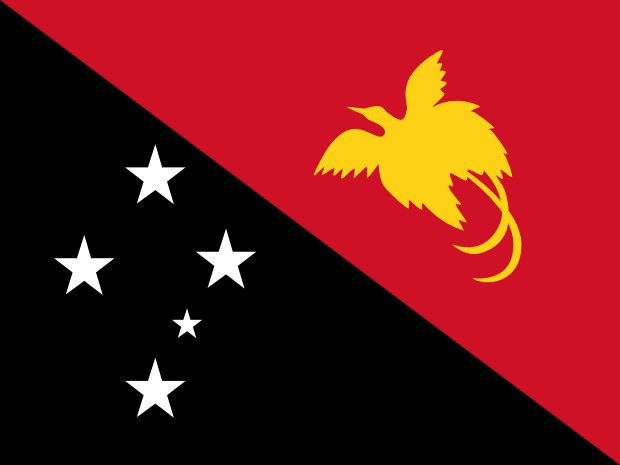
Flag is available in resolutions
| Icon 88x66 |  |
| Icon 32x24 |  |
Papua New Guinea
Papua New Guinea: A Land of Unrivaled Diversity
Papua New Guinea (PNG), a nation occupying the eastern half of the island of New Guinea and numerous smaller islands, stands as a testament to the raw, untamed beauty and profound cultural richness of the planet. It is a land where ancient traditions intertwine with the modern world, where dense rainforests conceal vibrant tribal communities, and where dramatic mountain ranges give way to pristine coastlines. The sheer diversity of PNG, in terms of its geography, people, and languages, is staggering, making it one of the most captivating and complex countries on Earth.
The geography of Papua New Guinea is as dramatic as it is varied. The island of New Guinea itself is bisected by the Owen Stanley Range, a formidable spine of mountains that reaches elevations of over 4,500 meters. These rugged highlands are characterized by deep valleys, steep slopes, and a climate that can shift from tropical heat in the lowlands to cool, misty conditions at higher altitudes. This mountainous terrain has historically served as a natural barrier, fostering the development of distinct cultural groups, each with its own unique customs, languages, and ways of life. To the north, the Sepik River basin is a vast expanse of lowland rainforest, crisscrossed by winding waterways that are vital for transportation and sustenance for the communities that live along its banks. The southern lowlands are characterized by extensive swamps and floodplains, particularly around the Fly River delta. Beyond the main island, PNG encompasses a multitude of islands, including New Britain, New Ireland, Bougainville, and the Admiralty Islands. These islands boast a diverse range of landscapes, from volcanic peaks and active volcanoes to coral reefs and sandy beaches, each contributing to the nation’s extraordinary biodiversity. The country’s coastline is extensive, stretching for thousands of kilometers, and is dotted with numerous bays, inlets, and offshore islands, many of which remain largely unexplored and untouched by modern development.
The population of Papua New Guinea is as remarkably diverse as its geography. It is home to an estimated 8.5 million people, representing over 800 distinct tribal groups, each with its own unique language, cultural practices, and social structures. This linguistic diversity is unparalleled globally, with over 840 living languages spoken within the country, a testament to centuries of isolation and the development of independent cultural trajectories. While Tok Pisin and Hiri Motu serve as official lingua francas, the vast majority of everyday communication occurs in indigenous languages. The people of PNG are renowned for their rich cultural heritage, which is expressed through elaborate ceremonies, intricate art forms, and deeply ingrained social customs. Traditional practices, such as elaborate face painting, ceremonial dances, and the construction of unique housing, are still very much alive, particularly in the more remote areas. The social organization often revolves around kinship groups, with strong emphasis placed on community, respect for elders, and the sharing of resources. While many Papua New Guineans live in rural villages, there is a growing urban population, with Port Moresby, the capital, being the largest city. The transition from traditional village life to urban living presents a unique set of challenges and opportunities for the country’s diverse population.
The history of Papua New Guinea is a complex tapestry woven from indigenous traditions, colonial encounters, and the pursuit of nationhood. For tens of thousands of years, the island of New Guinea was inhabited by indigenous peoples who developed sophisticated societies and distinct cultural practices in relative isolation. Archaeological evidence suggests early human settlement dating back at least 40,000 years. The first recorded European contact was in the 16th century, but significant European exploration and colonization did not begin until the late 19th century. The island was divided between the British (later Australian) and German colonial administrations. The southern part of the island became British New Guinea, later administered by Australia as the Territory of Papua, while the northeastern part became German New Guinea. Following World War I, Australia assumed control of German New Guinea, and after World War II, the two territories were combined under Australian administration as the Territory of Papua and New Guinea. During World War II, New Guinea became a major theatre of conflict, with fierce battles fought between Allied and Japanese forces, particularly in the Kokoda Track campaign, a pivotal moment in Australian military history. In 1975, Papua New Guinea gained full independence from Australia, becoming a sovereign nation. The post-independence era has been marked by challenges in nation-building, including managing vast geographical distances, diverse populations, and economic development. The country has also grappled with issues such as secessionist movements, particularly in Bougainville, and the ongoing need to balance traditional customs with modern governance.
The economy of Papua New Guinea is characterized by its reliance on natural resources. Mining, particularly gold, copper, and nickel, is a significant contributor to the national GDP. The country also has substantial reserves of oil and natural gas, which have become increasingly important export commodities. Agriculture remains a vital sector, employing a large portion of the population. Key cash crops include coffee, cocoa, palm oil, and copra, which are primarily grown by smallholder farmers. Subsistence farming is also widespread, providing food security for many rural communities. Forestry is another important industry, though it is subject to concerns about sustainable management. The fishing industry, both commercial and artisanal, plays a crucial role in the coastal economy. Tourism, while still in its nascent stages, holds considerable potential, given the country’s unique natural and cultural attractions. However, the development of these sectors is often hampered by challenges such as limited infrastructure, particularly in remote areas, political instability, and the need for greater investment in education and human capital. The informal economy also plays a significant role, with many people engaging in small-scale trade and services to supplement their income.
Papua New Guinea offers a plethora of tourist attractions for the adventurous traveler seeking an experience far removed from the ordinary. The Kokoda Track is perhaps the most famous destination, a historic trekking route through rugged rainforest that commemorates the World War II campaign. For those interested in cultural immersion, visiting the Sepik River region offers a glimpse into the lives of traditional communities, renowned for their elaborate spirit houses and intricate wood carvings. The Highlands region, with its dramatic landscapes and vibrant tribal cultures, provides opportunities to witness traditional ceremonies and interact with local populations. Birdwatching enthusiasts will be enthralled by the sheer diversity of avian life, including the iconic Birds of Paradise, found in the country’s pristine rainforests. The coastal areas and islands offer pristine beaches, world-class diving and snorkeling opportunities among vibrant coral reefs, and the chance to explore shipwrecks from World War II. Places like Rabaul on New Britain, with its volcanic landscapes and historical significance, and the islands of New Ireland and Bougainville offer unique cultural and natural experiences. The capital city, Port Moresby, while primarily a commercial hub, also hosts the National Museum and Art Gallery, which provides a valuable insight into the country’s rich cultural heritage. For those seeking the truly remote and untouched, venturing into the interior rainforests or to the smaller, less-visited islands can offer an unparalleled sense of discovery.
In conclusion, Papua New Guinea is a land of extraordinary contrasts and unparalleled natural and cultural wealth. Its dramatic geography, from soaring mountains to dense rainforests and tropical islands, has shaped the development of its incredibly diverse population and their unique traditions. While the country faces ongoing challenges in its development, the resilience and richness of its people, coupled with the breathtaking beauty of its landscapes, make Papua New Guinea a destination of profound significance and enduring allure. It is a place that continues to captivate the imagination and offers a glimpse into a world where nature and culture remain inextricably linked.
Information about Papua New Guinea
The information comes from the publication CIA The World Factbook.
Automated text translation, excuse errors, please!
Country Papua New Guinea is situated in a location / continent East Asia. Papua New Guinea has an area of 462 840 km2 and 6 310 129 residents. The highest point has a height 4 509 above sea level. and it is called Mount Wilhelm. The lowest point is located at the level of 0 above sea level and it is named Pacific Ocean. System of government is Republic, Commonwealth member country and the date of independence 16th September 1975. The capital city is Port Moresby. Papua New Guinea has the international abbreviation PP.
Papua New Guinea - economy
Total gross domestic product (GDP) is 17 080 000 000 $. Total gross domestic product per capita in purchasing power parity is 2 600 $. GDP grows by 8.90 % a year. Inflation (consumer price index) is equal to 8.50 % a year. Papua New Guinea have 3 896 000 working-age population (from a total population 6 310 129 people). Unemployment is at 1.90 %. Papua New Guinea issued 3.10 % GDP to healt care and 1,10 % GDP to army. The public debt of the country is 22.10 % GDP. The total amount of foreign debt is 5 296 000 000 USD.
Papua New Guinea - demography
As suggested above, Papua New Guinea has 6 310 129 people. Population growth is in the amount 1.94 % per year. Number of children born per 1000 population per year is 25.92.Every mother has average 3.39 children. The infant mortality rate is 42.05 and maternal mortality 230.00 deaths per 100,000 births. Average estimated life expectancy makes 66.46 years. Mortality is 6.56 people per 1000 population per year.
Papua New Guinea - transport and telecommunications
Papua New Guinea has 9 349 km of roads and 562 airports. The total length of waterways (navigable rivers, canals, etc.) is 11 000 km. There is registered 31 ships.
Number of active mobile phones (sim card) in the country Papua New Guinea is 2 400 000. Number of active fixed telephone lines is 130 000. Papua New Guinea has 125 000 internet users, who have the available 4 847 Internet connections. Papua New Guinea has been assigned a domain first Choose range .pg.
Papua New Guinea - energetics
Papua New Guinea consumes a year 3 098 000 000 kWh of electricity. Annual electricity production is 3 331 000 000 kWh in power plants with a total installed electrical capacity 700 000 kW. Papua New Guinea exports 0 kWh and imports 0 kWh of electricity per year Energy mix of power generation is as follows: fossil fuels: 61.1 %, nuclear energy: 0 %, renewable: 8.0 %, hydropower: 30.9 %. The country Papua New Guinea is harvested annually 30 000 barrels of oil.
Keywords: Flags of countries, Flag of Papua New Guinea, telecommunications, information, national flags, Papua New Guinea, all flags, list of countries, energetics, economy, flags of countries in the world, transport, flag states, flag, list of flags, world countries, demography, politic.