Korea, North
Flag of Korea, North
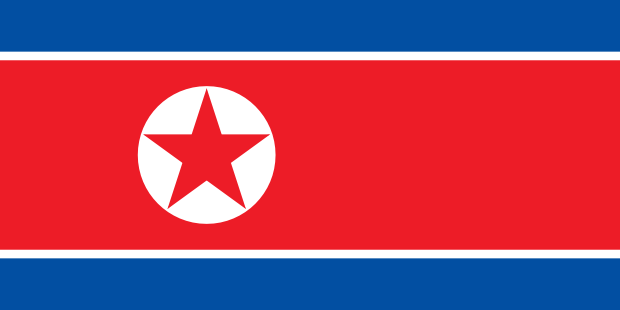
Flag is available in resolutions
| Icon 88x44 |  |
| Icon 32x16 |  |
Korea, North
Korea, North: A Land of Enigma and Resilience
North Korea, officially the Democratic Peoples Republic of Korea (DPRK), is a nation shrouded in mystery and defined by its unique political and social landscape. Nestled in the northern half of the Korean Peninsula, it shares a heavily fortified border with South Korea to the south, a border that has remained one of the most militarized in the world since the Korean War. To its north, it is bordered by China and Russia, and to the east, it faces the Sea of Japan (often referred to as the East Sea in Korea). This geographical isolation, coupled with its stringent political system, has created a country that is largely inaccessible and unknown to the outside world, fostering an aura of enigma that persists to this day. Despite its reclusive nature, North Korea possesses a rich history, a distinct culture, and a complex socio-economic structure that warrants a deeper examination.
The population of North Korea is estimated to be around 26 million people, with the vast majority residing in urban areas. The capital city, Pyongyang, is a sprawling metropolis and the political, economic, and cultural heart of the nation. Life in North Korea is characterized by a profound sense of collective identity and a deep-seated loyalty to the ruling Workers Party of Korea and its leaders, most notably the Kim dynasty. The state exerts a pervasive influence over all aspects of daily life, from employment and education to media consumption and personal relationships. Citizens are expected to adhere to a strict social code and to prioritize the needs of the state above individual desires. This emphasis on collectivism is deeply ingrained in the North Korean psyche, stemming from decades of ideological indoctrination and the constant reinforcement of national unity in the face of perceived external threats. While official narratives paint a picture of contented citizens dedicated to building a socialist utopia, the reality for many likely involves significant hardship and limited personal freedoms. The state’s control over information means that reliable, independent accounts of daily life are scarce, making it difficult to fully comprehend the lived experiences of the North Korean people.
North Korea’s history is a tumultuous journey marked by periods of foreign occupation, division, and conflict. The Korean Peninsula was unified for centuries under various dynasties, but its strategic location made it a frequent target for foreign powers. In the early 20th century, Korea fell under Japanese colonial rule, a period of intense exploitation and cultural suppression that lasted for 35 years. Following Japans defeat in World War II, the peninsula was divided into two zones of occupation by the victorious Allied powers: the Soviet Union in the north and the United States in the south. This division, intended to be temporary, solidified into two distinct states with opposing ideologies. In 1948, the Democratic Peoples Republic of Korea was established in the north, led by Kim Il-sung, a former anti-Japanese guerrilla fighter. Three years later, the Korean War erupted, a devastating conflict that claimed millions of lives and left the peninsula in ruins. The war ended in an armistice, not a peace treaty, meaning the two Koreas remain technically at war to this day. The legacy of the Korean War continues to shape North Korea’s foreign policy and its perception of the outside world, fostering a deep-seated sense of vulnerability and a commitment to self-reliance, known as „Juche“. The Kim dynasty has maintained absolute control since the war, with Kim Il-sung succeeded by his son Kim Jong-il, and subsequently by his grandson Kim Jong-un. This hereditary succession has cemented the Kim familys grip on power and has become a defining characteristic of North Korean governance.
The geography of North Korea is characterized by its mountainous terrain, which covers approximately 80% of the country. The Taebaek Mountains form the backbone of the peninsula, extending northward into North Korea. These rugged landscapes have historically played a significant role in the nation’s defense, providing natural barriers against invaders. The eastern coast is characterized by steep cliffs and narrow plains, while the western coast features broader plains and a more indented shoreline with numerous islands. Major rivers, such as the Yalu and Tumen rivers, form natural borders with China. The climate is continental, with cold, dry winters and hot, humid summers. The mountainous regions are largely forested, providing valuable timber resources, while the western plains are more suitable for agriculture, though arable land is limited. The countrys natural resources include coal, iron ore, and various other minerals, which have historically formed the basis of its industrial sector. However, the harsh climate and the challenging terrain often make resource extraction and transportation difficult.
North Koreas economy is centrally planned and heavily reliant on state control. Historically, the country prioritized heavy industry and military development, leading to significant investment in these sectors. Following the collapse of the Soviet Union and the subsequent economic hardship in the 1990s, the North Korean economy has struggled significantly. Despite attempts at reform and limited engagement with the global economy, it remains largely isolated and underdeveloped. Key industries include mining, manufacturing, and agriculture, though agricultural output is often insufficient to feed the population, leading to recurrent food shortages. The country has also made significant strides in its military capabilities, particularly in the development of nuclear weapons and ballistic missiles, which have drawn international condemnation and severe sanctions. The state allocates a disproportionately large share of its resources to its military, often at the expense of civilian needs. The informal economy, or „jangmadang“, has grown in recent years as a vital source of goods and income for many citizens, providing a crucial lifeline in a system that often fails to meet basic needs.
Despite its isolation, North Korea possesses several tourist attractions, though access and visitor experiences are highly controlled. Pyongyang itself is a major draw, with its grand monumental architecture, such as the Juche Tower and the Arch of Triumph, reflecting the state’s ideology and historical narratives. The city also boasts impressive public spaces, including Kim Il-sung Square, and the Pyongyang Metro, known for its ornate stations. Outside the capital, visitors can explore the scenic beauty of Mount Kumgang, a sacred mountain renowned for its picturesque landscapes and Buddhist temples. The ancient capital of Kaesong offers a glimpse into Korea’s historical past, with its well-preserved traditional houses and the Koryo Museum. The DMZ (Demilitarized Zone) separating North and South Korea is a stark reminder of the ongoing division and a site of significant historical interest. However, tourism in North Korea is strictly managed, with all visitors accompanied by state-appointed guides and itineraries meticulously planned. Independent travel is not permitted, and access to many areas is restricted. The intent of promoting tourism is often seen as a means for the regime to generate foreign currency and to showcase a carefully curated image of the country to the outside world.
In conclusion, North Korea remains a land of stark contrasts and enduring mysteries. Its history of struggle and resilience, its unique societal structure, and its complex geopolitical position continue to fascinate and perplex the international community. While the outside world largely views North Korea through a lens of political tension and economic hardship, understanding its people, its history, and its aspirations requires looking beyond the headlines and acknowledging the profound human experiences within its borders. The future of North Korea, its relationship with the world, and the well-being of its citizens remain subjects of intense speculation and concern, making it a country that continues to hold a significant, albeit often unsettling, place on the global stage.
Information about Korea, North
The information comes from the publication CIA The World Factbook.
Automated text translation, excuse errors, please!
Country Korea, North is situated in a location / continent East Asia. Korea, North has an area of 120 538 km2 and 24 589 122 residents. The highest point has a height 2 744 above sea level. and it is called Paektu-san. The lowest point is located at the level of 0 above sea level and it is named Sea of Japan. System of government is Communist state and the date of independence 15th August 1945. The capital city is Pyongyang. Korea, North has the international abbreviation KN.
Korea, North - economy
Total gross domestic product (GDP) is 40 000 000 000 $. Total gross domestic product per capita in purchasing power parity is 1 800 $. GDP grows by 4.00 % a year. Korea, North have 12 200 000 working-age population (from a total population 24 589 122 people). Korea, North issued 2.00 % GDP to healt care .The total amount of foreign debt is 12 500 000 000 USD.
Korea, North - demography
As suggested above, Korea, North has 24 589 122 people. Population growth is in the amount 0.54 % per year. Number of children born per 1000 population per year is 14.51.Every mother has average 2.01 children. The infant mortality rate is 26.21 and maternal mortality 81.00 deaths per 100,000 births. Average estimated life expectancy makes 69.20 years. Mortality is 9.12 people per 1000 population per year.
Korea, North - transport and telecommunications
Korea, North has 25 554 km of roads, 5 242 km of railway lines and 81 airports. The total length of waterways (navigable rivers, canals, etc.) is 2 250 km. There is registered 158 ships.
Number of active mobile phones (sim card) in the country Korea, North is 1 000 000. Number of active fixed telephone lines is 1 180 000. Korea, North have 7 Internet connections. Korea, North has been assigned a domain first Choose range .kp.
Korea, North - energetics
Korea, North consumes a year 17 120 000 000 kWh of electricity. Annual electricity production is 20 450 000 000 kWh in power plants with a total installed electrical capacity 9 500 000 kW. Korea, North exports 0 kWh and imports 0 kWh of electricity per year Energy mix of power generation is as follows: fossil fuels: 47.4 %, nuclear energy: 0 %, renewable: 0.0 %, hydropower: 52.6 %.
Keywords: flags of countries in the world, list of flags, information, all flags, energetics, Flag of Korea, North, Flags of countries, transport, flag states, demography, economy, list of countries, world countries, national flags, flag, telecommunications, Korea, North, politic.