Vietnam
Flag of Vietnam
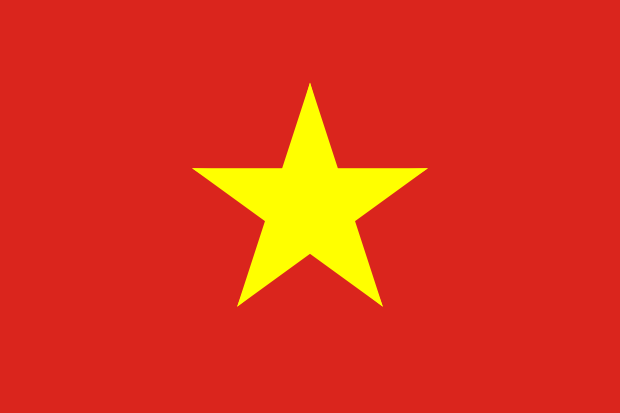
Flag is available in resolutions
| Icon 88x59 |  |
| Icon 32x21 |  |
Vietnam
Vietnam: A Land of Enduring Spirit and Natural Splendor
Vietnam, a S-shaped jewel gracing the eastern edge of the Indochinese Peninsula in Southeast Asia, is a nation that resonates with a profound history, captivating landscapes, and a resilient spirit. Its long, narrow coastline, kissed by the South China Sea, stretches over 3,000 kilometers, creating a diverse tapestry of environments. From the lush, verdant deltas of the north and south to the dramatic karst formations of the central coast and the rugged mountains that form its western border, Vietnam offers a breathtaking panorama of natural beauty. This geographical diversity has not only shaped its culture but also its economy and the very character of its people. With a population exceeding 98 million, Vietnam is a vibrant and dynamic country, a testament to its ability to overcome centuries of conflict and hardship to emerge as a thriving modern nation.
The history of Vietnam is a saga of resilience, independence, and a relentless struggle against foreign domination. For over a thousand years, Vietnam was under Chinese rule, a period that, while imposing its influence, also fostered a strong sense of Vietnamese identity and a desire for self-determination. This period, known as the First Chinese Domination, was followed by various dynasties that fought to maintain Vietnamese sovereignty. The arrival of French colonialists in the mid-19th century marked another significant chapter, leading to French Indochina. However, the seeds of independence were sown, culminating in the rise of Ho Chi Minh and the Viet Minh, who fought against both the Japanese occupation during World War II and the French colonialists. The subsequent First Indochina War ended with the Geneva Accords of 1954, dividing the country into North and South Vietnam. The ensuing Vietnam War, a protracted and devastating conflict that involved the United States, deeply scarred the nation but ultimately led to reunification under communist rule in 1975. Despite the immense human cost and the challenges of rebuilding, Vietnam has demonstrated remarkable fortitude, transforming itself from a war-torn nation into an economically dynamic and globally engaged country.
Geographically, Vietnam presents a striking contrast between its north and south. Northern Vietnam is characterized by the Red River Delta, a fertile agricultural heartland, and the mountainous regions that border China and Laos. The iconic Ha Long Bay, a UNESCO World Heritage site, with its thousands of limestone karsts and islets rising dramatically from the emerald waters, is a prime example of the north’s stunning natural beauty. Central Vietnam boasts a more varied landscape, including the Annamite Range and beautiful coastal plains. The city of Hue, the former imperial capital, offers a glimpse into Vietnam’s rich royal past, while the charming ancient town of Hoi An, a UNESCO World Heritage site, enchants visitors with its preserved architecture and vibrant silk trade history. Southern Vietnam is dominated by the Mekong Delta, often referred to as the “rice bowl” of Vietnam, a sprawling labyrinth of rivers, canals, and fertile land that supports a rich biodiversity and a significant agricultural output. The bustling metropolis of Ho Chi Minh City, formerly Saigon, stands as a testament to Vietnams rapid economic development, a city where historical sites stand alongside modern skyscrapers.
The Vietnamese economy has undergone a remarkable transformation, shifting from a centrally planned system to a socialist-oriented market economy. This economic liberalization, initiated in the late 1980s through the “Doi Moi” (Renovation) policy, has spurred significant growth and development. Key sectors driving the economy include manufacturing, agriculture, and tourism. Vietnam is a major global producer of rice, coffee, and seafood, contributing significantly to its export earnings. The manufacturing sector has also seen substantial growth, with a focus on textiles, electronics, and footwear, attracting foreign investment and creating numerous employment opportunities. The government’s commitment to improving infrastructure, investing in education, and fostering a favorable business environment has been instrumental in this economic resurgence. Despite the progress, challenges remain, including income inequality, environmental concerns, and the need for further structural reforms to ensure sustainable and inclusive growth.
Vietnams rich cultural heritage is a fascinating blend of indigenous traditions and influences from centuries of interaction with neighboring civilizations, particularly China, and later, the French. The concept of family and community is central to Vietnamese society, with a strong emphasis on respect for elders and ancestors. Traditional festivals, such as Tet Nguyen Dan (Lunar New Year), are vibrant celebrations that highlight the enduring cultural values and familial bonds. The country boasts a rich artistic tradition, evident in its intricate lacquerware, silk paintings, and traditional music and dance forms. Vietnamese cuisine, renowned worldwide for its fresh ingredients, delicate flavors, and healthy preparation methods, is an integral part of the cultural experience. Dishes like pho, banh mi, and spring rolls are not just meals but reflections of the countrys agricultural bounty and culinary ingenuity. The influence of Buddhism is also deeply ingrained in Vietnamese society, with numerous temples and pagodas dotting the landscape, serving as centers of spiritual life and architectural beauty.
For travelers, Vietnam offers an unparalleled journey through history, culture, and breathtaking landscapes. The capital city, Hanoi, is a captivating blend of old and new, with its bustling Old Quarter, serene Hoan Kiem Lake, and grand colonial architecture. A visit to the Ho Chi Minh Mausoleum offers a poignant encounter with the nation’s revered leader. The aforementioned Ha Long Bay is an absolute must-see, with its ethereal beauty best appreciated on a traditional junk boat cruise. Further south, the imperial city of Hue transports visitors back in time with its magnificent Citadel and royal tombs. Hoi An, with its lantern-lit streets and tailor shops, exudes an undeniable charm. The vibrant energy of Ho Chi Minh City, with its historical landmarks like the War Remnants Museum and the Cu Chi Tunnels, provides a stark reminder of the country’s turbulent past. Beyond these iconic destinations, Vietnam offers diverse experiences, from trekking in the northern mountains to exploring the pristine beaches of Phu Quoc Island. The warmth and hospitality of the Vietnamese people, coupled with the affordability of travel, make Vietnam an increasingly popular destination for adventurers, culture enthusiasts, and those seeking an authentic Southeast Asian experience. The country’s commitment to preserving its heritage while embracing modernity ensures that Vietnam remains a captivating and unforgettable destination for years to come.
Information about Vietnam
The information comes from the publication CIA The World Factbook.
Automated text translation, excuse errors, please!
Country Vietnam is situated in a location / continent East Asia. Vietnam has an area of 331 210 km2 and 91 519 289 residents. The highest point has a height 3 144 above sea level. and it is called Fan Si Pan. The lowest point is located at the level of 0 above sea level and it is named South China Sea. System of government is Communist state and the date of independence Second September 1945. The capital city is Hanoi (Ha Noi). Vietnam has the international abbreviation VM.
Vietnam - economy
Total gross domestic product (GDP) is 303 800 000 000 $. Total gross domestic product per capita in purchasing power parity is 3 400 $. GDP grows by 5.90 % a year. Inflation (consumer price index) is equal to 18.70 % a year. Vietnam have 46 480 000 working-age population (from a total population 91 519 289 people). Unemployment is at 2.30 %. Vietnam issued 7.20 % GDP to healt care and 2,50 % GDP to army. The public debt of the country is 57.30 % GDP. The total amount of foreign debt is 39 730 000 000 USD.
Vietnam - demography
As suggested above, Vietnam has 91 519 289 people. Population growth is in the amount 1.05 % per year. Number of children born per 1000 population per year is 16.83.Every mother has average 1.89 children. The infant mortality rate is 20.24 and maternal mortality 59.00 deaths per 100,000 births. Average estimated life expectancy makes 72.41 years. Mortality is 5.95 people per 1000 population per year.
Vietnam - transport and telecommunications
Vietnam has 180 549 km of roads, 2 632 km of railway lines and 44 airports. The total length of waterways (navigable rivers, canals, etc.) is 17 702 km. There is registered 579 ships.
Number of active mobile phones (sim card) in the country Vietnam is 154 000 000. Number of active fixed telephone lines is 16 400 000. Vietnam has 23 382 000 internet users, who have the available 175 612 Internet connections. Vietnam has been assigned a domain first Choose range .vn.
Vietnam - energetics
Vietnam consumes a year 101 000 000 000 kWh of electricity. Annual electricity production is 106 000 000 000 kWh in power plants with a total installed electrical capacity 15 190 000 kW. Vietnam exports 373 000 000 kWh and imports 281 000 000 kWh of electricity per year Energy mix of power generation is as follows: fossil fuels: 63.7 %, nuclear energy: 0 %, renewable: 0.1 %, hydropower: 36.2 %. The country Vietnam is harvested annually 318 100 barrels of oil.
Keywords: flags of countries in the world, all flags, Flag of Vietnam, demography, Flags of countries, transport, flag states, Vietnam, telecommunications, world countries, flag, energetics, list of countries, list of flags, information, economy, national flags, politic.