Mongolia
Flag of Mongolia
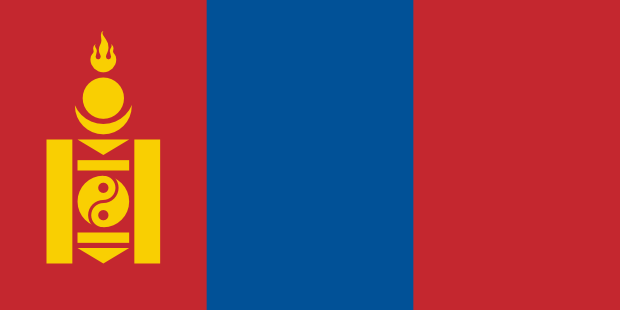
Flag is available in resolutions
| Icon 88x44 |  |
| Icon 32x16 |  |
Mongolia
Mongolia: A Land of Nomads, Empires, and Vast Landscapes
Mongolia, a vast and sparsely populated nation nestled in the heart of Asia, is a land steeped in history, defined by its dramatic landscapes, and shaped by the enduring spirit of its nomadic people. It is a country that conjures images of boundless steppes, towering mountains, ancient empires, and the echoes of horse hooves across the wind-swept plains. With a territory spanning over 1.5 million square kilometers, Mongolia is the 18th-largest country in the world by area, yet it ranks among the least densely populated, a testament to its immense geographical scale and its relatively small population. This unique juxtaposition of vastness and emptiness has profoundly influenced its culture, economy, and the very identity of its citizens. The Mongolian people, historically known for their nomadic pastoralism, have a rich cultural heritage that is deeply intertwined with the natural environment. Their resilience, adaptability, and strong sense of community have allowed them to thrive in one of the worlds most challenging yet breathtaking environments.
The population of Mongolia is remarkably homogeneous, with the Khalkha Mongols forming the dominant ethnic group, comprising around 85% of the total population. Other significant ethnic groups include Kazakhs, Dorvod Mongols, and Buryats, each contributing to the diverse tapestry of Mongolian society. The official language is Mongolian, written in the traditional Cyrillic script, though a growing number of younger Mongolians are also learning English, facilitated by increasing global interaction and the burgeoning tourism sector. The majority of Mongolians adhere to Tibetan Buddhism, a spiritual tradition that has deeply influenced their art, philosophy, and daily life. Shamanism also retains a presence, particularly in more remote areas, reflecting the ancient animistic beliefs that predate Buddhisms arrival. The population is predominantly young, with a significant proportion under the age of 25, indicating a dynamic and evolving society. Ulaanbaatar, the capital city, is the nations bustling hub, home to nearly half of the countrys entire population. This rapid urbanization presents both opportunities and challenges, as Mongolia navigates the complexities of modernization while striving to preserve its unique cultural heritage.
Mongolias history is one of epic proportions, marked by the rise and fall of mighty empires and the enduring legacy of its nomadic warriors. The most prominent figure in this history is undoubtedly Genghis Khan, born Temüjin, who united the disparate Mongol tribes in the early 13th century and forged the vast Mongol Empire, the largest contiguous empire in history. His military genius, strategic brilliance, and organizational skills allowed the Mongols to conquer vast swathes of Asia and Eastern Europe, spreading their influence and facilitating trade along the Silk Road. The Mongol Empire, though eventually fracturing into successor states, left an indelible mark on world history, connecting East and West and ushering in an era of unprecedented cultural exchange. Following the decline of the Mongol Empire, Mongolia experienced periods of fragmentation and was eventually brought under the influence of the Qing Dynasty of China. The early 20th century saw a struggle for independence, culminating in the declaration of independence in 1911. However, this was a turbulent period, with Mongolia becoming a Soviet satellite state in the 1920s, a status it maintained for over seven decades. During this time, the country underwent significant social, economic, and political reforms under communist rule, including collectivization of agriculture and the suppression of religious institutions. The late 20th century witnessed the peaceful democratic revolution of 1990, marking Mongolias transition to a multi-party democracy and a market economy. This period of transition has been characterized by both progress and challenges as the nation strives to build a prosperous future while honoring its rich and complex past.
The geography of Mongolia is as dramatic and varied as its history. The country is predominantly landlocked, bordered by Russia to the north and China to the south. Its landscape is characterized by vast, rolling steppes, arid deserts, and imposing mountain ranges. The Gobi Desert, in the south, is perhaps its most iconic geographical feature. This vast expanse of sand dunes, rocky plains, and oases is home to unique flora and fauna, including Bactrian camels and desert gazelles. To the north, the Altai Mountains dominate the western horizon, their snow-capped peaks forming a dramatic backdrop and serving as a natural barrier. The central and eastern regions are characterized by the vast Mongolian steppe, a seemingly endless sea of grass that has sustained nomadic life for centuries. This landscape is punctuated by numerous rivers, lakes, and seasonal watercourses, vital for both human and animal life. The climate is extreme, with long, harsh winters characterized by freezing temperatures and heavy snowfall, and short, hot summers. This continental climate dictates the rhythm of life for the nomadic herders, who move their livestock in search of pasture and water. The countrys mineral wealth is also significant, with substantial deposits of coal, copper, gold, and uranium contributing to its economic potential, though also presenting environmental challenges.
The Mongolian economy has undergone a significant transformation since the collapse of communism. Historically, it was heavily reliant on agriculture, primarily nomadic pastoralism. Today, while livestock remains a crucial sector, mining has emerged as the dominant force driving economic growth. Mongolia is rich in mineral resources, and the extraction of coal, copper, gold, and other valuable minerals accounts for a substantial portion of its export revenue and GDP. This reliance on the mining sector, however, exposes the economy to global commodity price fluctuations and raises concerns about environmental sustainability and equitable distribution of wealth. The government is actively seeking to diversify the economy, with tourism showing significant promise. The countrys unique natural beauty, rich cultural heritage, and adventurous spirit attract increasing numbers of international visitors. Agriculture, though less dominant than mining, remains vital for the livelihoods of a significant portion of the population, with livestock such as sheep, goats, cattle, and horses playing a central role in the nomadic lifestyle. The government is investing in infrastructure development, education, and healthcare to support sustainable growth and improve the quality of life for its citizens.
Mongolia offers a wealth of tourist attractions, catering to those seeking adventure, cultural immersion, and a connection with nature. The Gobi Desert is a must-visit for its stark beauty and unique wildlife. Visitors can explore dramatic sand dunes like those at Khongoryn Els, known as the Singing Sands, and witness the fossil-rich Flaming Cliffs, where paleontological discoveries have unearthed dinosaur eggs and skeletons. The ancient capital city of Karakorum, a UNESCO World Heritage site, stands as a testament to the grandeur of the Mongol Empire, with its ruins and the Erdene Zuu Monastery, one of the earliest Buddhist monasteries in Mongolia. The Terelj National Park, a short drive from Ulaanbaatar, offers stunning granite rock formations, verdant valleys, and opportunities for hiking, horseback riding, and experiencing nomadic life firsthand. The Khövsgöl Lake, often called the Blue Pearl of Mongolia, is the countrys largest freshwater lake, surrounded by pristine forests and mountains, and is a popular destination for its natural beauty and recreational activities. For those interested in wildlife, the Altai Tavan Bogd National Park in the west offers opportunities to spot ibex, argali sheep, and golden eagles, and to witness the traditional eagle hunting practices of the Kazakh people. Experiencing a stay in a traditional ger, a portable felt dwelling, is an essential part of any Mongolian adventure, offering a glimpse into the nomadic way of life. The vastness of the landscape, the warmth of the people, and the echoes of history make Mongolia an unforgettable destination for any traveler.
Information about Mongolia
The information comes from the publication CIA The World Factbook.
Automated text translation, excuse errors, please!
Country Mongolia is situated in a location / continent East Asia. Mongolia has an area of 1 564 116 km2 and 3 179 997 residents. The highest point has a height 4 374 above sea level. and it is called Nayramadlin Orgil (Huyten Orgil). The lowest point is located at the level of 518 above sea level and it is named Hoh Nuur. System of government is republic and the date of independence July 11, 1921. The capital city is Ulaanbaatar. Mongolia has the international abbreviation MG.
Mongolia - economy
Total gross domestic product (GDP) is 13 430 000 000 $. Total gross domestic product per capita in purchasing power parity is 4 800 $. GDP grows by 17.30 % a year. Inflation (consumer price index) is equal to 9.50 % a year. Mongolia have 1 147 000 working-age population (from a total population 3 179 997 people). Unemployment is at 9.90 %. Mongolia issued 9.30 % GDP to healt care and 1,40 % GDP to army. The total amount of foreign debt is 1 900 000 000 USD.
Mongolia - demography
As suggested above, Mongolia has 3 179 997 people. Population growth is in the amount 1.47 % per year. Number of children born per 1000 population per year is 20.70.Every mother has average 2.19 children. The infant mortality rate is 36.00 and maternal mortality 63.00 deaths per 100,000 births. Average estimated life expectancy makes 68.63 years. Mortality is 6.01 people per 1000 population per year.
Mongolia - transport and telecommunications
Mongolia has 49 249 km of roads, 1 908 km of railway lines and 44 airports. The total length of waterways (navigable rivers, canals, etc.) is 580 km. There is registered 57 ships.
Number of active mobile phones (sim card) in the country Mongolia is 2 942 000. Number of active fixed telephone lines is 187 600. Mongolia has 330 000 internet users, who have the available 20 865 Internet connections. Mongolia has been assigned a domain first Choose range .mn.
Mongolia - energetics
Mongolia consumes a year 3 375 000 000 kWh of electricity. Annual electricity production is 4 056 000 000 kWh in power plants with a total installed electrical capacity 833 200 kW. Mongolia exports 22 200 000 kWh and imports 262 900 000 kWh of electricity per year Energy mix of power generation is as follows: fossil fuels: 99.9 %, nuclear energy: 0 %, renewable: 0.1 %, hydropower: 0.0 %. The country Mongolia is harvested annually 6 983 barrels of oil.
Keywords: national flags, flags of countries in the world, energetics, all flags, telecommunications, world countries, transport, Mongolia, flag states, information, Flags of countries, demography, list of countries, Flag of Mongolia, flag, economy, list of flags, politic.