Cambodia
Flag of Cambodia
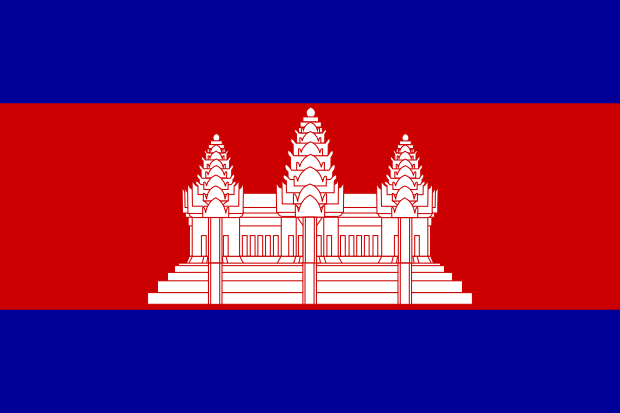
Flag is available in resolutions
| Icon 88x59 |  |
| Icon 32x21 |  |
Cambodia
Cambodia: A Land of Resilience and Ancient Wonders
Cambodia, officially known as the Kingdom of Cambodia, is a captivating Southeast Asian nation nestled in the heart of the Indochinese Peninsula. Bordered by Thailand to the west and northwest, Laos to the northeast, Vietnam to the east and southeast, and the Gulf of Thailand to the southwest, Cambodia presents a rich tapestry of history, culture, and breathtaking natural beauty. Its identity is inextricably linked to the mighty Mekong River, which flows through the country, and the iconic Angkor Wat, a testament to a glorious past. The Khmer people, the dominant ethnic group, have endured centuries of change, from the grandeur of the Khmer Empire to the devastating Khmer Rouge regime, and have emerged with an indomitable spirit and a deep sense of national pride. Understanding Cambodia requires delving into its complex past, appreciating its vibrant present, and anticipating its promising future.
The population of Cambodia is predominantly Khmer, accounting for over 90% of the total. This ethnic homogeneity contributes to a strong sense of cultural unity. The official language is Khmer, spoken by the vast majority of the population, and it is written in its own distinctive script, which is both elegant and complex. While Khmer is the lingua franca, there are also smaller ethnic minorities, including Cham, Vietnamese, and Chinese communities, who have integrated into Cambodian society over centuries, bringing their own unique cultural influences. Buddhism, specifically Theravada Buddhism, is the state religion and plays a central role in the lives of most Cambodians. Temples, or *wats*, are not merely places of worship but also community hubs and centers of education. The spiritual devotion is evident in the daily lives of the people, from monks collecting alms at dawn to families participating in religious festivals. The population is relatively young, with a significant proportion under the age of 25, a demographic characteristic that presents both opportunities and challenges for the nations development. Life expectancy has been steadily increasing, reflecting improvements in healthcare and living standards, though disparities still exist between urban and rural areas.
Cambodia’s history is a saga of remarkable highs and devastating lows. The golden age of Cambodian civilization was undoubtedly the Khmer Empire, which flourished from the 9th to the 15th centuries. This era witnessed the construction of magnificent architectural marvels, most notably the sprawling temple complex of Angkor, including the awe-inspiring Angkor Wat, the largest religious monument in the world. The empire’s influence extended far beyond its borders, shaping the culture and religions of much of Southeast Asia. However, internal strife and external pressures led to the empire’s decline. The subsequent centuries saw Cambodia caught in the geopolitical struggles of its more powerful neighbors, Thailand and Vietnam, often becoming a pawn in their conflicts. In the 19th century, Cambodia sought protection from France, becoming a French protectorate in 1863. This period of French colonial rule brought some modernization but also suppressed Cambodian sovereignty. Independence was finally achieved in 1953 under King Norodom Sihanouk. The following decades were marked by political instability, culminating in the horrific rise of the Khmer Rouge regime in 1975. Led by Pol Pot, the Khmer Rouge imposed a radical agrarian communist ideology, leading to the Cambodian genocide, a period of systematic killing and starvation that resulted in the deaths of an estimated 1.7 to 2 million people – nearly a quarter of the country’s population. The regime’s brutal policies aimed to create an agrarian utopia, but instead, they decimated the nations intellectuals, artists, and any perceived enemies. The fall of the Khmer Rouge in 1979, with Vietnamese intervention, marked the beginning of a long and arduous process of recovery and rebuilding. The country has since been striving to heal its wounds, establish democratic institutions, and foster economic growth, a journey that continues to this day.
Geographically, Cambodia is characterized by a low-lying, fertile central plain dominated by the Tonle Sap Lake and the Mekong River system. The Tonle Sap, Southeast Asia’s largest freshwater lake, is a vital ecological and economic resource. Its water levels fluctuate dramatically with the monsoon seasons, creating a unique ecosystem and supporting a rich biodiversity. During the wet season, the Tonle Sap’s flow reverses, inundating vast areas of surrounding land, which is crucial for rice cultivation and fish breeding. The Mekong River, a lifeline for the region, enters Cambodia from Laos and flows through the heart of the country before dividing into two branches, the Mekong and the Bassac, as it enters Vietnam. The landscape also includes mountainous regions in the southwest, along the border with Thailand, and in the northeast, forming part of the Annamite Range. The coastal areas in the southwest offer beautiful beaches and islands, attracting a growing number of tourists. Cambodias climate is tropical, with distinct wet and dry seasons. The wet season, from May to October, is characterized by heavy rainfall and high humidity, while the dry season, from November to April, is warm and less humid. This climate supports a diverse range of flora and fauna, though deforestation has impacted some habitats.
The Cambodian economy, while still developing, has shown resilience and steady growth in recent years. Historically, agriculture has been the backbone of the economy, with rice being the primary crop, supporting a large portion of the rural population. However, there has been a significant shift towards other sectors. The garment and footwear industry has become a major contributor to Cambodia’s exports, providing employment for hundreds of thousands of people, predominantly women. This industry, while crucial for economic development, faces challenges related to labor rights and working conditions. Tourism has also emerged as a vital economic driver, particularly with the allure of Angkor Wat and the country’s natural beauty. The government is actively investing in infrastructure, including roads, ports, and energy, to facilitate trade and attract foreign investment. Other sectors contributing to the economy include construction, manufacturing, and increasingly, services. However, Cambodia still faces challenges such as poverty, corruption, and the need for further diversification of its economy to reduce reliance on a few key industries. Efforts are being made to promote higher-value industries and to improve education and skills training to create a more competitive workforce.
Cambodia’s tourist attractions are a compelling blend of ancient history, natural beauty, and cultural experiences. The undisputed crown jewel is the Angkor Archaeological Park, a UNESCO World Heritage Site. The iconic Angkor Wat, with its intricate bas-reliefs and soaring towers, is a mesmerizing sight, especially at sunrise. Nearby, the enigmatic faces of Bayon Temple in Angkor Thom evoke a sense of mystery and wonder. The jungle-clad ruins of Ta Prohm, famously featured in the movie *Tomb Raider*, offer a glimpse into how nature can reclaim ancient structures. Beyond Angkor, the capital city of Phnom Penh offers a poignant journey through Cambodia’s recent history at the Tuol Sleng Genocide Museum (S-21 Prison) and the Killing Fields of Choeung Ek. The Royal Palace and the Silver Pagoda provide a glimpse into the countrys royal heritage and Buddhist traditions. For those seeking natural beauty, the southern coast offers pristine beaches and islands like Koh Rong and Koh Rong Samloem, with their white sands and turquoise waters. The Cardamom Mountains provide opportunities for ecotourism, trekking, and discovering diverse wildlife. The Mekong River itself offers scenic boat trips, allowing visitors to experience rural life along its banks and witness the unique floating villages. The vibrant street life, bustling markets, and delicious Khmer cuisine further enrich the travel experience, offering a taste of the genuine warmth and hospitality of the Cambodian people.
In conclusion, Cambodia is a nation that has weathered immense hardship and is now on a path of recovery and progress. Its rich history, exemplified by the grandeur of Angkor, stands in stark contrast to the horrors of the Khmer Rouge era. Yet, the resilience of its people, their deep-rooted Buddhist faith, and their welcoming spirit are undeniable. From the ancient temples that whisper tales of a glorious past to the bustling markets and tranquil landscapes, Cambodia offers a profoundly moving and unforgettable experience for any traveler. As the country continues to develop economically and socially, it remains a testament to the enduring strength of the human spirit and the captivating allure of a land steeped in history and culture.
Information about Cambodia
The information comes from the publication CIA The World Factbook.
Automated text translation, excuse errors, please!
Country Cambodia is situated in a location / continent East Asia. Cambodia has an area of 181 035 km2 and 14 952 665 residents. The highest point has a height 1 810 above sea level. and it is called Phnum Aoral. The lowest point is located at the level of 0 above sea level and it is named Gulf of Thailand. System of government is constitutional monarchy and the date of independence 9th November 1953. The capital city is Phnom Penh. Cambodia has the international abbreviation CB.
Cambodia - economy
Total gross domestic product (GDP) is 33 890 000 000 $. Total gross domestic product per capita in purchasing power parity is 2 200 $. GDP grows by 6.10 % a year. Inflation (consumer price index) is equal to 5.50 % a year. Cambodia have 8 800 000 working-age population (from a total population 14 952 665 people). Unemployment is at 3.50 %. Cambodia issued 5.80 % GDP to healt care and 3,00 % GDP to army. The total amount of foreign debt is 5 028 000 000 USD.
Cambodia - demography
As suggested above, Cambodia has 14 952 665 people. Population growth is in the amount 1.69 % per year. Number of children born per 1000 population per year is 25.17.Every mother has average 2.78 children. The infant mortality rate is 54.08 and maternal mortality 250.00 deaths per 100,000 births. Average estimated life expectancy makes 63.04 years. Mortality is 7.97 people per 1000 population per year.
Cambodia - transport and telecommunications
Cambodia has 38 093 km of roads, 690 km of railway lines and 16 airports. The total length of waterways (navigable rivers, canals, etc.) is 3 700 km. There is registered 544 ships.
Number of active mobile phones (sim card) in the country Cambodia is 10 000 000. Number of active fixed telephone lines is 530 000. Cambodia has 78 500 internet users, who have the available 13 768 Internet connections. Cambodia has been assigned a domain first Choose range .kh.
Cambodia - energetics
Cambodia consumes a year 1 759 000 000 kWh of electricity. Annual electricity production is 1 137 000 000 kWh in power plants with a total installed electrical capacity 390 900 kW. Cambodia exports 0 kWh and imports 842 000 000 kWh of electricity per year Energy mix of power generation is as follows: fossil fuels: 95.2 %, nuclear energy: 0 %, renewable: 1.5 %, hydropower: 3.3 %.
Keywords: all flags, information, world countries, list of flags, Cambodia, energetics, flag states, economy, Flags of countries, demography, list of countries, Flag of Cambodia, national flags, transport, telecommunications, flags of countries in the world, flag, politic.