Korea, South
Flag of Korea, South
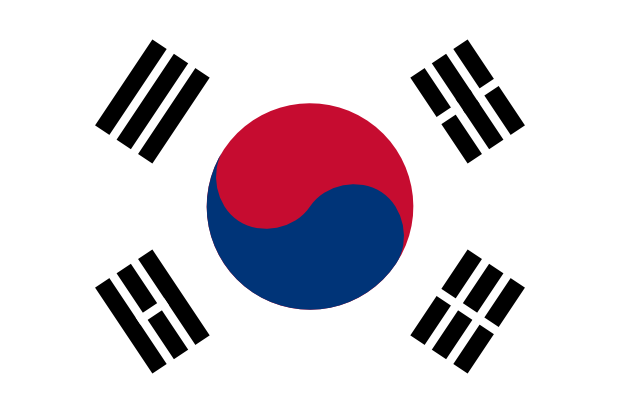
Flag is available in resolutions
| Icon 88x59 |  |
| Icon 32x21 |  |
Korea, South
Here is an article about South Korea, approximately 5000 characters long, written in English:
South Korea, officially the Republic of Korea, is a vibrant and dynamic nation situated in the southern half of the Korean Peninsula in East Asia. Bordered by the Democratic Peoples Republic of Korea (North Korea) to the north, the Yellow Sea to the west, the East Sea (Sea of Japan) to the east, and the Korea Strait separating it from Japan to the south, South Korea boasts a strategic and geographically diverse landscape. The country is renowned for its rapid economic development, technological prowess, and a rich cultural heritage that seamlessly blends ancient traditions with cutting-edge modernity. Its population, largely homogenous with a small but growing number of foreign residents, is known for its industriousness, strong sense of community, and a deep respect for education. The capital city, Seoul, is a sprawling metropolis that serves as the epicenter of South Korea’s political, economic, and cultural life, a testament to the nation’s remarkable transformation over the past several decades.
The history of Korea is a long and complex tapestry, deeply interwoven with periods of unification, division, and foreign influence. For centuries, the Korean Peninsula was a unified entity, fostering a distinct cultural identity. However, the early 20th century marked a turning point with the Japanese colonial rule from 1910 to 1945. This period of subjugation left an indelible mark on the nation, shaping its subsequent trajectory. Following World War II, Korea was divided into two zones of occupation, with the Soviet Union administering the North and the United States the South. This division tragically solidified into two separate states, leading to the Korean War (1950-1953), a devastating conflict that further entrenched the separation and left a lasting legacy of tension on the peninsula. Since the armistice, South Korea has embarked on an extraordinary journey of reconstruction and development, transforming itself from a war-torn nation into one of the world’s leading economies, a phenomenon often referred to as the Miracle on the Han River. This resilience and determination are central to the South Korean spirit.
Geographically, South Korea presents a varied and captivating landscape. The country is predominantly mountainous, with approximately 70% of its landmass covered by rugged terrain, particularly along the eastern coast. The Taebaek Mountains form the backbone of the peninsula, offering breathtaking vistas and numerous hiking opportunities. Interspersed within these mountain ranges are fertile plains and river valleys, which are crucial for agriculture, particularly rice cultivation. The coastline is extensive and irregular, dotted with thousands of islands, the largest and most famous being Jeju Island, a volcanic paradise known for its unique natural beauty and distinct culture. South Korea experiences a temperate climate with four distinct seasons. Summers are typically hot and humid, often accompanied by monsoon rains, while winters are cold and dry, with snow common in mountainous regions. The numerous rivers, such as the Han River that flows through Seoul, play a vital role in transportation, irrigation, and the nation’s overall ecosystem.
The South Korean economy is a global powerhouse, characterized by its high level of technological advancement and a strong export-oriented focus. Industries such as electronics, automobiles, shipbuilding, and semiconductors are at the forefront of global markets, with companies like Samsung, Hyundai, and LG achieving international recognition. The nations commitment to research and development has been a key driver of its economic success, fostering innovation and competitiveness. Beyond these heavy industries, South Korea also excels in areas like biotechnology, telecommunications, and entertainment, with the global phenomenon of K-Pop and K-dramas demonstrating the countrys growing cultural influence. The government has actively supported industrial development through strategic policies and investments, creating a highly skilled workforce and a robust infrastructure that facilitates international trade. This economic dynamism is a cornerstone of modern South Korean identity.
South Korea offers a wealth of tourist attractions that cater to a diverse range of interests, from historical exploration to modern marvels. The capital city, Seoul, is a vibrant hub that seamlessly blends ancient palaces like Gyeongbokgung and Changdeokgung with futuristic skyscrapers and bustling shopping districts such as Myeongdong. Visitors can immerse themselves in the countrys rich history at the National Museum of Korea or experience the energy of the city from the N Seoul Tower. Beyond Seoul, the ancient capital of Gyeongju, often referred to as the museum without walls, is a UNESCO World Heritage site brimming with Silla Dynasty relics, including ancient temples, royal tombs, and the iconic Bulguksa Temple. Jeju Island, a subtropical paradise, beckons with its stunning volcanic landscapes, pristine beaches, and unique cultural heritage, offering activities like hiking Mount Hallasan and exploring lava tubes. For those seeking a deeper understanding of the countrys complex history, the Demilitarized Zone (DMZ) separating North and South Korea offers a poignant and thought-provoking experience, providing a stark reminder of the peninsula’s enduring division. The country’s efficient public transportation system, including its high-speed rail network, makes exploring these diverse destinations both convenient and enjoyable.
Information about Korea, South
The information comes from the publication CIA The World Factbook.
Automated text translation, excuse errors, please!
Country Korea, South is situated in a location / continent East Asia. Korea, South has an area of 99 720 km2 and 48 860 500 residents. The highest point has a height 1 950 above sea level. and it is called Halla-san. The lowest point is located at the level of 0 above sea level and it is named Sea of Japan. System of government is republic and the date of independence 15th August 1945. The capital city is Seoul. Korea, South has the international abbreviation KS.
Korea, South - economy
Total gross domestic product (GDP) is 1 574 000 000 000 $. Total gross domestic product per capita in purchasing power parity is 32 100 $. GDP grows by 3.60 % a year. Inflation (consumer price index) is equal to 4.00 % a year. Korea, South have 25 100 000 working-age population (from a total population 48 860 500 people). Unemployment is at 3.40 %. Korea, South issued 6.50 % GDP to healt care .The public debt of the country is 33.60 % GDP. The total amount of foreign debt is 397 300 000 000 USD.
Korea, South - demography
As suggested above, Korea, South has 48 860 500 people. Population growth is in the amount 0.20 % per year. Number of children born per 1000 population per year is 8.42.Every mother has average 1.23 children. The infant mortality rate is 4.08 and maternal mortality 16.00 deaths per 100,000 births. Average estimated life expectancy makes 79.30 years. Mortality is 6.38 people per 1000 population per year.
Korea, South - transport and telecommunications
Korea, South has 103 029 km of roads, 3 381 km of railway lines and 114 airports. The total length of waterways (navigable rivers, canals, etc.) is 1 600 km. There is registered 786 ships.
Number of active mobile phones (sim card) in the country Korea, South is 52 507 000. Number of active fixed telephone lines is 29 468 000. Korea, South has 39 400 000 internet users, who have the available 293 862 Internet connections. Korea, South has been assigned a domain first Choose range .kr.
Korea, South - energetics
Korea, South consumes a year 455 100 000 000 kWh of electricity. Annual electricity production is 459 500 000 000 kWh in power plants with a total installed electrical capacity 80 590 000 kW. Korea, South exports 0 kWh and imports 0 kWh of electricity per year Energy mix of power generation is as follows: fossil fuels: 69.9 %, nuclear energy: 22 %, renewable: 1.3 %, hydropower: 2.0 %. The country Korea, South is harvested annually 19 990 barrels of oil.
Keywords: flag, information, economy, Flags of countries, national flags, Korea, South, transport, flags of countries in the world, Flag of Korea, South, flag states, world countries, list of countries, telecommunications, demography, list of flags, all flags, energetics, politic.