United Arab Emirates
Flag of United Arab Emirates
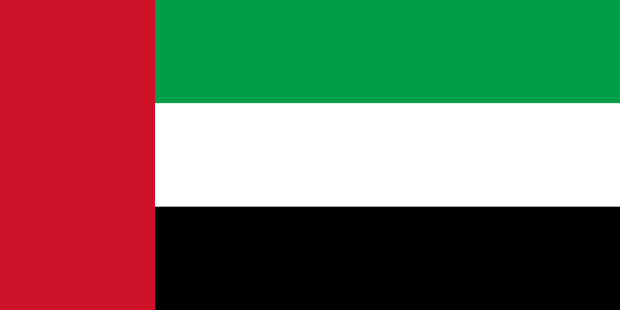
Flag is available in resolutions
| Icon 88x44 |  |
| Icon 32x16 |  |
United Arab Emirates
The United Arab Emirates: A Tapestry of Tradition and Tomorrow
The United Arab Emirates (UAE), a federation of seven emirates located on the eastern side of the Arabian Peninsula, is a land of stark contrasts and remarkable transformation. From its ancient pearl diving heritage to its futuristic skylines, the UAE has rapidly evolved into a global hub for business, tourism, and culture. This captivating nation, bordered by Oman and Saudi Arabia, and with coastlines on the Persian Gulf and the Gulf of Oman, is a testament to human ambition and a deep respect for tradition. Its strategic location has historically made it a vital trading post, a role it continues to embrace with unparalleled vigour in the modern era. The very essence of the UAE lies in its ability to seamlessly blend its rich Bedouin past with an unyielding vision for the future, creating a unique and dynamic environment that draws millions from across the globe.
The population of the UAE is as diverse and vibrant as its landscape. While the indigenous Emirati population forms a significant cultural core, the vast majority of residents are expatriates, hailing from all corners of the world. This demographic mosaic has fostered a cosmopolitan atmosphere, where a multitude of languages, traditions, and cuisines coexist harmoniously. The expatriate workforce is crucial to the nation’s economic engine, contributing significantly to its rapid development and global standing. This multiculturalism is not merely a demographic fact but a lived reality, reflected in the bustling souks, the diverse culinary scene, and the international flavour of its major cities. Despite the influx of people from various backgrounds, a strong sense of national identity and pride in Emirati heritage remains paramount, diligently preserved and celebrated. The government actively promotes cultural understanding and integration, ensuring that the UAE’s unique identity is not diluted but enriched by its global populace.
The history of the UAE is deeply intertwined with the sea and the desert. For centuries, the inhabitants of this region relied on pearl diving, fishing, and trade for their sustenance. The Trucial States, as they were known, were a collection of sheikhdoms that entered into maritime treaties with the British in the 19th century to suppress piracy and ensure safe passage for ships. This period of British influence, while significant, was a prelude to the nation’s eventual independence. The discovery of oil in the mid-20th century marked a monumental turning point, transforming the economic landscape and paving the way for unprecedented development. In 1971, the Trucial States united to form the United Arab Emirates, a visionary step driven by the late Sheikh Zayed bin Sultan Al Nahyan, the father of the nation. His leadership and foresight were instrumental in laying the foundation for the UAE’s prosperity and its commitment to progress, social welfare, and international cooperation. This unification was not merely a political act but a profound declaration of shared destiny and a collective ambition to build a nation that would stand tall on the world stage.
Geographically, the UAE presents a varied terrain. The majority of the land is arid desert, characterized by vast sand dunes, particularly in the Empty Quarter (Rub al Khali). However, the country also boasts a rugged mountain range, the Hajar Mountains, which straddle the border with Oman and offer a dramatic contrast to the sweeping desert vistas. The coastline is dotted with islands, some natural and others man-made, such as the iconic Palm Jumeirah. The climate is predominantly hot and arid, with extremely high temperatures during the summer months, tempered by pleasant and mild winters. Water scarcity is a significant challenge, which the UAE has addressed through advanced desalination technologies, a testament to its innovative approach to environmental management. The nation’s commitment to sustainability is increasingly evident, with significant investments in renewable energy and conservation efforts aimed at preserving its natural heritage for future generations.
The UAE’s economy has undergone a meteoric transformation, driven primarily by its vast oil and gas reserves. However, recognizing the finite nature of these resources, the nation has proactively diversified its economy, with a strong focus on sectors such as tourism, real estate, finance, logistics, and aviation. Dubai, in particular, has emerged as a global financial and business hub, attracting multinational corporations and international talent. Abu Dhabi, the capital, is investing heavily in sectors like renewable energy and advanced technology, aiming to secure a sustainable economic future. The governments strategic vision and significant investments in infrastructure, education, and innovation have created a business-friendly environment that fosters growth and entrepreneurship. This economic diversification is not merely an opportunistic shift but a carefully orchestrated strategy to ensure long-term prosperity and reduce reliance on a single commodity. The free zones established across the emirates offer attractive incentives for foreign investors, further bolstering the nation’s economic dynamism.
The UAE is a treasure trove of tourist attractions, catering to a wide array of interests. Dubai is renowned for its futuristic architecture, including the Burj Khalifa, the world’s tallest building, and the Dubai Mall, a shopper’s paradise. The city also offers vibrant nightlife, world-class dining, and a plethora of entertainment options, from desert safaris to indoor ski slopes. Abu Dhabi, while more traditional, boasts the magnificent Sheikh Zayed Grand Mosque, a breathtaking example of Islamic architecture, and the Louvre Abu Dhabi, a cultural landmark. The emirate of Sharjah is actively promoting itself as the cultural capital of the UAE, with numerous museums and art galleries. For those seeking a more traditional experience, the northern emirates like Ras Al Khaimah offer stunning natural landscapes, historical forts, and opportunities for adventure tourism. The UAE’s commitment to developing its tourism infrastructure, coupled with its emphasis on safety and hospitality, has cemented its position as a premier global tourist destination. The meticulous planning and execution of major events, from sporting championships to international conferences, further enhance its appeal and global connectivity.
In conclusion, the United Arab Emirates is a nation that has defied expectations, transforming itself from a collection of desert emirates into a global powerhouse. Its success is a product of visionary leadership, strategic economic diversification, a welcoming multicultural society, and an unwavering commitment to progress while honouring its rich heritage. The UAE stands as a compelling example of how tradition and modernity can not only coexist but thrive in symbiotic harmony, creating a truly unique and captivating nation on the world stage. It is a land where the whispers of ancient winds across the dunes meet the hum of cutting-edge innovation, a place that continues to inspire awe and beckon the world to witness its remarkable journey.
Information about United Arab Emirates
The information comes from the publication CIA The World Factbook.
Automated text translation, excuse errors, please!
Country United Arab Emirates is situated in a location / continent Middle East. United Arab Emirates has an area of 83 600 km2 and 5 314 317 residents. The highest point has a height 1 527 above sea level. and it is called Jabal Yibir. The lowest point is located at the level of 0 above sea level and it is named Persian Gulf. System of government is federation and the date of independence Second December 1971. The capital city is Abu Dhabi. United Arab Emirates has the international abbreviation AE.
United Arab Emirates - economy
Total gross domestic product (GDP) is 262 100 000 000 $. Total gross domestic product per capita in purchasing power parity is 48 800 $. GDP grows by 4.90 % a year. Inflation (consumer price index) is equal to 0.90 % a year. United Arab Emirates have 4 111 000 working-age population (from a total population 5 314 317 people). Unemployment is at 2.40 %. United Arab Emirates issued 2.80 % GDP to healt care .The public debt of the country is 43.50 % GDP. The total amount of foreign debt is 158 700 000 000 USD.
United Arab Emirates - demography
As suggested above, United Arab Emirates has 5 314 317 people. Population growth is in the amount 3.06 % per year. Number of children born per 1000 population per year is 15.76.Every mother has average 2.38 children. The infant mortality rate is 11.59 and maternal mortality 12.00 deaths per 100,000 births. Average estimated life expectancy makes 76.71 years. Mortality is 2.04 people per 1000 population per year.
United Arab Emirates - transport and telecommunications
United Arab Emirates has 4 080 km of roads and 42 airports. There is registered 61 ships.
Number of active mobile phones (sim card) in the country United Arab Emirates is 10 926 000. Number of active fixed telephone lines is 1 480 000. United Arab Emirates has 3 449 000 internet users, who have the available 371 969 Internet connections. United Arab Emirates has been assigned a domain first Choose range .ae.
United Arab Emirates - energetics
United Arab Emirates consumes a year 74 120 000 000 kWh of electricity. Annual electricity production is 83 310 000 000 kWh in power plants with a total installed electrical capacity 23 250 000 kW. United Arab Emirates exports 0 kWh and imports 0 kWh of electricity per year Energy mix of power generation is as follows: fossil fuels: 100 %, nuclear energy: 0 %, renewable: 0.0 %, hydropower: 0.0 %. The country United Arab Emirates is harvested annually 3 087 000 barrels of oil.
Keywords: all flags, Flags of countries, telecommunications, list of flags, flags of countries in the world, energetics, flag states, flag, world countries, economy, United Arab Emirates, list of countries, transport, Flag of United Arab Emirates, demography, national flags, information, politic.