Kuwait
Flag of Kuwait
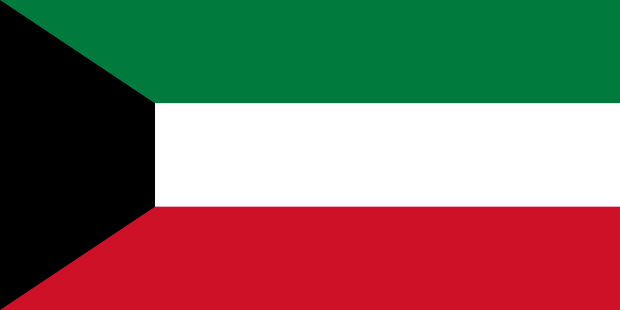
Flag is available in resolutions
| Icon 88x44 |  |
| Icon 32x16 |  |
Kuwait
Kuwait: A Jewel of the Arabian Peninsula
Kuwait, officially the State of Kuwait, is a small but strategically significant country situated in the northeastern corner of the Arabian Peninsula. Bordered by Saudi Arabia to the south and Iraq to the north and west, it boasts a long coastline along the Persian Gulf, a body of water that has profoundly shaped its history and economy. Despite its relatively modest size, Kuwait is a nation of immense wealth, primarily derived from its vast oil reserves, and it plays a pivotal role in regional and global energy markets. Its modern identity is a fascinating blend of ancient Bedouin traditions and rapid contemporary development, creating a unique cultural tapestry.
The population of Kuwait is a striking testament to its economic success and strategic location. While the number of Kuwaiti citizens is relatively small, comprising roughly 30% of the total population, the country is home to a vast expatriate workforce. This diverse demographic influx, drawn by lucrative employment opportunities, particularly in the oil sector, has transformed Kuwait into a multicultural hub. The majority of the population resides in urban centers, with the capital city, Kuwait City, being the most populous and vibrant. This demographic composition presents both opportunities and challenges, fostering a dynamic exchange of ideas and cultures while also necessitating careful consideration of social integration and national identity. The official language is Arabic, but English is widely spoken and understood, especially in business and commercial circles, reflecting the country’s international connections. Islam is the official religion, and its principles deeply influence the social fabric and legal system of Kuwait, though a degree of religious freedom is generally afforded to non-Muslim residents.
The history of Kuwait is a narrative of resilience, trade, and strategic importance. For centuries, the region was inhabited by nomadic Bedouin tribes who relied on pearl diving and maritime trade for sustenance. The Al-Sabah dynasty, which continues to rule Kuwait today, rose to prominence in the 18th century, establishing a stable leadership that fostered the growth of Kuwait as a prominent trading port. Its strategic location at the head of the Persian Gulf made it a desirable territory for various regional powers. In the late 19th century, facing Ottoman expansionism, Kuwait sought protection from the British Empire, signing a treaty in 1899 that established it as a British protectorate. This period saw the consolidation of Kuwait’s borders and a degree of autonomy under the Al-Sabah rule. The most transformative event in Kuwait’s modern history was the discovery of oil in the 1930s. The subsequent exploitation of these vast reserves, particularly after World War II, catapulted Kuwait from a modest trading post into one of the world’s wealthiest nations. However, this prosperity was tragically interrupted in 1990 when Iraq, under Saddam Hussein, invaded and annexed Kuwait, leading to the Gulf War. The liberation of Kuwait by a U.S.-led coalition in 1991 was a defining moment, solidifying its sovereignty and reinforcing its international alliances. The war left deep scars, but Kuwait’s subsequent reconstruction and recovery were remarkably swift, a testament to its economic strength and the determination of its people.
Geographically, Kuwait is characterized by its arid desert landscape, with vast expanses of sand and gravel plains. The countrys coastline stretches for approximately 470 kilometers (292 miles) along the Persian Gulf, featuring numerous islands, the most significant being Bubiyan Island, the largest island in the Persian Gulf, and Failaka Island, which holds historical and archaeological significance. The climate is extreme, with intensely hot summers, where temperatures can soar above 50 degrees Celsius (122 degrees Fahrenheit), and mild winters. Dust storms, known locally as shamals, are a common occurrence, particularly during the spring and summer months. Water scarcity is a significant challenge, and Kuwait relies heavily on desalination plants to meet its freshwater needs. Despite the harsh environment, Kuwait has managed to develop a sophisticated infrastructure and create verdant urban oases through extensive irrigation and landscaping efforts. The countrys oil fields are concentrated in the eastern part of the territory, a resource that underpins its entire economy.
The Kuwaiti economy is overwhelmingly dominated by the oil and gas sector, which accounts for the vast majority of its export earnings and government revenue. Kuwait is a founding member of the Organization of the Petroleum Exporting Countries (OPEC) and possesses some of the largest oil reserves in the world. The Kuwait Petroleum Corporation (KPC) is the state-owned oil company responsible for the exploration, production, refining, and marketing of petroleum products. While oil remains the primary driver of the economy, the Kuwaiti government has been actively pursuing diversification strategies to reduce its reliance on hydrocarbons. These efforts include investing in other sectors such as finance, real estate, telecommunications, and tourism. The country has a highly developed financial sector, with several prominent banks and investment firms. Despite its wealth, Kuwait also faces the challenge of managing its oil revenues responsibly and planning for a future where oil may not be as dominant a resource. The presence of a large expatriate workforce also plays a crucial role in the economy, providing skilled labor and contributing to various service industries.
Kuwait offers a surprising array of tourist attractions, blending its rich historical heritage with modern marvels. The iconic Kuwait Towers, a trio of slender towers symbolizing the country’s progress, offer panoramic views of Kuwait City and the Persian Gulf. The Al-Shaheed Park is a sprawling urban oasis, featuring museums, botanical gardens, and recreational facilities, providing a welcome respite from the desert heat and a space for cultural engagement. For history enthusiasts, Failaka Island is a must-visit, with its ancient Dilmun civilization ruins, Greek and Islamic archaeological sites, and a charming traditional village. The Grand Mosque is a magnificent example of Islamic architecture, open to visitors during specific hours. The Kuwait National Museum houses artifacts that trace the country’s history from ancient times to the present day. Shopping is a popular pastime, with modern malls like the Avenues Mall offering a wide range of international brands and entertainment options. For a glimpse into traditional Kuwaiti life, the Souk Al-Mubarakiya is a vibrant marketplace where one can find spices, textiles, traditional crafts, and fresh produce. The coastline also offers opportunities for water sports and relaxation. While not as heavily touristed as some of its neighbors, Kuwait’s unique blend of tradition and modernity, coupled with its rich history, makes it an intriguing destination for those seeking an authentic Arabian experience. The country’s commitment to preserving its cultural heritage while embracing progress is evident in its evolving landscape and the experiences it offers to visitors.
Information about Kuwait
The information comes from the publication CIA The World Factbook.
Automated text translation, excuse errors, please!
Country Kuwait is situated in a location / continent Middle East. Kuwait has an area of 17 818 km2 and 2 646 314 residents. The highest point has a height 306 above sea level. and it is called bezejmenné místo. The lowest point is located at the level of 0 above sea level and it is named Persian Gulf. System of government is constitutional emirate and the date of independence 19th June 1961. The capital city is Kuwait. Kuwait has the international abbreviation KU.
Kuwait - economy
Total gross domestic product (GDP) is 155 500 000 000 $. Total gross domestic product per capita in purchasing power parity is 42 200 $. GDP grows by 8.20 % a year. Inflation (consumer price index) is equal to 4.70 % a year. Kuwait have 2 243 000 working-age population (from a total population 2 646 314 people). Unemployment is at 2.20 %. Kuwait issued 6.80 % GDP to healt care and 5,30 % GDP to army. The public debt of the country is 6.50 % GDP. The total amount of foreign debt is 41 730 000 000 USD.
Kuwait - demography
As suggested above, Kuwait has 2 646 314 people. Population growth is in the amount 1.88 % per year. Number of children born per 1000 population per year is 20.96.Every mother has average 2.60 children. The infant mortality rate is 7.87 and maternal mortality 14.00 deaths per 100,000 births. Average estimated life expectancy makes 77.28 years. Mortality is 2.13 people per 1000 population per year.
Kuwait - transport and telecommunications
Kuwait has 5 749 km of roads and 7 airports. There is registered 34 ships.
Number of active mobile phones (sim card) in the country Kuwait is 4 400 000. Number of active fixed telephone lines is 566 300. Kuwait has 1 100 000 internet users, who have the available 2 730 Internet connections. Kuwait has been assigned a domain first Choose range .kw.
Kuwait - energetics
Kuwait consumes a year 43 410 000 000 kWh of electricity. Annual electricity production is 51 320 000 000 kWh in power plants with a total installed electrical capacity 10 940 000 kW. Kuwait exports 0 kWh and imports 0 kWh of electricity per year Energy mix of power generation is as follows: fossil fuels: 100 %, nuclear energy: 0 %, renewable: 0.0 %, hydropower: 0.0 %. The country Kuwait is harvested annually 2 682 000 barrels of oil.
Keywords: Flag of Kuwait, Kuwait, Flags of countries, flag, flags of countries in the world, national flags, economy, flag states, all flags, list of flags, telecommunications, transport, information, energetics, demography, list of countries, world countries, politic.