Georgia
Flag of Georgia
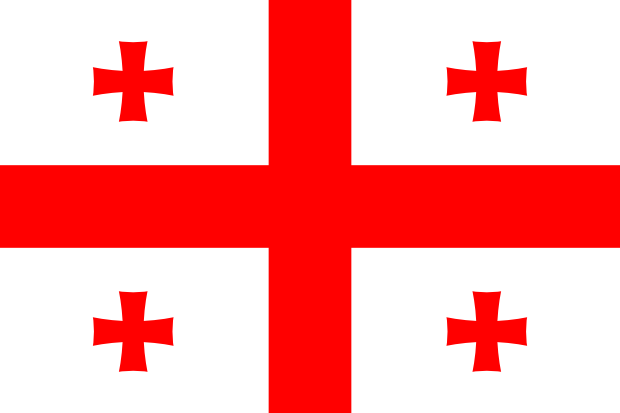
Flag is available in resolutions
| Icon 88x59 |  |
| Icon 32x21 |  |
Georgia
Georgia: A Land of Ancient Roots and Modern Aspirations
Nestled at the crossroads of Eastern Europe and Western Asia, Georgia is a nation steeped in history, blessed with breathtaking natural beauty, and driven by a vibrant cultural identity. This Caucasian gem, often overlooked in broader global narratives, offers a compelling tapestry of ancient traditions, a tumultuous past, and a burgeoning modern spirit. From the snow-capped peaks of the Greater Caucasus to the sun-drenched Black Sea coast, Georgia’s diverse geography has shaped its people, its economy, and its enduring appeal to visitors from around the globe. Its strategic location has also made it a historical battleground and a vital transit corridor, leaving an indelible mark on its rich and complex heritage.
The population of Georgia, estimated to be around 3.7 million people, is predominantly Georgian, with significant ethnic minorities including Azerbaijanis, Armenians, and Russians. The Georgian language, a unique Kartvelian language with its own distinct alphabet, is a powerful symbol of national unity and cultural pride. The majority of Georgians adhere to the Georgian Orthodox Church, a tradition that has played a pivotal role in the nation’s spiritual and cultural development for centuries. This deep-seated religious and linguistic heritage forms the bedrock of Georgian identity, fostering a strong sense of community and a profound respect for ancestral customs. The societal fabric is woven with threads of hospitality, a concept deeply ingrained in Georgian culture, where guests are traditionally treated with utmost respect and generosity, often referred to as “a gift from God.” This warmth and openness are palpable in everyday interactions, contributing to the welcoming atmosphere that defines the country.
Georgia’s history is a saga of empires, invasions, and resilience. Its strategic location has meant it has been a prize for numerous powers throughout the ages, including the Romans, Persians, Arabs, Mongols, and Ottomans. The nation’s Golden Age occurred in the 12th and 13th centuries under Queen Tamar, a period of significant political power, economic prosperity, and cultural flourishing. This era is often looked back upon with immense pride, representing a peak of Georgian sovereignty and influence. However, subsequent centuries saw Georgia fall under the sway of larger empires, most notably the Russian Empire in the 19th century, followed by a brief period of independence after World War I, and then incorporation into the Soviet Union. The struggle for independence from Soviet rule culminated in its re-establishment in 1991. The post-Soviet era has been marked by challenges, including civil unrest and territorial disputes, but also by a determined push towards democratic reforms and closer integration with Western institutions. The Rose Revolution of 2003 was a watershed moment, signaling a popular demand for change and a rejection of corruption.
Geographically, Georgia is a land of striking contrasts. The towering Greater Caucasus Mountains form a formidable natural barrier to the north, offering some of the most spectacular alpine scenery in Europe. These majestic peaks are a haven for hikers, skiers, and mountaineers, with popular destinations like Svaneti and Kazbegi attracting adventurers seeking pristine wilderness and dramatic vistas. South of the mountains, the landscape transitions to rolling hills, fertile valleys, and the subtropical Black Sea coast in the west. This coastal region, with its palm-lined boulevards and warm climate, is a popular summer resort area, boasting cities like Batumi, known for its modern architecture and vibrant nightlife. The central and eastern parts of the country are characterized by drier steppes and fertile agricultural land, where the majority of the population resides and where the country’s renowned wine culture thrives. The country is also crisscrossed by a network of rivers, with the Mtkvari (Kura) River being the most significant, playing a vital role in irrigation and transportation.
Georgia’s economy has undergone significant transformation since the collapse of the Soviet Union. While agriculture remains a cornerstone, particularly viticulture, the country has diversified its economic base. Georgia is renowned for its ancient winemaking tradition, dating back over 8,000 years, and is the birthplace of the qvevri method, a UNESCO-recognized intangible cultural heritage. Wine tourism is a growing sector, drawing connoisseurs to explore the vineyards and cellars of regions like Kakheti. The service sector, including tourism, is increasingly important, capitalizing on the country’s natural beauty and rich cultural heritage. Georgia has also sought to attract foreign investment in areas such as renewable energy, mining, and manufacturing. The government has implemented liberal economic policies, aiming to foster a business-friendly environment and attract foreign direct investment. However, challenges remain, including addressing regional economic disparities and creating more employment opportunities, particularly for young people.
Georgia’s tourist attractions are as diverse as its landscape. The capital city, Tbilisi, is a captivating blend of old and new. Its charming Old Town, with narrow cobblestone streets, colorful balconies, and ancient churches, stands in striking contrast to its modern architectural marvels like the Peace Bridge. The city’s sulfur baths, a tradition dating back centuries, offer a unique and relaxing experience. Further afield, the ancient cave city of Uplistsikhe offers a glimpse into Georgia’s early history, carved into the rock face and serving as a pagan religious center. The medieval city of Mtskheta, a UNESCO World Heritage site, is the spiritual heart of Georgia and home to the stunning Svetitskhoveli Cathedral. For nature lovers, the national parks, such as Borjomi-Kharagauli, offer extensive hiking trails and opportunities to witness diverse flora and fauna. The mountain region of Svaneti, with its iconic stone defensive towers, presents a unique cultural landscape and a challenging yet rewarding trekking experience. The Black Sea resort town of Batumi provides a different kind of allure, with its vibrant promenade, botanical gardens, and a lively atmosphere. Georgia’s appeal lies not only in its historical sites and natural wonders but also in the genuine warmth and hospitality of its people, making it a truly unforgettable travel destination. The country’s commitment to preserving its cultural heritage while embracing modernization ensures that it remains a compelling destination for years to come.
Information about Georgia
The information comes from the publication CIA The World Factbook.
Automated text translation, excuse errors, please!
Country Georgia is situated in a location / continent Middle East. Georgia has an area of 69 700 km2 and 4 570 934 residents. The highest point has a height 5 201 above sea level.. The lowest point is located at the level of 0 above sea level and it is named Black Sea. System of government is republic and the date of independence 9th April 1991. Georgia has the international abbreviation GG.
Georgia - economy
Total gross domestic product (GDP) is 24 860 000 000 $. Total gross domestic product per capita in purchasing power parity is 5 600 $. GDP grows by 7.00 % a year. Inflation (consumer price index) is equal to 8.50 % a year. Georgia have 1 945 000 working-age population (from a total population 4 570 934 people). Unemployment is at 16.30 %. Georgia issued 11.30 % GDP to healt care and 1,90 % GDP to army. The total amount of foreign debt is 11 080 000 000 USD.
Georgia - demography
As suggested above, Georgia has 4 570 934 people. Population growth is in the amount -0.33 % per year. Number of children born per 1000 population per year is 10.75.Every mother has average 1.46 children. The infant mortality rate is 14.68 and maternal mortality 67.00 deaths per 100,000 births. Average estimated life expectancy makes 77.32 years. Mortality is 10.05 people per 1000 population per year.
Georgia - transport and telecommunications
Georgia has 20 329 km of roads, 1 612 km of railway lines and 22 airports. There is registered 142 ships.
Number of active mobile phones (sim card) in the country Georgia is 4 430 000. Number of active fixed telephone lines is 1 342 000. Georgia has 1 300 000 internet users, who have the available 358 109 Internet connections. Georgia has been assigned a domain first Choose range .ge.
Georgia - energetics
Georgia consumes a year 9 256 000 000 kWh of electricity. Annual electricity production is 10 100 000 000 kWh in power plants with a total installed electrical capacity 4 538 000 kW. Georgia exports 931 000 000 kWh and imports 471 000 000 kWh of electricity per year Energy mix of power generation is as follows: fossil fuels: 37.2 %, nuclear energy: 0 %, renewable: 0.0 %, hydropower: 62.8 %. The country Georgia is harvested annually 1 000 barrels of oil.
Keywords: Flag of Georgia, list of countries, demography, all flags, flag states, energetics, information, Flags of countries, flags of countries in the world, flag, economy, Georgia, list of flags, national flags, transport, telecommunications, world countries, politic.