Barbados
Flag of Barbados
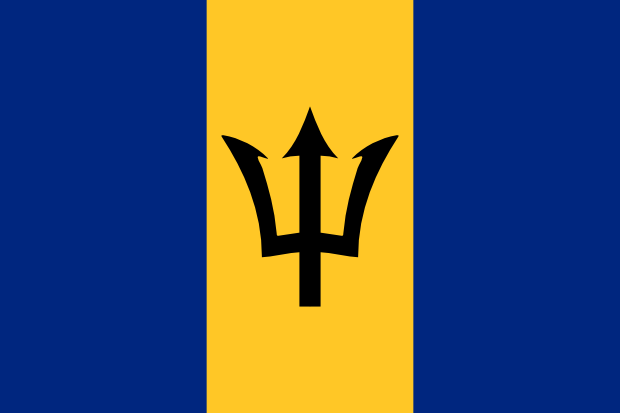
Flag is available in resolutions
| Icon 88x59 |  |
| Icon 32x21 |  |
Barbados
Barbados: Jewel of the Caribbean
Barbados, a sovereign island nation nestled in the eastern Caribbean Sea, stands as a beacon of natural beauty, rich history, and vibrant culture. Its geographical isolation, situated east of the Windward Islands and north of Trinidad and Tobago, has played a significant role in shaping its unique identity and destiny. With a landmass of approximately 430 square kilometers, this crescent-shaped island is the easternmost of the Lesser Antilles, a geographical distinction that has influenced its climate, its flora and fauna, and its historical interactions with the wider world. The island’s relatively flat terrain, a stark contrast to the mountainous volcanic islands of its neighbours, is characterized by rolling hills, fertile plains, and a dramatic coastline that transitions from the calm, turquoise waters of the west coast to the wild, surf-battered shores of the east. This diverse topography supports a lush, tropical vegetation, including sugarcane fields that have historically been the backbone of its economy, as well as a rich array of plant and animal life. The population of Barbados, predominantly of African descent, is a testament to the island’s colonial past, a legacy of the transatlantic slave trade. However, Barbadian society today is a harmonious blend of cultures, where African, European, and Indian influences intermingle to create a distinct and welcoming national character. The official language is English, but the melodic lilt of Bajan Creole, a patois rich in African and British influences, can be heard in everyday conversations, adding a unique flavour to the island’s linguistic landscape.
The history of Barbados is a compelling narrative of exploration, colonization, and eventual independence. First sighted by Europeans in the early 16th century, likely by the Portuguese explorer Pedro Campos, the island remained largely uninhabited until English settlers arrived in 1627. The English established a permanent colony, quickly recognizing the island’s suitability for growing sugarcane. This crop would come to define Barbados’ economy and society for centuries. The introduction of sugarcane cultivation led to the establishment of large plantations and the importation of enslaved Africans to work them. This period, marked by immense hardship and suffering for the enslaved population, left an indelible mark on the island’s demographics and cultural heritage. The legacy of slavery is deeply ingrained in Barbadian history, and the struggle for freedom and equality has shaped its social and political development. The island was a British colony for over three centuries, experiencing periods of both prosperity and turmoil. It witnessed numerous slave rebellions, the abolition of slavery in 1834, and the subsequent development of its political institutions. In 1966, Barbados achieved full independence from the United Kingdom, becoming a sovereign nation within the Commonwealth. This transition marked a new era for the island, one of self-governance and national pride, while still maintaining strong ties with its former colonial power and other international partners. The Barbadian people have since worked to forge their own path, building a stable democracy and a thriving economy.
Geographically, Barbados is a coral island, formed from the uplift of the seabed by tectonic activity and the accumulation of coral limestone over millions of years. This geological origin contributes to its distinctive landscape. The western coast, known as the Platinum Coast, is characterized by calm, crystal-clear waters, powdery white sand beaches, and luxurious resorts, making it a prime destination for sun-seekers and water sports enthusiasts. The eastern coast, on the other hand, faces the Atlantic Ocean and is more rugged and dramatic. Here, powerful waves crash against the shore, attracting surfers and offering breathtaking views of the untamed sea. Inland, the terrain rises gently towards a central ridge, with elevations reaching up to 336 meters at Mount Hillaby. The island is crisscrossed by numerous rivers and streams, which have carved out valleys and gullies, adding to the picturesque scenery. The climate is tropical, with average temperatures hovering around 26-30 degrees Celsius year-round. The year is divided into two distinct seasons: the dry season, from December to May, and the wet season, from June to November, which coincides with the hurricane season. The island’s natural beauty is further enhanced by its lush vegetation, including tropical forests, botanical gardens, and vibrant coral reefs teeming with marine life.
The Barbadian economy has undergone a significant transformation over the centuries. Historically, sugarcane cultivation and the production of rum were the pillars of its economy. The island’s sugar was highly sought after in Europe, and rum became a globally recognized spirit, a testament to Barbadian craftsmanship. However, in the latter half of the 20th century, Barbados strategically diversified its economy, recognizing the need to reduce its reliance on a single commodity. This diversification led to the development of a robust tourism sector, which has since become the island’s primary economic driver. The pristine beaches, warm climate, and rich cultural heritage attract millions of visitors each year, generating substantial revenue and employment. Beyond tourism, Barbados has also established itself as an important international financial services centre. Its stable political environment, favorable tax regime, and skilled workforce have attracted numerous offshore companies and financial institutions. Other key sectors include light manufacturing, agriculture (though on a smaller scale than historically), and the export of certain goods. The government has also invested in education and technology, aiming to foster innovation and further economic growth. This balanced approach has contributed to Barbados’ status as one of the most developed nations in the Caribbean, with a high standard of living and a strong social welfare system.
Barbados offers a wealth of tourist attractions, catering to a wide range of interests. For history buffs, Bridgetown, the capital city, is a UNESCO World Heritage site, boasting colonial architecture, historic fortifications like the Bridgetown Garrison, and the iconic Parliament Buildings. The island’s sugar heritage is preserved at numerous plantation houses, such as St. Nicholas Abbey, where visitors can learn about the island’s past and sample its famous rum. Nature lovers will be captivated by the Andromeda Botanic Gardens, a sanctuary of tropical flora, and Harrison’s Cave, a magnificent underground cave system with stalactites and stalagmites. The rugged beauty of the east coast, with its dramatic cliffs and powerful waves, is best experienced at Bathsheba, a popular spot for its natural rock formations and surfing. For those seeking relaxation and aquatic adventures, the west coast offers pristine beaches like Mullins Bay and Crane Beach, renowned for its pink sand and gentle waters. Snorkeling and diving opportunities abound, with vibrant coral reefs and shipwrecks waiting to be explored. The island’s vibrant culture is evident in its lively festivals, such as the Crop Over festival, a celebration of the end of the sugar harvest, and its delicious cuisine, a fusion of African, Indian, and European flavours. From the lively rhythms of calypso music to the warm hospitality of its people, Barbados promises an unforgettable experience for every visitor. The island’s commitment to preserving its natural and cultural heritage, coupled with its modern infrastructure and welcoming atmosphere, solidifies its position as a premier Caribbean destination.
Information about Barbados
The information comes from the publication CIA The World Factbook.
Automated text translation, excuse errors, please!
Country Barbados is situated in a location / continent Central America. Barbados has an area of 430 km2 and 287 733 residents. The highest point has a height 336 above sea level. and it is called Mount Hillaby. The lowest point is located at the level of 0 above sea level and it is named Atlantic Ocean. System of government is Republic, Commonwealth member country and the date of independence 30th November 1966. The capital city is Bridgetown. Barbados has the international abbreviation BB.
Barbados - economy
Total gross domestic product (GDP) is 6 576 000 000 $. Total gross domestic product per capita in purchasing power parity is 23 700 $. GDP grows by 0.50 % a year. Inflation (consumer price index) is equal to 9.10 % a year. Barbados have 175 000 working-age population (from a total population 287 733 people). Unemployment is at 12.00 %. Barbados issued 6.80 % GDP to healt care and 0,80 % GDP to army. The public debt of the country is 95.90 % GDP. The total amount of foreign debt is 668 000 000 USD.
Barbados - demography
As suggested above, Barbados has 287 733 people. Population growth is in the amount 0.35 % per year. Number of children born per 1000 population per year is 12.23.Every mother has average 1.68 children. The infant mortality rate is 11.63 and maternal mortality 51.00 deaths per 100,000 births. Average estimated life expectancy makes 74.52 years. Mortality is 8.39 people per 1000 population per year.
Barbados - transport and telecommunications
Barbados has 1 600 km of roads and 1 airports. There is registered 109 ships.
Number of active mobile phones (sim card) in the country Barbados is 347 900. Number of active fixed telephone lines is 140 700. Barbados has 188 000 internet users, who have the available 1 522 Internet connections. Barbados has been assigned a domain first Choose range .bb.
Barbados - energetics
Barbados consumes a year 955 000 000 kWh of electricity. Annual electricity production is 1 037 000 000 kWh in power plants with a total installed electrical capacity 239 100 kW. Barbados exports 0 kWh and imports 0 kWh of electricity per year Energy mix of power generation is as follows: fossil fuels: 100 %, nuclear energy: 0 %, renewable: 0.0 %, hydropower: 0.0 %. The country Barbados is harvested annually 1 000 barrels of oil.
Keywords: transport, Barbados, telecommunications, Flags of countries, economy, flag, demography, all flags, world countries, Flag of Barbados, flag states, information, list of countries, national flags, flags of countries in the world, energetics, list of flags, politic.