Guatemala
Flag of Guatemala
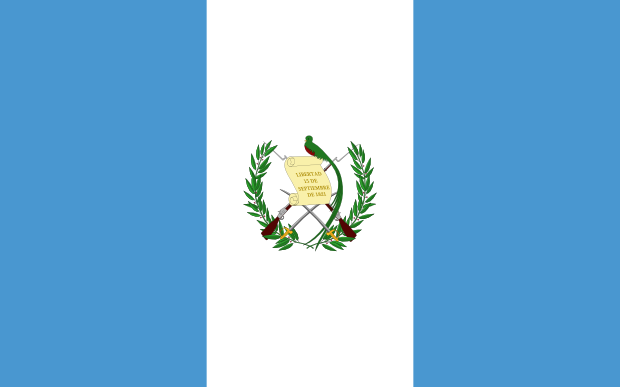
Flag is available in resolutions
| Icon 88x55 |  |
| Icon 32x20 |  |
Guatemala
Guatemala: Land of Eternal Spring and Ancient Wonders
Nestled in the heart of Central America, Guatemala, officially the Republic of Guatemala, is a nation that pulses with a vibrant tapestry of ancient history, breathtaking landscapes, and a rich, enduring culture. Often referred to as the Land of Eternal Spring for its consistently pleasant climate, this country offers a captivating blend of volcanic peaks, lush rainforests, and the echoes of a civilization that once dominated the region – the Maya. From the bustling streets of its capital to the remote villages cradling ancestral traditions, Guatemala invites exploration and promises an unforgettable journey into a world where the past gracefully intertwines with the present.
The demographic mosaic of Guatemala is as diverse as its geography. The majority of the population, approximately 60%, identifies as Indigenous Maya, belonging to numerous distinct ethnic groups, each with its own language, customs, and traditional attire. This profound Indigenous heritage is a cornerstone of Guatemalan identity, visible in the vibrant textiles, the spiritual practices, and the enduring agricultural traditions that persist across the country. The remaining population is predominantly Mestizo, a blend of Indigenous and European ancestry, with smaller communities of Afro-Caribbean descent and European immigrants. This ethnic diversity fosters a rich cultural exchange, though it has also historically been a source of social and political challenges. Spanish is the official language, but the country is a remarkable testament to linguistic diversity, with 21 distinct Mayan languages still spoken, alongside Xinca and Garifuna. This linguistic richness is a precious inheritance, a living link to the countrys deep historical roots. The population is largely young, with a significant proportion under the age of 25, a demographic characteristic that fuels both the nations dynamism and its ongoing development needs. Urban centers like Guatemala City, Antigua, and Quetzaltenango are hubs of activity, while rural areas remain deeply connected to agricultural rhythms and traditional ways of life. Religious adherence is predominantly Roman Catholic, a legacy of Spanish colonization, but there is a growing Evangelical Protestant presence, and many Indigenous communities continue to blend Catholic practices with ancient Maya spiritual beliefs, creating a unique syncretism.
Guatemalas history is a saga of ancient grandeur, colonial subjugation, and a complex post-colonial journey. The pre-Columbian era was dominated by the Maya civilization, which flourished for centuries, leaving behind an unparalleled legacy of monumental architecture, sophisticated astronomical knowledge, and intricate hieroglyphic writing. Cities like Tikal, El Mirador, and Copán (though partly in Honduras) stand as awe-inspiring testaments to their ingenuity and power. The arrival of the Spanish conquistadors in the 16th century marked a dramatic turning point. Led by Pedro de Alvarado, the Spanish conquered the Maya kingdoms, establishing a colonial administration that imposed its language, religion, and social structures. Guatemala, known as the Captaincy General of Guatemala, became a significant part of the Spanish Empire in Central America. Independence from Spain was declared in 1821, followed by a brief period as part of the First Mexican Empire and then the Federal Republic of Central America. In 1847, Guatemala became fully independent. The 20th century was marked by political instability, including periods of authoritarian rule and a protracted civil war that raged for over three decades, from 1960 to 1996. This conflict, deeply rooted in social inequality and political repression, had a devastating impact on the country, particularly on its Indigenous population. The signing of the Peace Accords in 1996 ushered in a new era of democratic transition, though the challenges of reconciliation, justice, and equitable development remain significant. The scars of this history are still visible, but the resilience of the Guatemalan people and their commitment to building a more just and peaceful future are undeniable.
The geography of Guatemala is a striking embodiment of Central Americas dramatic geological forces. Situated at the intersection of tectonic plates, the country is characterized by a rugged mountainous spine that runs through its center, formed by the Sierra Madre de Chiapas. This volcanic range is responsible for the Land of Eternal Spring moniker, as the higher altitudes provide a temperate climate year-round, moderating the tropical heat. The country boasts an impressive number of volcanoes, many of which are still active, including the iconic Volcán de Agua, Volcán de Fuego, and Volcán Pacaya, the latter being a popular tourist destination for its accessible volcanic activity. To the north and east lie the Petén lowlands, vast expanses of tropical rainforest that are home to ancient Maya ruins and an incredible biodiversity. The Pacific coast to the south is a narrow strip of fertile land, known for its agricultural production, while the Caribbean coast in the northeast is characterized by lush jungle and a distinct Afro-Caribbean culture. Guatemalas diverse ecosystems support a rich array of flora and fauna, from the resplendent quetzal, the national bird, to jaguars, monkeys, and a dazzling variety of birdlife. The country is also crisscrossed by numerous rivers, many of which originate in the highlands and flow towards the Pacific or Caribbean, shaping the landscape and providing vital water resources. The presence of numerous lakes, such as the stunning Lake Atitlán, cradled by volcanoes, adds to the countrys breathtaking scenic beauty.
Guatemalas economy is a dynamic mix of traditional agriculture and growing industries, though it faces challenges related to inequality and informal employment. Agriculture remains a cornerstone, with key exports including coffee, sugar, bananas, and cardamom. The production of these commodities is often carried out on large plantations, but also by numerous smallholder farmers who rely on these crops for their livelihoods. The countrys fertile volcanic soils and favorable climate are ideal for these agricultural pursuits. Beyond agriculture, the manufacturing sector is expanding, particularly in the production of textiles, apparel, and processed foods, often linked to export markets. Tourism has emerged as a significant and growing industry, driven by Guatemalas rich cultural heritage and stunning natural beauty. Remittances from Guatemalans working abroad, particularly in the United States, also play a crucial role in the national economy, providing vital income for many families. However, Guatemala grapples with significant economic challenges, including high levels of poverty, particularly in rural Indigenous communities, and a substantial informal economy that often lacks worker protections and benefits. Efforts are ongoing to diversify the economy, promote sustainable development, and improve access to education and employment opportunities for all citizens.
Guatemala is a treasure trove of tourist attractions, offering experiences that cater to a wide range of interests. The crown jewel of its historical sites is undoubtedly Tikal, a UNESCO World Heritage site and one of the most magnificent Maya cities ever discovered. Towering temples and pyramids emerge from the dense jungle canopy, evoking the grandeur of a lost civilization. The sheer scale and architectural brilliance of Tikal are humbling, and exploring its plazas and structures is like stepping back in time. Another essential destination is Antigua Guatemala, a colonial gem and another UNESCO World Heritage site. This meticulously preserved city, surrounded by volcanoes, boasts cobblestone streets, colorful colonial architecture, and a wealth of historic churches and convents, many of which bear the marks of past earthquakes. Antigua is a vibrant hub for Spanish language schools, artisan markets, and world-class dining. The breathtaking Lake Atitlán is a natural wonder, often described as one of the most beautiful lakes in the world. Its cerulean waters are framed by three majestic volcanoes, and its shores are dotted with indigenous Mayan villages, each with its own distinct character and traditions. Visitors can explore these villages by boat, immerse themselves in local culture, and witness traditional weaving and craftsmanship. For those seeking adventure, the active Volcán Pacaya offers a chance to hike to its summit and witness its geothermal activity, with opportunities to roast marshmallows over volcanic vents. The northern Petén region offers access to other significant Maya sites like Yaxhá and Quiriguá, as well as the opportunity to explore the vast rainforest and its diverse wildlife. Beyond these iconic locations, Guatemalas highlands offer opportunities for hiking and exploring coffee plantations, while the Caribbean coast provides a different cultural experience with its Garifuna communities and laid-back atmosphere. The country’s vibrant markets, particularly in Chichicastenango, offer a sensory overload of colors, smells, and sounds, showcasing the rich textile traditions and local produce. Guatemala is a destination that rewards curiosity, offering a profound connection to history, nature, and the enduring spirit of its people.
Information about Guatemala
The information comes from the publication CIA The World Factbook.
Automated text translation, excuse errors, please!
Country Guatemala is situated in a location / continent Central America. Guatemala has an area of 108 889 km2 and 14 099 032 residents. The highest point has a height 4 211 above sea level. and it is called Volcan Tajumulco. The lowest point is located at the level of 0 above sea level and it is named Pacific Ocean. System of government is republic and the date of independence 15th September 1821. The capital city is Guatemala. Guatemala has the international abbreviation GT.
Guatemala - economy
Total gross domestic product (GDP) is 75 670 000 000 $. Total gross domestic product per capita in purchasing power parity is 5 100 $. GDP grows by 3.80 % a year. Inflation (consumer price index) is equal to 6.20 % a year. Guatemala have 5 571 000 working-age population (from a total population 14 099 032 people). Unemployment is at 4.10 %. Guatemala issued 5.70 % GDP to healt care and 0,40 % GDP to army. The public debt of the country is 24.50 % GDP. The total amount of foreign debt is 15 670 000 000 USD.
Guatemala - demography
As suggested above, Guatemala has 14 099 032 people. Population growth is in the amount 1.95 % per year. Number of children born per 1000 population per year is 26.48.Every mother has average 3.18 children. The infant mortality rate is 25.16 and maternal mortality 120.00 deaths per 100,000 births. Average estimated life expectancy makes 71.17 years. Mortality is 4.92 people per 1000 population per year.
Guatemala - transport and telecommunications
Guatemala has 14 095 km of roads, 332 km of railway lines and 291 airports. The total length of waterways (navigable rivers, canals, etc.) is 990 km.
Number of active mobile phones (sim card) in the country Guatemala is 20 716 000. Number of active fixed telephone lines is 1 626 000. Guatemala has 2 279 000 internet users, who have the available 346 834 Internet connections. Guatemala has been assigned a domain first Choose range .gt.
Guatemala - energetics
Guatemala consumes a year 8 161 000 000 kWh of electricity. Annual electricity production is 8 146 000 000 kWh in power plants with a total installed electrical capacity 2 673 000 kW. Guatemala exports 193 300 000 kWh and imports 525 600 000 kWh of electricity per year Energy mix of power generation is as follows: fossil fuels: 58.2 %, nuclear energy: 0 %, renewable: 12.7 %, hydropower: 29.1 %. The country Guatemala is harvested annually 10 000 barrels of oil.
Keywords: Guatemala, flags of countries in the world, energetics, information, telecommunications, Flags of countries, economy, demography, transport, all flags, list of countries, world countries, list of flags, flag, flag states, Flag of Guatemala, national flags, politic.