Saint Vincent and the Grenadines
Flag of Saint Vincent and the Grenadines
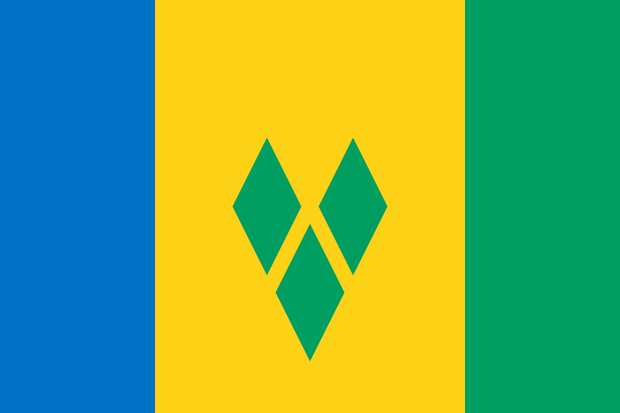
Flag is available in resolutions
| Icon 88x59 |  |
| Icon 32x21 |  |
Saint Vincent and the Grenadines
Saint Vincent and the Grenadines: An Archipelago of Enchantment
Nestled in the southeastern Caribbean Sea, Saint Vincent and the Grenadines is a captivating island nation composed of the larger island of Saint Vincent and a chain of smaller islands known as the Grenadines. This jewel of the Lesser Antilles, a part of the Windward Islands, offers a breathtaking tapestry of lush volcanic landscapes, pristine beaches, and vibrant coral reefs, making it a highly sought-after destination for those seeking an idyllic escape. With a population that harmoniously blends African, European, and Indigenous Caribbean heritage, the nation exudes a warm and welcoming spirit, a testament to its rich and complex history. The official language is English, though a local Creole dialect, Vincentian Creole, is widely spoken, adding a unique linguistic flavour to the islands. The capital and largest settlement, Kingstown, on the southwestern coast of Saint Vincent, serves as the nation’s administrative, economic, and cultural hub, buzzing with local life and colonial architecture.
The history of Saint Vincent and the Grenadines is a compelling narrative of indigenous resilience, colonial struggle, and eventual independence. Prior to European arrival, the islands were inhabited by the Carib people, a seafaring indigenous group who fiercely resisted colonization. Christopher Columbus is credited with sighting the main island in 1498, naming it after Saint Vincent of Saragossa. However, sustained European settlement proved challenging due to the Carib’s formidable resistance. The French made early attempts at colonization but eventually ceded the island to the British in 1763. The period that followed was marked by intermittent conflicts between the British and the French, as well as significant uprisings by the Garifuna, descendants of West African slaves who intermarried with the Carib. The Garifuna, known for their strong cultural identity and resistance to colonial rule, were eventually deported by the British in 1796, a tragic chapter in the islands’ history. Saint Vincent and the Grenadines gained internal self-governance in 1969 and full independence from the United Kingdom on October 27, 1979, becoming a sovereign state within the Commonwealth. This journey of self-determination has shaped the nation’s identity, fostering a strong sense of pride and a commitment to preserving its unique cultural heritage.
Geographically, Saint Vincent and the Grenadines presents a dramatic and diverse landscape. The main island, Saint Vincent, is dominated by the Soufrire volcano, an active stratovolcano that stands at 1,234 meters (4,049 feet). Its slopes are cloaked in dense, tropical rainforests, crisscrossed by numerous rivers and waterfalls, offering spectacular hiking opportunities and a haven for biodiversity. The island’s coastline is a mosaic of black volcanic sand beaches on the west coast and golden sandy stretches on the east. The Grenadines, a string of smaller islands and cays stretching southwards, are renowned for their postcard-perfect beaches, crystal-clear turquoise waters, and vibrant coral reefs. Islands like Bequia, Mustique, Canouan, Mayreau, and Union Island each possess their own distinct charm, from the sophisticated allure of Mustique, a playground for the rich and famous, to the laid-back, authentic Caribbean vibe of Bequia. The underwater world surrounding the Grenadines is a diver’s and snorkeler’s paradise, teeming with colourful marine life and offering some of the best diving experiences in the Caribbean. The nation’s exclusive economic zone extends to the south, encompassing Tobago Cays Marine Park, a protected area of five uninhabited islands renowned for its horseshoe reef and abundant sea turtles.
The economy of Saint Vincent and the Grenadines has historically been reliant on agriculture, with bananas being the primary export crop. While still significant, the agricultural sector has seen diversification in recent years, with increased production of dasheen, arrowroot, and coconuts. Tourism has emerged as a crucial pillar of the economy, attracting visitors with its natural beauty, adventure activities, and luxurious resorts. The nation’s commitment to sustainable tourism is evident in its efforts to protect its pristine environment and promote eco-friendly practices. The development of the Argyle International Airport on Saint Vincent has further boosted the tourism sector, enhancing accessibility for international travellers. The fishing industry also plays a vital role, providing sustenance and income for many coastal communities. Small-scale manufacturing, primarily focused on food processing and light industry, contributes to the local economy, though it remains a smaller sector compared to tourism and agriculture. The government continues to invest in infrastructure development and economic diversification strategies to ensure long-term prosperity and reduce reliance on traditional sectors.
Saint Vincent and the Grenadines boasts a wealth of tourist attractions catering to a wide range of interests. On Saint Vincent, the Botanical Gardens, established in 1765, are among the oldest in the Western Hemisphere and showcase a stunning array of tropical flora, including the iconic St. Vincent parrot. The rugged interior offers opportunities for hiking to the summit of La Soufrire volcano, providing panoramic views of the archipelago. The historic Fort Charlotte, perched on a ridge overlooking Kingstown harbour, offers a glimpse into the islands colonial past. The picturesque Wallilabou Bay, with its dramatic cliffs and cascading waterfalls, gained international fame as a filming location for the movie Pirates of the Caribbean. The Grenadines, however, are where the nation truly shines for many visitors. The Tobago Cays Marine Park is a must-visit, offering unparalleled opportunities for snorkelling and diving amongst sea turtles, rays, and a vibrant array of fish. Each of the inhabited Grenadine islands has its own unique appeal. Bequia, the largest of the Grenadines, retains a charming, traditional Caribbean atmosphere with its working boatyards and friendly locals. Mustique, a private island, is synonymous with exclusivity and celebrity sightings, boasting luxurious villas and pristine beaches. Canouan offers a blend of upscale resorts and natural beauty, while Mayreau, one of the smallest inhabited islands, provides an authentic, tranquil escape with its stunning Salt Whistle Bay. Union Island, often referred to as the Maltese Falcon of the Grenadines, serves as a hub for exploring the surrounding smaller islands and cays. For sailing enthusiasts, the Grenadines offer some of the most spectacular cruising grounds in the world, with calm waters, gentle breezes, and secluded anchorages. The vibrant underwater world, with its healthy coral reefs and diverse marine life, makes the islands a premier destination for scuba diving and snorkelling, with sites like the Tobago Cays, The Pinnacle, and Cable Room offering unforgettable experiences.
The cultural landscape of Saint Vincent and the Grenadines is a vibrant fusion of its historical influences. Music and dance are integral to the islands’ identity, with genres like calypso, soca, and reggae permeating daily life. Festivals, such as Carnival, are major events, characterized by elaborate costumes, energetic parades, and lively music. The nation’s cuisine reflects its diverse heritage, with fresh seafood being a staple, often prepared with local spices and tropical fruits. Popular dishes include grilled fish, callaloo soup, and various preparations of breadfruit and plantain. Traditional crafts, including basket weaving, pottery, and wood carving, are still practiced, offering visitors authentic souvenirs. The annual Bequia Music Festival and the Canouan Regatta are significant cultural events that draw both locals and tourists, showcasing the islands musical talents and maritime traditions. The warm hospitality of the Vincentian people, their easygoing nature, and their strong sense of community are palpable throughout the islands, contributing significantly to the welcoming atmosphere that defines this Caribbean paradise. The nation’s commitment to preserving its cultural heritage is evident in its museums, cultural centres, and ongoing efforts to support local artists and artisans.
Information about Saint Vincent and the Grenadines
The information comes from the publication CIA The World Factbook.
Automated text translation, excuse errors, please!
Country Saint Vincent and the Grenadines is situated in a location / continent Central America. Saint Vincent and the Grenadines has an area of 389 km2 and 103 537 residents. The highest point has a height 1 234 above sea level. and it is called La Soufriere. The lowest point is located at the level of 0 above sea level and it is named Caribbean Sea. System of government is Republic, Commonwealth member country and the date of independence 27th October 1979. The capital city is Kingstown. Saint Vincent and the Grenadines has the international abbreviation VC.
Saint Vincent and the Grenadines - economy
Total gross domestic product (GDP) is 1 275 000 000 $. Total gross domestic product per capita in purchasing power parity is 11 600 $. GDP grows by -0.40 % a year. Inflation (consumer price index) is equal to 2.30 % a year. Saint Vincent and the Grenadines have 57 520 working-age population (from a total population 103 537 people). Unemployment is at 15.00 %. Saint Vincent and the Grenadines issued 5.60 % GDP to healt care .The total amount of foreign debt is 264 900 000 USD.
Saint Vincent and the Grenadines - demography
As suggested above, Saint Vincent and the Grenadines has 103 537 people. Population growth is in the amount -0.31 % per year. Number of children born per 1000 population per year is 14.36.Every mother has average 1.89 children. The infant mortality rate is 13.86 and maternal mortality 48.00 deaths per 100,000 births. Average estimated life expectancy makes 74.39 years. Mortality is 7.02 people per 1000 population per year.
Saint Vincent and the Grenadines - transport and telecommunications
Saint Vincent and the Grenadines has 829 km of roads and 6 airports. There is registered 412 ships.
Number of active mobile phones (sim card) in the country Saint Vincent and the Grenadines is 131 800. Number of active fixed telephone lines is 22 700. Saint Vincent and the Grenadines has 76 000 internet users, who have the available 336 Internet connections. Saint Vincent and the Grenadines has been assigned a domain first Choose range .vc.
Saint Vincent and the Grenadines - energetics
Saint Vincent and the Grenadines consumes a year 122 800 000 kWh of electricity. Annual electricity production is 132 000 000 kWh in power plants with a total installed electrical capacity 49 000 kW. Saint Vincent and the Grenadines exports 0 kWh and imports 0 kWh of electricity per year Energy mix of power generation is as follows: fossil fuels: 81.6 %, nuclear energy: 0 %, renewable: 0.0 %, hydropower: 18.4 %.
Keywords: list of countries, transport, flag, energetics, national flags, Saint Vincent and the Grenadines, world countries, information, all flags, Flag of Saint Vincent and the Grenadines, demography, list of flags, flags of countries in the world, Flags of countries, telecommunications, flag states, economy, politic.