Saint Kitts and Nevis
Flag of Saint Kitts and Nevis
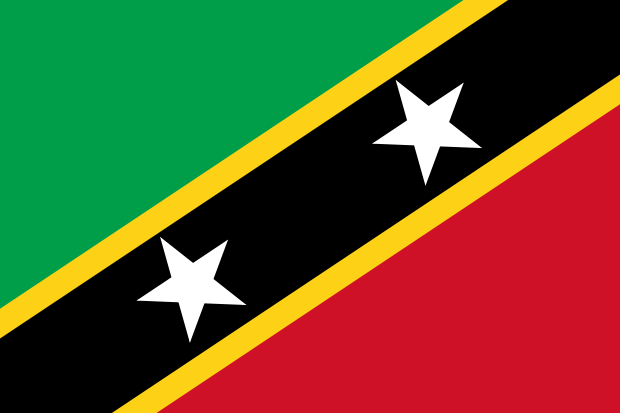
Flag is available in resolutions
| Icon 88x59 |  |
| Icon 32x21 |  |
Saint Kitts and Nevis
Saint Kitts and Nevis: A Gem of the Caribbean
Nestled in the heart of the Lesser Antilles, Saint Kitts and Nevis is a dual-island nation that embodies the quintessential Caribbean dream. This sovereign state, comprised of two islands, Saint Kitts and Nevis, boasts a rich tapestry of history, a vibrant culture, and breathtaking natural beauty. With its pristine beaches, lush rainforests, and a legacy shaped by colonial powers and the resilience of its people, Saint Kitts and Nevis offers a captivating experience for any traveler. The islands, though small in landmass, punch well above their weight in terms of charm and allure, drawing visitors from across the globe seeking sun-drenched relaxation, historical exploration, and a taste of authentic Caribbean life.
The population of Saint Kitts and Nevis is a harmonious blend of African, European, and indigenous Caribbean ancestries, a testament to its complex past. The majority of the population is of African descent, descendants of enslaved Africans brought to the islands to work on sugar plantations. This heritage is deeply woven into the fabric of the nation’s culture, evident in its music, dance, cuisine, and vibrant festivals. The official language is English, though a French-based Creole, known as Kittitian Creole, is also spoken by many, particularly on Nevis. The people are known for their warmth, hospitality, and laid-back demeanor, embodying the spirit of “island time.” The nation’s capital, Basseterre, on Saint Kitts, is a bustling port city where this cultural fusion is most palpable, with lively markets, colorful buildings, and a constant hum of activity.
The history of Saint Kitts and Nevis is a fascinating narrative of exploration, colonization, and eventual independence. Christopher Columbus is credited with sighting the islands in 1493, naming the larger island San Cristobal. However, it was the English who established the first permanent European settlement in the Caribbean on Saint Kitts in 1623, led by Sir Thomas Warner. The island, then known as Saint Christopher, quickly became a strategic outpost for the British Empire, leading to frequent conflicts with the French, who also laid claim to the territory. This period of intense rivalry saw the islands change hands multiple times, leaving behind a legacy of fortifications and colonial architecture. The introduction of sugar cane cultivation in the 17th century profoundly shaped the islands’ economy and society, leading to the brutal transatlantic slave trade and the establishment of a plantation-based economy. The abolition of slavery in 1834 marked a turning point, and the islands eventually gained full independence from the United Kingdom on September 19, 1983. This journey from colonial possession to sovereign nation is a source of immense pride for the Kittitian and Nevisian people, and echoes of this history can be found throughout the islands, from the imposing Brimstone Hill Fortress to the remnants of old sugar mills.
Geographically, Saint Kitts and Nevis is a study in volcanic drama and tropical splendor. Saint Kitts, the larger of the two islands, is dominated by the majestic Mount Liamuiga, a dormant volcano whose lush slopes are covered in dense rainforest. The island’s coastline is a mosaic of black sand beaches, a result of its volcanic origins, and stretches of golden sand. Nevis, a more intimate and seemingly tranquil island, is characterized by the iconic Nevis Peak, another dormant volcano that rises dramatically from the center of the island, often shrouded in mist. The islands are separated by a narrow strait known as The Narrows. The interior of both islands is a haven for biodiversity, with a rich variety of flora and fauna thriving in the tropical climate. The rainforests are home to a multitude of bird species, including the national bird, the brown pelican, as well as vervet monkeys, which are a common sight. The surrounding waters are teeming with marine life, making them ideal for snorkeling and diving. The islands’ topography, shaped by ancient volcanic activity, creates a dramatic and picturesque landscape that is both awe-inspiring and incredibly beautiful.
The economy of Saint Kitts and Nevis has undergone a significant transformation over the centuries. Historically, sugar production was the cornerstone of the economy, but its decline in the late 20th century prompted a diversification. Today, tourism is the primary driver of the economy, attracting visitors with its luxurious resorts, pristine beaches, and rich cultural heritage. The islands are a popular destination for cruise ships, and the cruise port in Basseterre is a vital hub for the local economy. Beyond tourism, the nation has also focused on developing its offshore financial services sector, attracting international businesses with its stable political environment and favorable regulatory framework. Agriculture, though no longer the dominant force it once was, still plays a role, with the cultivation of crops such as sugarcane (for niche markets and local consumption), coconuts, and tropical fruits contributing to the local economy and providing fresh produce for hotels and restaurants. The government has also invested in light manufacturing and the development of renewable energy sources, aiming for a more sustainable and diversified economic future.
Saint Kitts and Nevis offers a wealth of tourist attractions that cater to a wide range of interests. On Saint Kitts, the Brimstone Hill Fortress National Park is a UNESCO World Heritage site and a must-visit. This imposing fortress, built by the British in the 18th century, offers panoramic views of the surrounding islands and is a testament to the military engineering of the era. The St. Kitts Scenic Railway, a narrow-gauge railway that circles the island, provides a unique and leisurely way to experience the diverse landscapes, from coastal vistas to lush interior valleys and old sugar plantations. For nature lovers, the Concordia Heritage Trail offers guided walks through the rainforest, revealing the island’s rich biodiversity and stunning natural beauty. The capital city of Basseterre itself is worth exploring, with its colorful colonial architecture, bustling markets, and the historic Independence Square.
Nevis, often referred to as the “Queen of the Caribbees,” offers a more tranquil and unspoiled experience. Nevis Peak beckons hikers to its summit, offering challenging trails and rewarding views. The island is renowned for its beautiful beaches, such as Pinney’s Beach, which is lined with palm trees and dotted with charming beach bars. The Nevis Botanical Gardens provide a serene escape, showcasing a vibrant collection of tropical plants and flowers. History enthusiasts can explore the Alexander Hamilton Museum, dedicated to the life of the American Founding Father who was born on Nevis, and the remnants of the Montpelier Estate, a former sugar plantation that now houses a luxury hotel. The island’s charm lies in its unhurried pace of life, its lush landscapes, and its well-preserved colonial heritage, offering a truly relaxing and authentic Caribbean getaway. The underwater world surrounding both islands is equally captivating, with vibrant coral reefs and abundant marine life making it a paradise for divers and snorkelers. Whether you seek adventure, relaxation, or a deep dive into history and culture, Saint Kitts and Nevis promises an unforgettable journey.
Information about Saint Kitts and Nevis
The information comes from the publication CIA The World Factbook.
Automated text translation, excuse errors, please!
Country Saint Kitts and Nevis is situated in a location / continent Central America. Saint Kitts and Nevis has an area of 261 km2 and 50 726 residents. The highest point has a height 1 156 above sea level. and it is called Mount Liamuiga. The lowest point is located at the level of 0 above sea level and it is named Caribbean Sea. System of government is Republic, Commonwealth member country and the date of independence 19th September 1983. The capital city is Basseterre. Saint Kitts and Nevis has the international abbreviation SC.
Saint Kitts and Nevis - economy
Total gross domestic product (GDP) is 886 200 000 $. Total gross domestic product per capita in purchasing power parity is 15 800 $. GDP grows by -2.00 % a year. Inflation (consumer price index) is equal to 3.80 % a year. Saint Kitts and Nevis have 18 170 working-age population (from a total population 50 726 people). Unemployment is at 4.50 %. Saint Kitts and Nevis issued 6.00 % GDP to healt care .The public debt of the country is 200.00 % GDP. The total amount of foreign debt is 199 100 000 USD.
Saint Kitts and Nevis - demography
As suggested above, Saint Kitts and Nevis has 50 726 people. Population growth is in the amount 0.81 % per year. Number of children born per 1000 population per year is 13.90.Every mother has average 1.79 children. The infant mortality rate is 9.43 .Average estimated life expectancy makes 74.84 years. Mortality is 7.08 people per 1000 population per year.
Saint Kitts and Nevis - transport and telecommunications
Saint Kitts and Nevis has 383 km of roads, 50 km of railway lines and 2 airports. There is registered 152 ships.
Number of active mobile phones (sim card) in the country Saint Kitts and Nevis is 84 600. Number of active fixed telephone lines is 20 600. Saint Kitts and Nevis has 17 000 internet users, who have the available 52 Internet connections. Saint Kitts and Nevis has been assigned a domain first Choose range .kn.
Saint Kitts and Nevis - energetics
Saint Kitts and Nevis consumes a year 125 600 000 kWh of electricity. Annual electricity production is 135 000 000 kWh in power plants with a total installed electrical capacity 22 000 kW. Saint Kitts and Nevis exports 0 kWh and imports 0 kWh of electricity per year Energy mix of power generation is as follows: fossil fuels: 100 %, nuclear energy: 0 %, renewable: 0.0 %, hydropower: 0.0 %.
Keywords: list of flags, Saint Kitts and Nevis, world countries, information, Flag of Saint Kitts and Nevis, flag states, national flags, flag, Flags of countries, all flags, transport, flags of countries in the world, demography, energetics, economy, telecommunications, list of countries, politic.