Nicaragua
Flag of Nicaragua
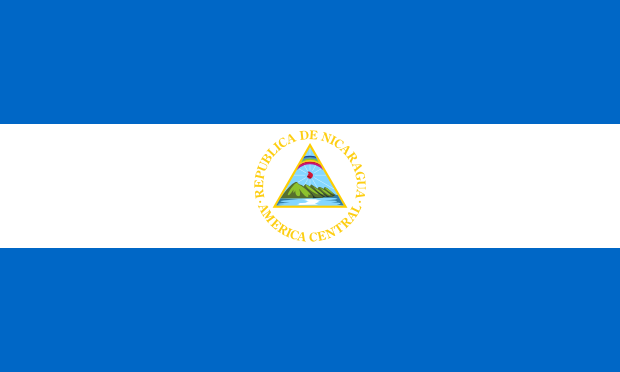
Flag is available in resolutions
| Icon 88x53 |  |
| Icon 32x19 |  |
Nicaragua
Nicaragua: Land of Lakes and Volcanoes
Nicaragua, officially the Republic of Nicaragua, is the largest country in Central America, a vibrant tapestry woven from a rich history, diverse geography, and a resilient people. Nestled between Honduras to the north and Costa Rica to the south, it boasts a long Pacific coastline and a more extensive Caribbean shore, granting it a unique dual identity. Its name, derived from the indigenous Nicarao people, evokes a deep connection to the land and its ancient inhabitants. This is a nation that has weathered colonial rule, internal conflict, and natural disasters, yet it continues to emerge with a spirit of perseverance and a profound cultural heritage. Understanding Nicaragua means delving into its dramatic landscapes, its complex past, and the warmth of its inhabitants.
The geography of Nicaragua is a defining characteristic, shaping its climate, its economy, and its very identity. The country is broadly divided into three main regions: the Pacific lowlands, the central highlands, and the Caribbean lowlands. The Pacific region is characterized by a fertile volcanic chain, a testament to the geological forces at play beneath the surface. Here, numerous volcanoes, some active and others dormant, punctuate the landscape, offering both breathtaking vistas and the ever-present potential for seismic activity. This region is also home to the country’s largest cities and its most significant agricultural production. Moving inland, the central highlands present a cooler, more mountainous terrain, characterized by rolling hills, cloud forests, and coffee plantations that cling to the slopes. This area provides a vital watershed and is crucial for Nicaragua’s agricultural output. Finally, the Caribbean lowlands, also known as the Mosquito Coast, are a stark contrast to the Pacific. This vast, sparsely populated region is dominated by dense rainforests, extensive wetlands, and a network of rivers that empty into the Caribbean Sea. The climate here is tropical, with high humidity and abundant rainfall, fostering a unique biodiversity and a distinct cultural heritage influenced by Afro-Caribbean traditions. The country is also dotted with numerous lakes, the most prominent being Lake Nicaragua (Cocibolca), the largest freshwater lake in Central America, and Lake Managua (Xolotlán), both of which are significant sources of water and transportation.
The history of Nicaragua is a compelling narrative of indigenous resilience, colonial ambition, and the struggle for self-determination. Before the arrival of Europeans, the land was inhabited by various indigenous groups, including the Nicarao, who left an indelible mark on the country’s name and early cultural foundations. Spanish colonization began in the early 16th century, with the establishment of settlements and the imposition of Spanish rule. Like much of Latin America, Nicaragua experienced centuries of colonial exploitation, with its resources and labor exploited to benefit the Spanish crown. Following independence from Spain in 1821, Nicaragua, along with other Central American nations, briefly joined the Federal Republic of Central America before embarking on its own path as an independent republic. The late 19th and early 20th centuries were marked by political instability, punctuated by periods of U.S. intervention, particularly in the early 20th century, aimed at protecting American economic interests and maintaining regional stability. The mid-20th century saw the rise of the Somoza dynasty, a family that ruled Nicaragua with an iron fist for over four decades, amassing immense wealth and power while suppressing dissent. This authoritarian rule fueled widespread discontent, leading to the Sandinista revolution in 1979, which overthrew the Somoza regime. The Sandinista National Liberation Front (FSLN) then governed for a period, implementing social reforms but also facing internal opposition and external pressure, including the U.S.-backed Contra insurgency. The 1990s saw a transition to democratic rule, with various political parties taking power, though the legacy of past conflicts and socio-economic challenges continued to shape the nation. The early 21st century has seen the return of the FSLN to power, with Daniel Ortega serving as president, a period marked by both continuity and new challenges.
The population of Nicaragua is a rich blend of mestizo, indigenous, and Afro-Caribbean heritage, contributing to a vibrant and diverse cultural landscape. The majority of Nicaraguans are mestizos, individuals of mixed European and indigenous ancestry, who form the dominant cultural and linguistic group. Indigenous communities, particularly in the western highlands and on the Caribbean coast, maintain their distinct languages, traditions, and cultural practices, adding layers of complexity to the national identity. The Afro-Caribbean population, primarily concentrated on the eastern coast, has a unique cultural heritage influenced by their African and English-speaking Caribbean roots, evident in their music, dance, and language. Spanish is the official language, spoken by the vast majority of the population. However, on the Caribbean coast, indigenous languages such as Miskito, Sumu, and Rama, as well as English Creole, are also spoken. The official religion is Roman Catholicism, a legacy of Spanish colonization, though Protestant denominations have a growing presence. Nicaraguan society is characterized by a strong sense of community and family, with traditions and social gatherings playing a central role in daily life. The arts flourish in Nicaragua, from the intricate pottery and weaving of indigenous communities to the vibrant murals and expressive music that often reflect the nation’s history and social realities.
The economy of Nicaragua, while still developing, is increasingly diversified, with agriculture playing a pivotal role. Historically, Nicaragua has been an agrarian economy, and this remains true today. Key agricultural exports include coffee, sugar, beef, tobacco, and bananas, with coffee being a particularly important commodity for both domestic consumption and international trade. The fertile volcanic soils of the Pacific lowlands and the temperate climate of the highlands are ideal for coffee cultivation, making it a cornerstone of the nation’s export earnings. Beyond agriculture, the manufacturing sector is growing, particularly in the assembly of goods for export, such as textiles and apparel. The government has also invested in developing the services sector, including tourism, which is increasingly recognized for its potential to drive economic growth and create employment opportunities. Remittances from Nicaraguans working abroad, particularly in the United States and Costa Rica, also represent a significant source of income for many families and contribute to the national economy. However, Nicaragua faces persistent challenges, including poverty, income inequality, and vulnerability to natural disasters such as hurricanes and earthquakes, which can have a devastating impact on its economy. Efforts are underway to diversify the economy further, promote sustainable development, and attract foreign investment to create a more robust and resilient economic future.
Nicaragua’s natural beauty and rich cultural heritage offer a wealth of tourist attractions, drawing visitors seeking authentic experiences beyond the typical tourist trail. The country’s volcanic landscapes are a major draw, with opportunities for hiking, climbing, and exploring active volcanoes. Masaya Volcano National Park is a must-visit, allowing visitors to peer into a glowing lava lake, a truly awe-inspiring spectacle. The Apoyo Lagoon, a stunning crater lake formed by a collapsed volcano, offers a tranquil escape for swimming, kayaking, and relaxation. The colonial cities of Nicaragua are steeped in history and charm. Granada, one of the oldest cities in the Americas, boasts well-preserved Spanish colonial architecture, with colorful buildings, ornate churches, and charming plazas. Visitors can explore its cobblestone streets, take a horse-drawn carriage ride, or visit the iconic Cathedral of Granada. León, another historic city, is known for its revolutionary spirit and its impressive cathedral, a UNESCO World Heritage site, which offers panoramic views from its rooftop. The Caribbean coast presents a different, yet equally captivating, experience. The Corn Islands (Big Corn Island and Little Corn Island) are tropical paradises with white-sand beaches, turquoise waters, and vibrant coral reefs, perfect for snorkeling, diving, and unwinding. The Miskito Coast offers opportunities for ecotourism, with opportunities to explore rainforests, encounter diverse wildlife, and learn about the unique Afro-Caribbean culture. For those interested in history and archaeology, the Ometepe Island, formed by two volcanoes rising from Lake Nicaragua, is home to ancient petroglyphs and a rich indigenous past. Nicaragua’s commitment to preserving its natural and cultural heritage makes it a compelling destination for travelers seeking adventure, history, and genuine cultural immersion.
Information about Nicaragua
The information comes from the publication CIA The World Factbook.
Automated text translation, excuse errors, please!
Country Nicaragua is situated in a location / continent Central America. Nicaragua has an area of 130 370 km2 and 5 727 707 residents. The highest point has a height 2 438 above sea level. and it is called Mogoton. The lowest point is located at the level of 0 above sea level and it is named Pacific Ocean. System of government is republic and the date of independence 15th September 1821. The capital city is Managua. Nicaragua has the international abbreviation NU.
Nicaragua - economy
Total gross domestic product (GDP) is 19 120 000 000 $. Total gross domestic product per capita in purchasing power parity is 3 200 $. GDP grows by 4.70 % a year. Inflation (consumer price index) is equal to 8.10 % a year. Nicaragua have 2 885 000 working-age population (from a total population 5 727 707 people). Unemployment is at 7.30 %. Nicaragua issued 9.50 % GDP to healt care and 0,60 % GDP to army. The public debt of the country is 70.50 % GDP. The total amount of foreign debt is 4 073 000 000 USD.
Nicaragua - demography
As suggested above, Nicaragua has 5 727 707 people. Population growth is in the amount 1.07 % per year. Number of children born per 1000 population per year is 19.12.Every mother has average 2.08 children. The infant mortality rate is 21.86 and maternal mortality 95.00 deaths per 100,000 births. Average estimated life expectancy makes 72.18 years. Mortality is 5.04 people per 1000 population per year.
Nicaragua - transport and telecommunications
Nicaragua has 19 137 km of roads and 143 airports. The total length of waterways (navigable rivers, canals, etc.) is 2 220 km.
Number of active mobile phones (sim card) in the country Nicaragua is 4 822 000. Number of active fixed telephone lines is 287 600. Nicaragua has 199 800 internet users, who have the available 176 985 Internet connections. Nicaragua has been assigned a domain first Choose range .ni.
Nicaragua - energetics
Nicaragua consumes a year 2 646 000 000 kWh of electricity. Annual electricity production is 3 585 000 000 kWh in power plants with a total installed electrical capacity 1 104 000 kW. Nicaragua exports 100 000 kWh and imports 2 000 000 kWh of electricity per year Energy mix of power generation is as follows: fossil fuels: 67.8 %, nuclear energy: 0 %, renewable: 22.6 %, hydropower: 9.5 %.
Keywords: telecommunications, flag, flag states, world countries, Nicaragua, flags of countries in the world, demography, list of flags, energetics, Flag of Nicaragua, Flags of countries, economy, transport, national flags, list of countries, information, all flags, politic.