Costa Rica
Flag of Costa Rica
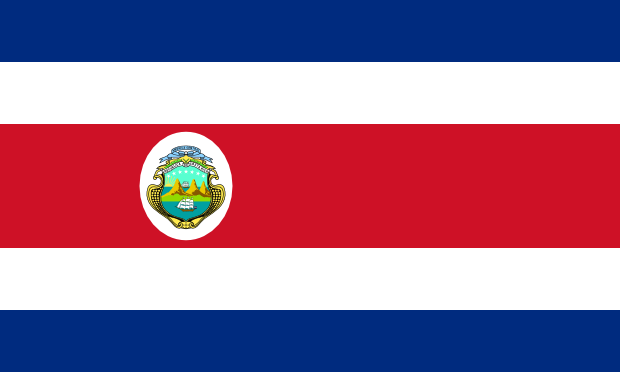
Flag is available in resolutions
| Icon 88x53 |  |
| Icon 32x19 |  |
Costa Rica
Costa Rica: A Jewel of Biodiversity and Peace
Costa Rica, nestled in the heart of Central America, is a nation that consistently captivates the world with its unparalleled biodiversity, commitment to peace, and vibrant culture. Bordered by Nicaragua to the north and Panama to the south, its Pacific and Caribbean coastlines offer a stunning juxtaposition of dramatic cliffs, pristine beaches, and lush rainforests. This small but mighty country, roughly the size of West Virginia, punches far above its weight in terms of natural wonders and progressive social policies, earning it the nickname “The Switzerland of Central America” for its neutrality and democratic traditions. Its name, meaning “Rich Coast,” hints at the abundance of natural resources and opportunities that have drawn people to its shores for centuries, and continue to define its identity today.
The story of Costa Rica’s population is one of a rich tapestry woven from indigenous roots, European colonization, and subsequent waves of immigration. The indigenous peoples, such as the Chorotega and Huetar, inhabited the land long before the arrival of Europeans. While their numbers were significantly reduced by disease and conflict during the colonial era, their legacy endures in cultural traditions, language, and archaeological sites. Spanish colonization began in the 16th century, and over time, a mestizo population, a blend of Spanish and indigenous heritage, became dominant. Unlike some of its neighbors, Costa Rica did not experience a large influx of enslaved Africans for plantation labor. Instead, its economy was initially based on small-scale farming and trade. In the 19th and 20th centuries, Costa Rica welcomed immigrants from various parts of the world, including Italy, Germany, China, and the United States, each contributing to the nation’s diverse cultural mosaic. This multiculturalism is evident in its cuisine, music, and the welcoming nature of its people, known as “Ticos” and “Ticas.” The society is characterized by a strong sense of community, a relatively high level of education, and a deep appreciation for family and tradition.
Costa Rica’s history is marked by a distinctive path towards democracy and peace, setting it apart from many of its Central American neighbors. While the region was often plagued by political instability and civil unrest in the 20th century, Costa Rica chose a different route. Following a brief but bloody civil war in 1948, the country made a profound decision: to abolish its army in 1949. This landmark act, championed by President José Figueres Ferrer, has had a transformative impact, redirecting national resources towards education, healthcare, and environmental conservation. This commitment to peace has fostered a stable political environment, attracting foreign investment and promoting sustainable development. Prior to this, Costa Rica had a history of relatively peaceful transitions of power, with a growing emphasis on democratic institutions and social welfare programs since the late 19th century. The country has consistently held free and fair elections, and its judiciary is known for its independence. This dedication to non-violence has not only shaped its internal development but also positioned Costa Rica as a mediator and advocate for peace on the international stage.
The geography of Costa Rica is nothing short of spectacular, a testament to its location along the Pacific Ring of Fire. The country is a land of dramatic contrasts, featuring towering volcanoes, verdant rainforests, cloud forests, and a stunning coastline. The Cordillera de Talamanca, a mountain range that runs through the southern part of the country, is home to Cerro Chirripó, the highest peak in Costa Rica, offering breathtaking panoramic views. Active volcanoes, such as Arenal, Poás, and Irazú, dot the landscape, each with its unique allure, from steaming craters to hot springs. The Caribbean coast is characterized by its lush lowland rainforests, mangrove swamps, and a vibrant Afro-Caribbean culture, while the Pacific coast boasts a more diverse topography, with arid Guanacaste in the north and the rugged Osa Peninsula in the south. This incredible geographical diversity supports an astonishing array of flora and fauna, making Costa Rica a global leader in biodiversity conservation. Approximately a quarter of the countrys land is protected in national parks, wildlife reserves, and biological reserves, a testament to its commitment to preserving its natural heritage. The country’s commitment to environmentalism is not just a policy; it’s deeply ingrained in its national identity.
The Costa Rican economy has undergone a significant transformation over the decades, moving away from its traditional agricultural base towards a more diversified and service-oriented model. For much of its history, coffee and bananas were the cornerstones of its economy, and they remain important export commodities today, valued for their high quality. However, recognizing the need for economic resilience and sustainability, Costa Rica has strategically invested in new sectors. The tourism industry has become a major driver of economic growth, drawing millions of visitors annually who come to experience its natural beauty, adventure activities, and ecotourism opportunities. The country’s focus on ecotourism has been particularly successful, promoting sustainable travel practices that benefit local communities and conserve the environment. In addition to tourism, Costa Rica has also emerged as a hub for high-tech manufacturing and services, particularly in the areas of medical devices, electronics, and software development. Foreign direct investment has played a crucial role in this diversification, attracted by the country’s stable political climate, educated workforce, and favorable business environment. The government has actively promoted investment in these sectors through incentives and the development of special economic zones. While agriculture still plays a role, its relative importance has decreased, with a growing emphasis on value-added products and sustainable farming practices.
Costa Rica is a treasure trove of tourist attractions, offering something for every type of traveler. For nature enthusiasts, the Manuel Antonio National Park is a must-visit, renowned for its pristine beaches, lush rainforest trails, and abundant wildlife, including sloths, monkeys, and iguanas. The Monteverde Cloud Forest Reserve provides an ethereal experience, where visitors can walk amongst the mist-shrouded trees on hanging bridges, spotting unique bird species like the resplendent quetzal. The Arenal Volcano National Park offers opportunities for hiking, hot spring relaxation, and breathtaking views of the iconic conical volcano. For those seeking adventure, zip-lining through the rainforest canopy, white-water rafting on the Pacuare River, or surfing the renowned waves of Tamarindo are popular choices. The Caribbean coast, particularly the Tortuguero National Park, is famous for its canals and as a nesting ground for sea turtles, offering a unique wildlife viewing experience. Beyond its natural wonders, Costa Rica’s vibrant culture is also a significant draw. Visitors can explore the bustling markets of San José, the capital city, learn about the country’s history at its museums, and savor the delicious local cuisine, from gallo pinto to casado. The warmth and friendliness of the Tico people further enhance the visitor experience, making Costa Rica a truly unforgettable destination. The country’s commitment to sustainability means that many of its tourism offerings are designed to minimize environmental impact and maximize the benefits for local communities, ensuring that the “Rich Coast” remains rich for generations to come.
Information about Costa Rica
The information comes from the publication CIA The World Factbook.
Automated text translation, excuse errors, please!
Country Costa Rica is situated in a location / continent Central America. Costa Rica has an area of 51 100 km2 and 4 636 348 residents. The highest point has a height 3 810 above sea level. and it is called Cerro Chirripo. The lowest point is located at the level of 0 above sea level and it is named Pacific Ocean. System of government is republic and the date of independence 15th September 1821. The capital city is San Jose. Costa Rica has the international abbreviation CS.
Costa Rica - economy
Total gross domestic product (GDP) is 55 730 000 000 $. Total gross domestic product per capita in purchasing power parity is 12 100 $. GDP grows by 4.20 % a year. Inflation (consumer price index) is equal to 4.90 % a year. Costa Rica have 2 155 000 working-age population (from a total population 4 636 348 people). Unemployment is at 6.50 %. Costa Rica issued 10.50 % GDP to healt care .The public debt of the country is 44.70 % GDP. The total amount of foreign debt is 10 050 000 000 USD.
Costa Rica - demography
As suggested above, Costa Rica has 4 636 348 people. Population growth is in the amount 1.29 % per year. Number of children born per 1000 population per year is 16.40.Every mother has average 1.92 children. The infant mortality rate is 9.20 and maternal mortality 40.00 deaths per 100,000 births. Average estimated life expectancy makes 77.89 years. Mortality is 4.38 people per 1000 population per year.
Costa Rica - transport and telecommunications
Costa Rica has 38 049 km of roads, 278 km of railway lines and 153 airports. The total length of waterways (navigable rivers, canals, etc.) is 730 km. There is registered 1 ships.
Number of active mobile phones (sim card) in the country Costa Rica is 4 358 000. Number of active fixed telephone lines is 1 491 000. Costa Rica has 1 485 000 internet users, who have the available 146 164 Internet connections. Costa Rica has been assigned a domain first Choose range .cr.
Costa Rica - energetics
Costa Rica consumes a year 8 144 000 000 kWh of electricity. Annual electricity production is 9 113 000 000 kWh in power plants with a total installed electrical capacity 2 490 000 kW. Costa Rica exports 38 000 000 kWh and imports 62 000 000 kWh of electricity per year Energy mix of power generation is as follows: fossil fuels: 24.8 %, nuclear energy: 0 %, renewable: 13.7 %, hydropower: 61.5 %.
Keywords: list of countries, flags of countries in the world, flag states, telecommunications, Flag of Costa Rica, flag, Costa Rica, demography, information, world countries, all flags, national flags, energetics, economy, transport, list of flags, Flags of countries, politic.