Benin
Flag of Benin
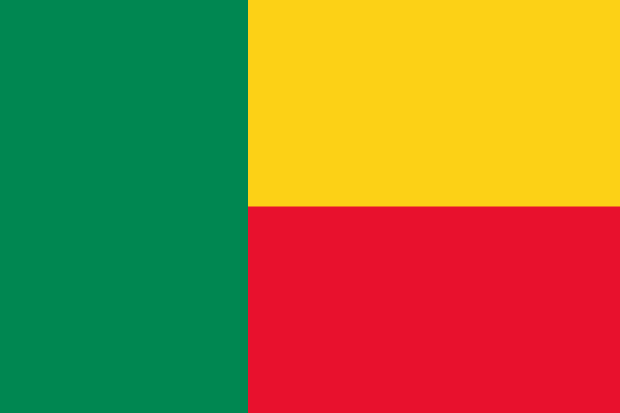
Flag is available in resolutions
| Icon 88x59 |  |
| Icon 32x21 |  |
Benin
Welcome to Benin: A Journey Through West Africa’s Vibrant Heart
Benin, officially the Republic of Benin, is a captivating nation nestled in West Africa, a land where ancient traditions intertwine with a dynamic present, and where the echoes of a complex history resonate across its diverse landscapes. Bordered by Togo to the west, Nigeria to the east, Burkina Faso and Niger to the north, and the Atlantic Ocean to the south, Benin occupies a strategically significant position, historically and culturally. This relatively small country, often overlooked in broader global narratives, possesses a richness that rewards those who seek to understand its soul. From its sprawling coastlines and dense southern forests to its vast northern savannas, Benin offers a tapestry of experiences, each thread woven with the stories of its people, their resilience, and their enduring spirit. Understanding Benin requires delving into its demographic mosaic, its fascinating historical trajectory, its varied geography, and the nascent stirrings of its economy, all while acknowledging the allure of its unique cultural heritage and burgeoning tourist attractions.
The demographic landscape of Benin is a testament to its ethnic and linguistic diversity. With an estimated population exceeding 13 million people, the nation is a vibrant melting pot of distinct cultural groups, each contributing to the national identity. The most prominent ethnic groups include the Fon, who are concentrated in the south and are historically associated with the powerful Kingdom of Dahomey; the Yoruba, found in the southeast, with deep cultural ties to their Nigerian counterparts; the Bariba and Fulani, who inhabit the northern regions and have strong pastoral traditions; and the Adja, also in the south. This intricate ethnic tapestry is mirrored in the countrys linguistic diversity, with over 50 indigenous languages spoken, though French remains the official language, a legacy of its colonial past. This linguistic richness, while presenting communication challenges, also fosters a unique cultural exchange and understanding between different communities. The population is predominantly young, with a significant proportion of individuals under the age of 25, presenting both opportunities and challenges for development and employment. The majority of Beninese people practice a blend of traditional African religions, Christianity, and Islam, often with syncretic elements where different beliefs are integrated. This religious pluralism contributes to a generally peaceful coexistence and a rich spiritual life that permeates many aspects of daily existence, from festivals and ceremonies to social customs. Urban centers like Cotonou, the economic capital, and Porto-Novo, the official capital, are growing rapidly, attracting people from rural areas in search of economic opportunities, leading to increasing urbanization and its associated social dynamics.
Benin’s history is a dramatic narrative, marked by periods of immense power, profound suffering, and eventual independence. The region was once the heartland of the formidable Kingdom of Dahomey, a powerful West African state that flourished from the 17th to the 19th centuries. The Dahomeyans were renowned for their organized military, particularly their female warriors known as the Agojie, and their significant involvement in the transatlantic slave trade. The city of Ouidah, in particular, became a major port for the export of enslaved people, a dark chapter that left an indelible scar on the nation’s past and its relationship with the wider world. The kingdom’s resistance to French colonial expansion eventually led to its subjugation in the late 19th century, and Benin, then known as Dahomey, became a French colony. The colonial era brought about significant changes, including the imposition of French administration, economy, and education systems, while also exploiting the country’s resources. Following World War II, a strong nationalist movement emerged, leading to Dahomey’s independence from France on August 1, 1960. The post-independence period was characterized by political instability, including a series of coups and military regimes, culminating in the establishment of a Marxist-Leninist state under Mathieu Kérékou in 1972. This era saw significant social and economic reforms, often with mixed results. In the early 1990s, Benin transitioned to a multi-party democracy, a pioneering move in West Africa at the time, and has since strived to maintain its democratic institutions, albeit with ongoing challenges. This rich and complex history has shaped the Beninese identity, instilling a deep sense of pride, resilience, and a profound understanding of the forces that have molded their nation.
The geography of Benin is as diverse as its people, presenting a varied topography that influences its climate, ecosystems, and economic activities. The country can be broadly divided into four distinct regions. The coastal plain in the south is low-lying and characterized by lagoons, swamps, and sandy beaches, a significant portion of which is occupied by the bustling economic hub of Cotonou. Moving north, the landscape transitions into a plateau region, with fertile soils supporting agriculture. Further north still, the terrain becomes more arid, characterized by savannas and rolling hills, eventually giving way to the Sudanian savanna in the extreme north, bordering Niger and Burkina Faso. Benin’s coastline, though relatively short, is crucial for its economy, housing its primary port and serving as a gateway for trade. The country is also crisscrossed by several rivers, the most significant being the Niger River, which forms part of its northern border, and the Ouémé River, which flows through the south to the Atlantic. These waterways are vital for transportation, irrigation, and fishing. The climate in Benin is tropical, with two distinct rainy seasons in the south and a single rainy season in the north, followed by a prolonged dry season. Temperatures are consistently high throughout the year, with humidity levels varying depending on the season and region. This climatic diversity supports a range of agricultural products, from cassava and yams in the south to cotton and shea nuts in the north. The countrys natural resources also include offshore oil reserves, which have become increasingly important to its economy.
The Beninese economy, while still developing, is showing signs of growth and diversification. Agriculture remains the backbone of the economy, employing a substantial portion of the population and contributing significantly to the GDP. Key agricultural products include cotton, which is a major export commodity, as well as maize, cassava, yams, beans, and palm oil. Livestock farming and fishing are also important sectors, particularly in the rural and coastal areas. In recent years, Benin has made strides in developing its industrial sector, with a focus on agro-processing, textiles, and light manufacturing. The discovery and exploitation of offshore oil reserves have provided a significant boost to the national revenue, although the country is working to diversify its economy beyond oil dependence. The service sector, particularly trade and telecommunications, is also growing, driven by urbanization and increased connectivity. The informal sector plays a vital role in the Beninese economy, providing livelihoods for a large segment of the population through small businesses, street vending, and artisanal crafts. Benin is actively seeking foreign investment and is implementing reforms to improve the business environment and attract international capital. Efforts are also being made to develop its tourism potential, leveraging its rich cultural heritage and natural beauty. Challenges remain, including poverty, unemployment, and the need for improved infrastructure, but the country’s commitment to economic reform and development offers promising prospects for the future.
Benin’s allure for tourists lies in its rich cultural tapestry, its historical significance, and its natural beauty. The historical sites are particularly compelling, offering a glimpse into the powerful Kingdom of Dahomey and the tragic era of the slave trade. Ouidah, a UNESCO World Heritage site, is a must-visit, with its Door of No Return, the slave dungeons, and the Sacred Forest, all bearing witness to a profound and moving past. Abomey, the former capital of Dahomey, boasts impressive royal palaces, also a UNESCO World Heritage site, which showcase the grandeur and artistry of the ancient kingdom. Beyond its historical resonance, Benin is a land of vibrant traditions and spiritual practices. The voodoo religion, often misunderstood in the West, is deeply ingrained in Beninese culture, and its colorful ceremonies and festivals are a fascinating spectacle. Ganvié, a stilt village on Lake Nokoué, is another iconic destination. This unique settlement, built entirely on wooden stilts, is home to the Tofinu people, who have adapted their lives to the rhythms of the lake, creating a floating community with its own markets, schools, and way of life. The Pendjari National Park in the north offers a more adventurous experience, providing opportunities for wildlife safaris to spot elephants, lions, cheetahs, and a variety of bird species. The country’s beaches, though not as developed as in some neighboring countries, offer a tranquil escape, particularly around Grand-Popo, known for its serene coastline and artisanal fishing villages. The vibrant markets, filled with colorful textiles, intricate crafts, and local produce, offer an immersive sensory experience and a chance to interact with the friendly Beninese people. From the historical weight of its past to the lively pulse of its present-day culture, Benin offers a travel experience that is both enriching and unforgettable, a true journey into the heart of West Africa.
Information about Benin
The information comes from the publication CIA The World Factbook.
Automated text translation, excuse errors, please!
Country Benin is situated in a location / continent Africa. Benin has an area of 112 622 km2 and 9 598 787 residents. The highest point has a height 658 above sea level. and it is called Mont Sokbaro. The lowest point is located at the level of 0 above sea level and it is named Atlantic Ocean. System of government is republic and the date of independence First August 1960. The capital city is Porto-Novo (official capital). Benin has the international abbreviation BN.
Benin - economy
Total gross domestic product (GDP) is 14 870 000 000 $. Total gross domestic product per capita in purchasing power parity is 1 500 $. GDP grows by 3.10 % a year. Inflation (consumer price index) is equal to 2.70 % a year. Benin have 3 662 000 working-age population (from a total population 9 598 787 people). Benin issued 4.20 % GDP to healt care and 1,00 % GDP to army. The public debt of the country is 31.10 % GDP. The total amount of foreign debt is 1 395 000 000 USD.
Benin - demography
As suggested above, Benin has 9 598 787 people. Population growth is in the amount 2.88 % per year. Number of children born per 1000 population per year is 37.55.Every mother has average 5.22 children. The infant mortality rate is 60.03 and maternal mortality 350.00 deaths per 100,000 births. Average estimated life expectancy makes 60.26 years. Mortality is 8.79 people per 1000 population per year.
Benin - transport and telecommunications
Benin has 16 000 km of roads, 438 km of railway lines and 5 airports. The total length of waterways (navigable rivers, canals, etc.) is 150 km.
Number of active mobile phones (sim card) in the country Benin is 7 765 000. Number of active fixed telephone lines is 152 700. Benin has 200 100 internet users, who have the available 495 Internet connections. Benin has been assigned a domain first Choose range .bj.
Benin - energetics
Benin consumes a year 778 000 000 kWh of electricity. Annual electricity production is 120 000 000 kWh in power plants with a total installed electrical capacity 60 000 kW. Benin exports 0 kWh and imports 866 000 000 kWh of electricity per year Energy mix of power generation is as follows: fossil fuels: 98.3 %, nuclear energy: 0 %, renewable: 0.0 %, hydropower: 1.7 %.
Keywords: world countries, Flag of Benin, telecommunications, Flags of countries, energetics, Benin, flag states, flags of countries in the world, information, demography, all flags, list of flags, list of countries, flag, national flags, transport, economy, politic.