Tanzania
Flag of Tanzania
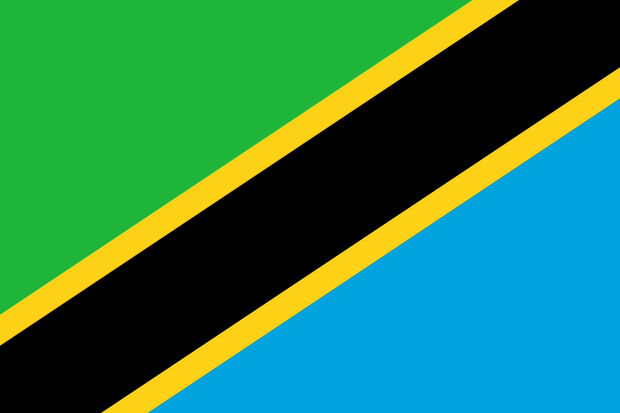
Flag is available in resolutions
| Icon 88x59 |  |
| Icon 32x21 |  |
Tanzania
Tanzania: A Tapestry of Nature, Culture, and History
Tanzania, a vast and vibrant East African nation, beckons with its unparalleled natural beauty, rich cultural heritage, and a history shaped by ancient civilizations and colonial powers. Straddling the Equator, this land of diverse landscapes, from the iconic Serengeti plains to the spice-scented shores of Zanzibar, offers an extraordinary journey for any traveler. Its name itself is a testament to its union, born from the merger of Tanganyika and Zanzibar in 1964, creating a country that embodies both the mainlands sprawling wilderness and the islands exotic allure.
The demographic mosaic of Tanzania is as varied as its geography. With an estimated population exceeding 60 million people, it is one of the most populous countries in East Africa. The population is predominantly rural, with agriculture forming the backbone of the economy and the lifestyle for a significant portion of its inhabitants. However, urban centers like Dar es Salaam, the former capital and largest city, are experiencing rapid growth, becoming hubs of commerce and cultural exchange. The Tanzanian populace is comprised of over 120 distinct ethnic groups, each with its own unique language, customs, and traditions. Among the most prominent are the Sukuma, Nyamwezi, Chagga, and Hutu. This incredible ethnic diversity contributes to a rich tapestry of cultural expressions, evident in music, dance, art, and storytelling. Swahili, a Bantu language with Arabic influences, serves as the official and national language, fostering a sense of unity across this diverse nation. English is also widely spoken, particularly in business and education. The religious landscape is also a blend of traditions, with Islam being prevalent in coastal areas and Zanzibar, while Christianity holds sway in the interior. Traditional African beliefs also continue to be practiced by many communities.
Tanzanias history is a long and complex narrative, stretching back millennia. Archaeological evidence suggests human habitation in the region dating back millions of years, with early hominid fossils found in the Great Rift Valley. The coast became a vital trading hub as early as the first millennium AD, with Arab and Persian merchants establishing settlements and facilitating trade in ivory, gold, and slaves. This period saw the rise of influential Swahili city-states like Kilwa Kisiwani, whose ruins stand as a testament to their former glory. The arrival of Europeans in the 15th century marked a new chapter. The Portuguese were the first to establish a significant presence, followed by the Omani Arabs who eventually gained control of the coast. In the late 19th century, the region was carved up by colonial powers, with Tanganyika falling under German East Africa and Zanzibar becoming a British protectorate. The colonial era brought significant changes, including the introduction of cash crops, the establishment of administrative structures, and the exploitation of natural resources. Following World War I, Tanganyika was administered by Britain under a League of Nations mandate. The independence movement gained momentum in the post-war years, culminating in Tanganyikas independence on December 9, 1961, led by Julius Nyerere. Zanzibar gained its independence from British rule on December 10, 1963, and a revolution shortly after led to the establishment of a socialist republic. The subsequent unification of Tanganyika and Zanzibar on April 26, 1964, formed the United Republic of Tanzania, with Nyerere as its first president. Nyereres leadership was characterized by his vision of Ujamaa, a form of African socialism aimed at promoting self-reliance and social equality, though its implementation faced significant challenges.
Geographically, Tanzania is a land of breathtaking contrasts and immense scale. It is the largest country in East Africa, bordering Kenya and Uganda to the north, Rwanda, Burundi, and the Democratic Republic of Congo to the west, Zambia, Malawi, and Mozambique to the south, and the Indian Ocean to the east. The country is dominated by the vast Serengeti plains, a UNESCO World Heritage Site renowned for its annual wildebeest migration, a spectacle of nature that draws millions of visitors. To the north, Mount Kilimanjaro, Africas highest peak, stands majestically, a dormant volcano offering challenging climbs and awe-inspiring views. The Great Rift Valley, a colossal geological feature, cuts through the western part of the country, creating dramatic escarpments and numerous lakes, including the vast Lake Victoria, the largest lake in Africa and the source of the Nile River. Lake Tanganyika, the worlds second-deepest freshwater lake, forms part of Tanzanias western border. The country also boasts a diverse coastline along the Indian Ocean, characterized by pristine white-sand beaches, coral reefs, and the historically significant island of Zanzibar. Zanzibar, an archipelago off the coast, is a tropical paradise with lush spice plantations, ancient stone towns, and a unique blend of African, Arab, and European influences. Inland, the landscape shifts to savannas, woodlands, and the miombo forests, teeming with an incredible array of wildlife. The countrys climate varies significantly depending on altitude and proximity to the coast, ranging from tropical along the coast to temperate in the highlands.
The Tanzanian economy, while still heavily reliant on agriculture, is experiencing diversification and growth, particularly in the tourism and mining sectors. Agriculture remains the dominant employer, with key crops including coffee, tea, cotton, cashews, and sisal. Livestock farming is also a significant contributor to the rural economy. The discovery of significant natural gas reserves has opened new avenues for economic development, and the government is actively investing in infrastructure and energy projects. Mining is another crucial sector, with Tanzania being a major producer of gold, diamonds, and gemstones. The tourism industry is arguably Tanzanias most significant foreign exchange earner. The countrys world-renowned national parks, such as the Serengeti, Ngorongoro Conservation Area, Tarangire, and the Selous Game Reserve, attract visitors from across the globe eager to witness the Big Five – lions, leopards, elephants, rhinos, and buffalo – in their natural habitat. Zanzibars appeal lies in its historical Stone Town, its beautiful beaches, and its vibrant spice culture. The government is committed to sustainable tourism development, aiming to balance economic benefits with the preservation of its natural and cultural heritage. Other industries include manufacturing, which is gradually expanding, and fisheries, particularly along the coast and the Great Lakes.
Tanzania is a treasure trove of tourist attractions, offering an unforgettable experience for every type of traveler. The Serengeti National Park is, without doubt, the crown jewel, famous for the Great Migration, where millions of wildebeest and zebras traverse the plains in search of greener pastures. The Ngorongoro Conservation Area, a UNESCO World Heritage Site, is a natural wonder, a caldera that cradles a remarkable concentration of wildlife, including the rare black rhinoceros. Visitors can descend into the crater floor for an unparalleled game-viewing experience. Further south, the Selous Game Reserve, the largest game reserve in Africa, offers a more remote and wild safari adventure, with boat safaris on the Rufiji River providing a unique perspective. For those seeking a different kind of natural wonder, Mount Kilimanjaro presents an iconic trekking challenge, with routes like the Marangu and Machame offering stunning vistas as climbers ascend to its snow-capped summit. The Gombe Stream National Park is famous for its chimpanzee trekking, made popular by Jane Goodalls groundbreaking research. Beyond the mainlands wilderness, Zanzibar offers a captivating blend of history and tropical beauty. The Stone Town, a UNESCO World Heritage Site, is a labyrinth of narrow streets, bustling markets, and ancient buildings that whisper tales of its rich past as a center of trade and culture. The islands pristine beaches, such as Nungwi and Kendwa, provide idyllic settings for relaxation and water sports. A visit to a spice plantation is a must, allowing visitors to experience the fragrant aromas of cloves, cinnamon, and nutmeg, and learn about their cultivation. For those interested in marine life, the Mnemba Atoll offers world-class diving and snorkeling opportunities amidst vibrant coral reefs. The cultural richness of Tanzania is equally compelling, with opportunities to interact with local communities, learn about their traditions, and witness traditional dances and music. From the awe-inspiring wildlife encounters to the historical intrigue and the serene beauty of its islands, Tanzania truly offers a journey that touches the soul.
Information about Tanzania
The information comes from the publication CIA The World Factbook.
Automated text translation, excuse errors, please!
Country Tanzania is situated in a location / continent Africa. Tanzania has an area of 947 300 km2 and 46 912 768 residents. The highest point has a height 5 895 above sea level. and it is called Kilimanjaro. The lowest point is located at the level of 0 above sea level and it is named Indian Ocean. System of government is republic and the date of independence 26th April 1964. The capital city is Dar es Salaam. Tanzania has the international abbreviation TZ.
Tanzania - economy
Total gross domestic product (GDP) is 64 710 000 000 $. Total gross domestic product per capita in purchasing power parity is 1 500 $. GDP grows by 6.70 % a year. Inflation (consumer price index) is equal to 12.70 % a year. Tanzania have 24 060 000 working-age population (from a total population 46 912 768 people). Tanzania issued 5.10 % GDP to healt care and 0,20 % GDP to army. The public debt of the country is 36.10 % GDP. The total amount of foreign debt is 9 490 000 000 USD.
Tanzania - demography
As suggested above, Tanzania has 46 912 768 people. Population growth is in the amount 1.96 % per year. Number of children born per 1000 population per year is 31.81.Every mother has average 5.08 children. The infant mortality rate is 65.74 and maternal mortality 460.00 deaths per 100,000 births. Average estimated life expectancy makes 53.14 years. Mortality is 11.92 people per 1000 population per year.
Tanzania - transport and telecommunications
Tanzania has 91 049 km of roads, 3 689 km of railway lines and 106 airports. There is registered 94 ships.
Number of active mobile phones (sim card) in the country Tanzania is 25 666 000. Number of active fixed telephone lines is 161 100. Tanzania has 678 000 internet users, who have the available 25 832 Internet connections. Tanzania has been assigned a domain first Choose range .tz.
Tanzania - energetics
Tanzania consumes a year 3 589 000 000 kWh of electricity. Annual electricity production is 4 489 000 000 kWh in power plants with a total installed electrical capacity 957 000 kW. Tanzania exports 0 kWh and imports 0 kWh of electricity per year Energy mix of power generation is as follows: fossil fuels: 39.5 %, nuclear energy: 0 %, renewable: 0.0 %, hydropower: 60.5 %.
Keywords: demography, telecommunications, flag states, all flags, world countries, list of countries, flag, energetics, flags of countries in the world, national flags, Flag of Tanzania, economy, transport, Flags of countries, list of flags, Tanzania, information, politic.