Botswana
Flag of Botswana
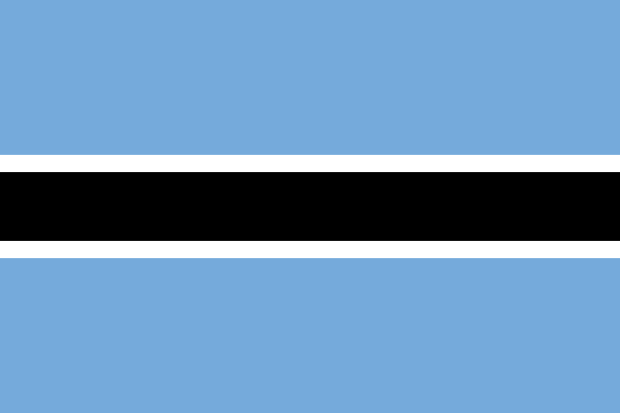
Flag is available in resolutions
| Icon 88x59 |  |
| Icon 32x21 |  |
Botswana
Botswana: A Jewel of Southern Africa
Botswana, a landlocked nation nestled in the heart of Southern Africa, is a country that often surprises visitors with its vast, untamed wilderness, rich cultural heritage, and remarkable economic success. Bordered by South Africa, Namibia, Zambia, and Zimbabwe, Botswana occupies a strategic position, yet it has carved out a unique identity marked by its commitment to conservation, democratic governance, and the judicious management of its natural resources. The country’s landscape is incredibly diverse, ranging from the arid expanse of the Kalahari Desert to the lush wetlands of the Okavango Delta, creating a mosaic of ecosystems that support an astonishing array of wildlife. This geographical duality has profoundly shaped Botswana’s history, economy, and the very fabric of its society.
The population of Botswana, though relatively small with just over two million people, is characterized by its ethnic diversity, with the Tswana people forming the largest ethnic group. Other significant ethnic communities include the Kalanga, Basarwa (San), and Kgalagadi, each contributing to the rich tapestry of Botswana’s cultural landscape. The official language is English, a legacy of its colonial past, but Setswana is widely spoken and serves as a unifying national language. The majority of the population adheres to Christianity, though traditional beliefs and practices remain influential, particularly in rural areas. The demographic profile of Botswana is relatively young, with a significant proportion of its population under the age of 25, presenting both opportunities and challenges for future development. The country has made commendable strides in healthcare and education since its independence, leading to improvements in life expectancy and literacy rates, though challenges related to HIV/AIDS and access to quality education in remote areas persist. The urban centers, such as the capital city Gaborone and Francistown, are growing rapidly, drawing people from rural areas in search of economic opportunities, leading to a gradual shift in population distribution.
Botswana’s history is a compelling narrative of resilience, self-determination, and strategic leadership. Before European colonization, the region was inhabited by various indigenous groups, including the San people, who are among the oldest inhabitants of Southern Africa. The emergence of the Tswana kingdoms in the 18th and 19th centuries marked a significant period of political and social organization. The arrival of European missionaries and traders in the 19th century gradually led to increased European influence. In 1885, the territory was declared a British protectorate, known as Bechuanaland. During the colonial era, Bechuanaland remained largely underdeveloped, with the British administration focusing primarily on maintaining order and preventing encroachment by neighboring colonial powers. However, this period also laid the groundwork for the development of administrative structures that would later be crucial for independent governance. The struggle for independence was relatively peaceful, culminating in Botswana’s attainment of self-rule on September 30, 1966, under the leadership of Sir Seretse Khama, its first president. Khama’s vision for a democratic, non-racial, and prosperous nation was instrumental in shaping Botswana’s post-independence trajectory. His emphasis on good governance, fiscal prudence, and equitable distribution of wealth, particularly from diamond mining, set Botswana on a path of remarkable economic growth and stability, distinguishing it from many of its neighbors who faced significant political turmoil.
The geography of Botswana is dominated by the Kalahari Desert, which covers more than 70% of the country. This vast, semi-arid sandy savanna is characterized by its red soil, sparse vegetation, and extreme temperatures. Despite its arid nature, the Kalahari supports a surprising amount of wildlife adapted to its harsh conditions, including springbok, gemsbok, and the elusive brown hyena. The most iconic geographical feature of Botswana, however, is the Okavango Delta. This inland delta, formed by the Okavango River, is one of the worlds largest inland deltas and a UNESCO World Heritage Site. The delta is a labyrinth of channels, lagoons, and islands that teem with life, attracting an incredible diversity of wildlife, including elephants, lions, hippos, crocodiles, and a myriad of bird species. The annual flooding of the Okavango, originating from rainfall in the Angolan highlands, transforms the landscape and creates a vibrant ecosystem. To the east of the Kalahari lies the Makgadikgadi Pans, a colossal salt pan that is the remnant of a prehistoric superlake. During the wet season, parts of the pans are covered by a shallow layer of water, attracting flamingos and other migratory birds. Botswana also has a mountainous region in the southeast, with the Tswapong Hills and the Otse Hill offering scenic beauty and cultural significance. The country’s rivers, though few, are vital for its water supply and support life in the surrounding areas.
Botswana’s economy has undergone a dramatic transformation since independence, largely driven by the discovery and prudent management of its vast diamond reserves. Diamonds are the backbone of Botswana’s economy, accounting for a significant portion of its export earnings and government revenue. The country has established a successful partnership with De Beers, a leading diamond company, through Debswana, a joint venture that has ensured that the benefits of diamond mining are shared with the nation. Beyond diamonds, Botswana also has substantial reserves of other minerals, including coal, nickel, copper, and soda ash, which contribute to its export portfolio. The government has actively pursued diversification strategies to reduce its reliance on diamonds. The tourism sector has emerged as a major growth industry, capitalizing on Botswana’s pristine wilderness and abundant wildlife. Safari tourism, particularly in the Okavango Delta and Chobe National Park, attracts visitors from around the globe, generating substantial revenue and creating employment opportunities. Agriculture, though facing challenges due to the arid climate, remains important, with cattle ranching being a significant contributor to the rural economy and export earnings. The government has also invested in infrastructure development, including roads, telecommunications, and energy, to support economic growth and attract foreign investment. The financial sector is relatively stable and well-regulated, and the country has a commitment to free market principles.
Botswana is a premier destination for wildlife enthusiasts and nature lovers, boasting some of the most spectacular natural landscapes and wildlife viewing opportunities in Africa. The Okavango Delta is undoubtedly the crown jewel, offering unparalleled experiences like mokoro (traditional dugout canoe) safaris, walking safaris, and game drives. The sheer abundance of wildlife, especially large mammals, is breathtaking. Chobe National Park, located in the north, is renowned for its massive elephant herds, which often congregate along the Chobe River. Boat safaris on the Chobe River provide an unforgettable perspective of these majestic creatures and a plethora of other animals and birds. The Central Kalahari Game Reserve offers a different kind of safari experience, focusing on the stark beauty of the desert and its uniquely adapted wildlife, including meerkats and black-maned lions. For those interested in paleontology and natural history, the Tsodilo Hills, a UNESCO World Heritage Site, are an absolute must-visit. This sacred place features a vast collection of rock paintings created by the San people over thousands of years, offering a glimpse into the spiritual and cultural life of ancient inhabitants. The capital city, Gaborone, while not primarily a wildlife destination, offers a glimpse into modern Botswana, with its markets, museums, and the National Museum and Art Gallery. The Kubu Island in the Makgadikgadi Pans is another unique attraction, a rocky outcrop rising from the salt pans, offering stunning sunsets and a sense of profound solitude. Botswana’s commitment to conservation is evident in its extensive network of national parks and game reserves, which are managed with a strong focus on sustainability and minimizing human impact. This dedication has ensured that its natural heritage is preserved for future generations, making it a truly remarkable destination.
Information about Botswana
The information comes from the publication CIA The World Factbook.
Automated text translation, excuse errors, please!
Country Botswana is situated in a location / continent Africa. Botswana has an area of 581 730 km2 and 2 098 018 residents. The highest point has a height 1 489 above sea level. and it is called Tsodilo Hills. The lowest point is located at the level of 513 above sea level and it is named junction of the Limpopo and Shashi řekas. System of government is republic and the date of independence 30th September 1966. The capital city is Gaborone. Botswana has the international abbreviation BC.
Botswana - economy
Total gross domestic product (GDP) is 30 090 000 000 $. Total gross domestic product per capita in purchasing power parity is 16 200 $. GDP grows by 4.60 % a year. Inflation (consumer price index) is equal to 8.50 % a year. Botswana have 1 269 000 working-age population (from a total population 2 098 018 people). Unemployment is at 7.50 %. Botswana issued 10.30 % GDP to healt care and 3,30 % GDP to army. The public debt of the country is 14.50 % GDP. The total amount of foreign debt is 1 973 000 000 USD.
Botswana - demography
As suggested above, Botswana has 2 098 018 people. Population growth is in the amount 1.48 % per year. Number of children born per 1000 population per year is 22.02.Every mother has average 2.46 children. The infant mortality rate is 10.49 and maternal mortality 160.00 deaths per 100,000 births. Average estimated life expectancy makes 55.74 years. Mortality is 12.00 people per 1000 population per year.
Botswana - transport and telecommunications
Botswana has 25 798 km of roads, 888 km of railway lines and 76 airports.
Number of active mobile phones (sim card) in the country Botswana is 2 900 000. Number of active fixed telephone lines is 149 600. Botswana has 120 000 internet users, who have the available 2 674 Internet connections. Botswana has been assigned a domain first Choose range .bw.
Botswana - energetics
Botswana consumes a year 2 955 000 000 kWh of electricity. Annual electricity production is 417 000 000 kWh in power plants with a total installed electrical capacity 132 000 kW. Botswana exports 0 kWh and imports 2 890 000 000 kWh of electricity per year Energy mix of power generation is as follows: fossil fuels: 100 %, nuclear energy: 0 %, renewable: 0.0 %, hydropower: 0.0 %.
Keywords: information, transport, list of flags, Flags of countries, flag, national flags, demography, energetics, world countries, Flag of Botswana, flags of countries in the world, list of countries, telecommunications, flag states, Botswana, economy, all flags, politic.