Comoros
Flag of Comoros
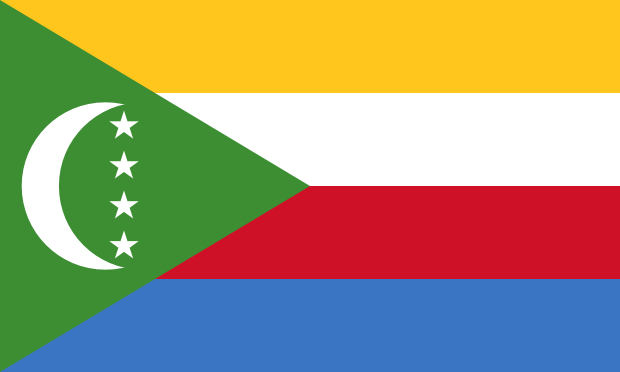
Flag is available in resolutions
| Icon 88x53 |  |
| Icon 32x19 |  |
Comoros
The Comoros Islands, an archipelago nation nestled in the Mozambique Channel between Madagascar and the African mainland, represent a captivating blend of African, Arab, and European influences, a tapestry woven over centuries of trade, migration, and colonial rule. Officially known as the Union of the Comoros, this island nation comprises four major islands: Grande Comore (Ngazidja), Anjouan (Nzwani), Mohéli (Mwali), and Mayotte (Maore), though Mayotte remains a French overseas collectivity, a point of ongoing contention for the Comorian government. The Comoros, with its dramatic volcanic landscapes, lush rainforests, and vibrant coral reefs, offers a unique and relatively untouched destination for those seeking an authentic cultural and natural experience.
The population of the Comoros is a testament to its rich historical interactions. Predominantly of Bantu origin, the Comorian people are a blend of indigenous islanders and settlers from mainland Africa, Arabia, Persia, and even Madagascar. This diverse ancestry is reflected in their language, customs, and religion. The official languages are Shikomori (a Bantu language with Arabic and French influences), Arabic, and French. Islam is the dominant religion, deeply ingrained in the social fabric and daily life, with mosques dotting the landscape and religious festivals playing a significant role in community gatherings. The Comorian people are known for their warmth and hospitality, often referred to as the perfume islands not only for their aromatic crops but also for the sweet disposition of its inhabitants. The population, though relatively small, is concentrated on the larger islands, with Moroni, the capital city on Grande Comore, serving as the administrative and economic hub. Family ties are strong, and community life is central, with traditional governance structures often coexisting alongside formal government institutions. The demographic profile shows a young population, with a high birth rate, posing challenges and opportunities for economic development and resource management.
The history of the Comoros is a long and intricate narrative, shaped by its strategic location as a trading post. Early settlement is believed to have been by Austronesian peoples, followed by Bantu migrations. By the 10th century, Arab traders and scholars began to establish a significant presence, introducing Islam and Arabic script, laying the foundation for the Swahili culture that would flourish across the East African coast. For centuries, the islands were ruled by various sultanates, each vying for influence and control, fostering a complex political landscape. The Portuguese briefly visited in the early 16th century, but their impact was minimal. The most significant external influence came with the arrival of the French in the 19th century. The Comoros were gradually colonized, becoming a French protectorate in 1841 and later a French colony. During the colonial era, the islands were administered as part of French Madagascar until 1946, when they gained a degree of autonomy. The push for independence gained momentum in the 1960s, and on July 6, 1975, the Comoros declared independence, with Grande Comore, Anjouan, and Mohéli forming the new nation. Mayotte, however, voted to remain a French territory, a decision that continues to be a source of tension. The post-independence period has been marked by political instability, including numerous coups and attempted coups, often fueled by internal power struggles and regional rivalries. Despite these challenges, the Comoros has strived to establish a stable democratic government and foster national unity.
Geographically, the Comoros are a land of striking contrasts and volcanic origins. The archipelago is situated on the northern end of the Mozambique Channel, approximately 200 kilometers east of the African continent. The islands are characterized by their rugged terrain, with active and dormant volcanoes dominating the landscapes. Grande Comore is home to Mount Karthala, one of the largest active volcanoes in the world, whose imposing presence shapes the island’s topography and climate. The volcanic soil is incredibly fertile, supporting a rich biodiversity and the cultivation of valuable aromatic plants. The coastline is a mix of sandy beaches, dramatic cliffs, and coral reefs, offering opportunities for diving and snorkeling. The climate is tropical maritime, with distinct wet and dry seasons. The wet season, from November to April, brings heavy rainfall and higher humidity, while the dry season, from May to October, is characterized by pleasant temperatures and less precipitation. The islands are also susceptible to tropical cyclones, which can cause significant damage. The smaller islands, like Mohéli, are known for their pristine natural beauty, including marine parks and protected areas that are crucial for the preservation of the archipelago’s unique ecosystems.
The economy of the Comoros is largely agrarian, with a significant reliance on the export of cash crops. The fertile volcanic soil and favorable climate make it an ideal location for the cultivation of vanilla, ylang-ylang, and cloves, earning the islands the moniker the perfume islands. These aromatic spices are highly sought after in the international market, forming the backbone of the Comorian export economy. Agriculture employs a substantial portion of the population, and subsistence farming is also prevalent, providing food security for many households. Other agricultural products include copra, bananas, and cassava. Beyond agriculture, the fishing industry plays a vital role, with abundant marine resources supporting local communities and contributing to the national economy. Tourism, while still in its nascent stages, holds considerable potential for growth. The pristine natural beauty, unique cultural heritage, and relatively untouched landscapes offer an attractive proposition for adventurous travelers. However, the development of the tourism sector is hampered by limited infrastructure, including transportation and accommodation facilities. The government is actively seeking to diversify the economy and attract foreign investment in sectors beyond agriculture, aiming to reduce its dependence on a few key commodities and create more employment opportunities for its growing population. The informal sector is also significant, with many Comorians engaged in small-scale trading and services.
The tourist attractions in the Comoros are as diverse as its population and history. Grande Comore, the largest island, offers the dramatic ascent of Mount Karthala, an unforgettable trekking experience for the adventurous, rewarding climbers with breathtaking panoramic views. The capital city, Moroni, boasts the Grande Mosquée du Vendredi, a beautiful example of Swahili architecture, and the historic medina, a labyrinth of narrow streets filled with bustling markets and traditional houses. The coastline of Grande Comore is dotted with picturesque beaches like Bouni and Chomoni, perfect for relaxation and swimming. Anjouan, known as the garden of the Comoros, is renowned for its lush green hills, cascading waterfalls, and terraced plantations. The capital, Mutsamudu, is a charming port town with a historic citadel that offers insights into the island’s past. The island’s interior is ideal for exploring scenic hiking trails and discovering its vibrant flora and fauna. Mohéli, the smallest of the main islands, is a haven for nature lovers. It is home to the Mohéli Marine Park, a protected area that safeguards a rich marine ecosystem, including sea turtles that nest on its shores. The islands untouched beaches and tranquil atmosphere provide an idyllic escape. While Mayotte remains a French territory, its stunning turquoise lagoons, coral reefs, and diverse marine life are a significant draw for visitors, though access and political status can be complex. The Comoros offers an authentic travel experience, far removed from mass tourism, where visitors can immerse themselves in the local culture, interact with friendly communities, and witness the raw, untamed beauty of this East African archipelago. The islands are a destination for those who appreciate natural splendor, cultural richness, and a genuine encounter with a unique corner of the world.
Information about Comoros
The information comes from the publication CIA The World Factbook.
Automated text translation, excuse errors, please!
Country Comoros is situated in a location / continent Africa. Comoros has an area of 2 235 km2 and 737 284 residents. The highest point has a height 2 360 above sea level. and it is called Le Karthala. The lowest point is located at the level of 0 above sea level and it is named Indian Ocean. System of government is republic and the date of independence 6th November 1975. The capital city is Moroni. Comoros has the international abbreviation CN.
Comoros - economy
Total gross domestic product (GDP) is 847 700 000 $. Total gross domestic product per capita in purchasing power parity is 1 200 $. GDP grows by 2.20 % a year. Inflation (consumer price index) is equal to 4.00 % a year. Comoros have 268 500 working-age population (from a total population 737 284 people). Unemployment is at 20.00 %. Comoros issued 3.40 % GDP to healt care and 2,80 % GDP to army. The total amount of foreign debt is 279 300 000 USD.
Comoros - demography
As suggested above, Comoros has 737 284 people. Population growth is in the amount 2.06 % per year. Number of children born per 1000 population per year is 31.49.Every mother has average 4.09 children. The infant mortality rate is 68.97 and maternal mortality 280.00 deaths per 100,000 births. Average estimated life expectancy makes 62.74 years. Mortality is 8.19 people per 1000 population per year.
Comoros - transport and telecommunications
Comoros has 880 km of roads and 4 airports. There is registered 149 ships.
Number of active mobile phones (sim card) in the country Comoros is 216 400. Number of active fixed telephone lines is 23 600. Comoros has 24 300 internet users, who have the available 15 Internet connections. Comoros has been assigned a domain first Choose range .km.
Comoros - energetics
Comoros consumes a year 48 360 000 kWh of electricity. Annual electricity production is 52 000 000 kWh in power plants with a total installed electrical capacity 6 000 kW. Comoros exports 0 kWh and imports 0 kWh of electricity per year Energy mix of power generation is as follows: fossil fuels: 83.3 %, nuclear energy: 0 %, renewable: 0.0 %, hydropower: 16.7 %.
Keywords: energetics, list of countries, world countries, Flag of Comoros, transport, flag, flag states, demography, list of flags, national flags, Comoros, information, telecommunications, economy, Flags of countries, all flags, flags of countries in the world, politic.