Djibouti
Flag of Djibouti
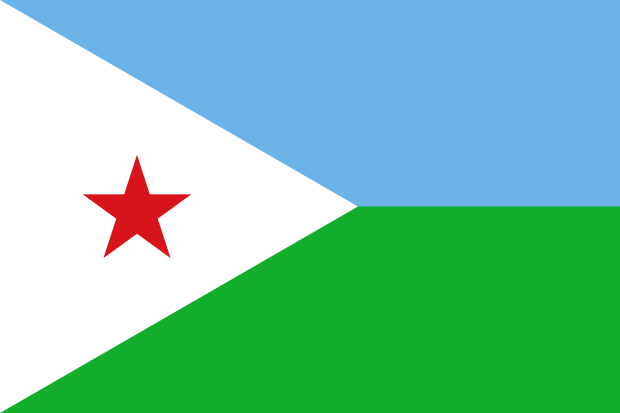
Flag is available in resolutions
| Icon 88x59 |  |
| Icon 32x21 |  |
Djibouti
Djibouti: A Strategic Nexus on the Horn of Africa
Djibouti, officially the Republic of Djibouti, is a small but strategically vital nation nestled in the Horn of Africa. Its geographical position at the confluence of the Red Sea and the Gulf of Aden, a crucial maritime chokepoint, has profoundly shaped its history, economy, and international relations. This arid land, characterized by volcanic landscapes, salt lakes, and a rugged coastline, is a melting pot of cultures, primarily influenced by its Somali and Afar populations, alongside Arab and French heritage. Understanding Djibouti requires delving into its unique geography, its complex past, and its modern-day role as a hub for international trade and military presence.
The geography of Djibouti is undeniably a dominant factor in its identity and development. Covering an area of just over 23,000 square kilometers, it is a land of stark contrasts. The northern and central regions are dominated by volcanic plateaus and mountain ranges, remnants of past tectonic activity. The highest point, Moussa Ali, reaches 2,021 meters. The southern and western parts are characterized by vast, arid plains and desert scrub. The coastline, stretching for approximately 314 kilometers, is a vital artery for trade and provides access to the Red Sea. Perhaps the most striking geographical feature is Lake Assal, a hypersaline lake situated 155 meters below sea level, making it the lowest point in Africa and the third-lowest on Earth. Its shimmering, salt-encrusted shores are a surreal spectacle. Another significant natural wonder is the Day Forest National Park, a small but important ecological refuge that harbors unique flora and fauna, a rarity in this predominantly dry environment. The climate is predominantly hot and arid, with very little rainfall, leading to a scarcity of arable land and a reliance on imported food. The country experiences two main seasons: a hot and dry season from May to September, and a cooler, slightly less dry season from October to April. The prevailing winds, known as the Khamsin, can also bring sandstorms, further exacerbating the challenging environmental conditions. Despite these hardships, the Djiboutian people have developed remarkable resilience and adapted their lifestyles to the harsh realities of their homeland.
Djiboutis history is intrinsically linked to its strategic location. For centuries, the region was inhabited by nomadic Somali and Afar peoples. The arrival of Europeans in the 19th century marked a turning point. France, seeking to secure a coaling station and a foothold in the lucrative East African trade routes, began to establish its presence in the late 1800s. In 1884, France signed treaties with local Somali sultans, leading to the creation of French Somaliland. This colonial era, which lasted for decades, saw the development of the port city of Djibouti as a key transshipment point for goods and a naval base. The French colonial administration introduced its language, legal system, and infrastructure, leaving an indelible mark on the country. During World War II, Djibouti, under Vichy French control, was a strategic concern for the Allied forces. Following the war, a movement for independence gained momentum. In 1967, French Somaliland was renamed the French Territory of the Afars and the Issas. Finally, on June 27, 1977, Djibouti achieved full independence, becoming the Republic of Djibouti. The post-independence period has been characterized by the ongoing challenge of nation-building in a region prone to instability and conflict. The country has managed to maintain its sovereignty and has played a role in regional peace efforts, though it has also grappled with internal political dynamics and economic development challenges.
The population of Djibouti is relatively small, estimated to be around one million people. The two largest ethnic groups are the Somalis, primarily the Issa clan, and the Afars. These two groups have historically shared the territory and have a complex, often intertwined, relationship. There are also smaller communities of Arabs, Europeans (predominantly French), and Ethiopians. The official languages are Somali and Afar, but French and Arabic are also widely spoken, reflecting the countrys colonial past and its connections to the Arab world. Islam is the dominant religion, with the vast majority of the population being Sunni Muslims. The Djiboutian society is largely traditional, with strong family ties and a deep respect for elders. However, the urban centers, particularly the capital city of Djibouti, are increasingly influenced by global trends and modern lifestyles. The population density is low, with most people living in the coastal areas and along the main transportation corridors. The country faces demographic challenges, including a relatively young population and the need to create sufficient employment opportunities for its growing workforce. The nomadic heritage of many Djiboutians continues to influence their way of life, with pastoralism remaining an important economic activity in some rural areas.
Djiboutis economy is heavily reliant on its strategic location and its role as a service provider. The port of Djibouti is the cornerstone of its economy. It serves as a vital gateway for landlocked Ethiopia, handling a significant portion of its imports and exports. The expansion and modernization of the port facilities have been a priority, attracting investment and boosting trade. Beyond port services, Djibouti has leveraged its location to become a significant hub for international military bases. Several major global powers, including the United States, France, China, Japan, and Italy, maintain military installations in the country. These bases contribute substantial revenue through leases and associated economic activity, providing employment and stimulating local businesses. The logistics and transshipment sector is therefore paramount, with a constant flow of goods and vessels passing through its waters. Other sectors of the economy include telecommunications, banking, and a nascent tourism industry. However, Djibouti faces considerable economic challenges. Its arid climate limits agricultural potential, making the country heavily dependent on food imports. Unemployment remains a persistent issue, particularly among the youth. The countrys economy is also susceptible to fluctuations in global trade and geopolitical events. The government has been actively seeking to diversify its economy and attract foreign investment in areas such as renewable energy and fisheries, but progress in these areas is gradual.
Despite its arid environment and limited natural resources, Djibouti offers a unique and intriguing array of tourist attractions for those seeking an off-the-beaten-path experience. The capital city of Djibouti itself is a fascinating blend of colonial architecture and bustling African markets. The presidential palace, the Grand Mosque, and the old train station are notable landmarks. The city’s vibrant markets, such as the Marché Central, offer a sensory overload of sights, sounds, and smells, where one can find local crafts, spices, and fresh produce. For nature enthusiasts, the Ardoukoba volcano offers a chance to witness the raw power of geological forces. Visitors can hike around the volcanic crater and marvel at the surreal lava fields. The Bay of Ghoubbet is another highlight, a stunning inlet of the Red Sea renowned for its crystal-clear waters and abundant marine life. Snorkeling and diving here reveal vibrant coral reefs and a diverse array of fish. The Day Forest National Park, though small, is a crucial ecological reserve. It is home to the endemic Djibouti francolin and offers a chance to experience a different side of Djibouti’s landscape, with its unique trees and vegetation. For those interested in unique geological formations, a visit to Lake Assal is an absolute must. The otherworldly landscape of salt flats, mineral formations, and the intensely blue, hypersaline water is unforgettable. The stark beauty of this natural wonder is a testament to the extreme environments that shape Djibouti. The Yoboki hot springs offer a chance to relax and rejuvenate in naturally heated waters, surrounded by the rugged desert scenery. While not a mass tourism destination, Djibouti offers a compelling experience for adventurous travelers interested in its unique geography, rich cultural heritage, and strategic importance. The country is gradually developing its tourism infrastructure, aiming to attract more visitors interested in its natural wonders and cultural experiences.
In conclusion, Djibouti is a nation defined by its strategic geographical location, its rich and complex history shaped by colonial influence and indigenous cultures, and its resilient population. Its economy, heavily reliant on its port and its role as a host to international military bases, is a testament to its ability to leverage its unique position. While facing significant environmental and economic challenges, Djibouti continues to play a crucial role in regional stability and international maritime security, a small but indispensable player on the global stage.
Information about Djibouti
The information comes from the publication CIA The World Factbook.
Automated text translation, excuse errors, please!
Country Djibouti is situated in a location / continent Africa. Djibouti has an area of 23 200 km2 and 774 389 residents. The highest point has a height 2 028 above sea level. and it is called Moussa Ali. The lowest point is located at the level of -155 above sea level and it is named Lac Assal. System of government is republic and the date of independence 27th June 1977. The capital city is Djibouti. Djibouti has the international abbreviation DJ.
Djibouti - economy
Total gross domestic product (GDP) is 2 260 000 000 $. Total gross domestic product per capita in purchasing power parity is 2 700 $. GDP grows by 4.50 % a year. Inflation (consumer price index) is equal to 5.10 % a year. Djibouti have 351 700 working-age population (from a total population 774 389 people). Unemployment is at 59.00 %. Djibouti issued 6.40 % GDP to healt care and 3,80 % GDP to army. The total amount of foreign debt is 812 500 000 USD.
Djibouti - demography
As suggested above, Djibouti has 774 389 people. Population growth is in the amount 2.29 % per year. Number of children born per 1000 population per year is 24.91.Every mother has average 2.63 children. The infant mortality rate is 53.31 and maternal mortality 200.00 deaths per 100,000 births. Average estimated life expectancy makes 61.57 years. Mortality is 8.08 people per 1000 population per year.
Djibouti - transport and telecommunications
Djibouti has 3 065 km of roads, 100 km of railway lines and 13 airports.
Number of active mobile phones (sim card) in the country Djibouti is 193 000. Number of active fixed telephone lines is 18 400. Djibouti has 25 900 internet users, who have the available 209 Internet connections. Djibouti has been assigned a domain first Choose range .dj.
Djibouti - energetics
Djibouti consumes a year 325 500 000 kWh of electricity. Annual electricity production is 350 000 000 kWh in power plants with a total installed electrical capacity 130 000 kW. Djibouti exports 0 kWh and imports 0 kWh of electricity per year Energy mix of power generation is as follows: fossil fuels: 100 %, nuclear energy: 0 %, renewable: 0.0 %, hydropower: 0.0 %.
Keywords: Djibouti, information, list of flags, all flags, transport, flag states, world countries, list of countries, economy, Flag of Djibouti, telecommunications, Flags of countries, flags of countries in the world, flag, demography, energetics, national flags, politic.