Seychelles
Flag of Seychelles
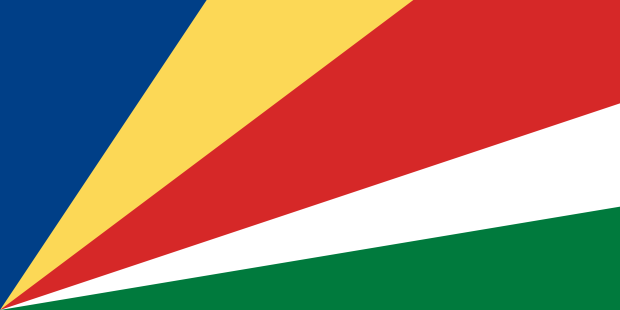
Flag is available in resolutions
| Icon 88x44 |  |
| Icon 32x16 |  |
Seychelles
The Seychelles: An Archipelago Paradise of Unparalleled Beauty and Rich History
The Seychelles, a breathtaking archipelago nestled in the western Indian Ocean, is a dream destination for many, conjuring images of pristine white-sand beaches, crystal-clear turquoise waters, and lush, verdant interiors. Comprising 115 islands, this island nation is a testament to natures artistry, offering a unique blend of stunning natural beauty, a fascinating history shaped by colonial powers and indigenous cultures, and a vibrant, albeit small, economy driven by tourism and fishing. The very name Seychelles evokes a sense of exoticism and tranquility, a promise of an escape from the mundane and an immersion into a world of unparalleled natural splendor and captivating cultural heritage.
The geography of the Seychelles is as diverse as it is beautiful. The archipelago is broadly divided into two main groups: the Inner Islands and the Outer Islands. The Inner Islands, including the most populated ones like Mahé, Praslin, and La Digue, are granite islands, characterized by their dramatic, boulder-strewn coastlines, mountainous interiors cloaked in dense tropical rainforests, and endemic flora and fauna. Mahé, the largest island, is home to the nations capital, Victoria, and boasts the highest peak, Morne Seychellois, offering panoramic views of the surrounding islands. Praslin is famed for the Vallée de Mai, a UNESCO World Heritage site, which is the natural habitat of the legendary Coco de Mer palm, whose giant, uniquely shaped nuts are a symbol of the Seychelles. La Digue, renowned for its laid-back atmosphere and iconic Anse Source dArgent beach, is a car-free paradise, where life moves at a gentle pace, traversed by bicycles and ox-carts. The Outer Islands, on the other hand, are mostly low-lying coral atolls and sand cays, scattered further out into the Indian Ocean. These islands, such as the Amirante Islands and the Farquhar Group, are less inhabited and offer a more remote and untouched experience, teeming with marine life and serving as crucial breeding grounds for seabirds and sea turtles. The geological origins of the Seychelles are also noteworthy; unlike most island nations formed by volcanic activity, the Inner Islands are remnants of the ancient supercontinent Gondwana, making them some of the oldest granitic islands on Earth. This ancient geological foundation contributes to their unique biodiversity, with many species found nowhere else on the planet. The surrounding ocean is a vibrant tapestry of coral reefs, home to an astonishing array of marine life, making the Seychelles a world-class destination for diving and snorkeling.
The population of the Seychelles is a fascinating reflection of its history, a melting pot of diverse ethnic backgrounds. The Seychellois people are primarily of mixed European, African, and Asian descent, a legacy of the islands colonial past and its role as a trading post. French and British colonists, along with enslaved Africans brought to the islands, formed the early foundations of the population. Over time, traders and laborers from India, China, and Madagascar also contributed to the cultural mosaic. This rich heritage is evident in the Seychellois language, Seychellois Creole, a beautiful fusion of French, English, and African languages, spoken alongside French and English, which are the official languages. Despite the diverse origins, a strong sense of national identity and unity prevails. The Seychellois are known for their warm hospitality, friendly demeanor, and a deep connection to their island home. The population is relatively small, concentrated mainly on Mahé, Praslin, and La Digue. This intimacy fosters a close-knit community where traditions are cherished and celebrated. Religious practices are also diverse, with Christianity, particularly Catholicism, being the dominant faith, alongside significant Muslim and Hindu minorities, reflecting the historical influx of people from different parts of the world. The social fabric is characterized by a strong emphasis on family and community, contributing to a generally peaceful and harmonious society.
The history of the Seychelles is a captivating narrative of discovery, colonization, and eventual independence. While the islands were likely known to Arab traders and possibly Polynesian navigators for centuries, their recorded history begins with European exploration. In the 17th century, the islands were claimed by France, named after Viscount Moreau de Séchelles, the French Minister of Finance. However, significant settlement did not begin until the mid-18th century with the establishment of the first French colony. The islands strategic location in the Indian Ocean soon attracted the attention of the British, who eventually took control of Seychelles in 1794 during the Napoleonic Wars. Following the defeat of Napoleon, Seychelles was formally ceded to Britain in 1814 through the Treaty of Paris. Under British rule, Seychelles developed as a colonial outpost, with plantations focusing on spices, copra, and vanilla. The abolition of slavery in the British Empire in 1835 had a profound impact on the islands, leading to the arrival of indentured laborers from India and Africa to work on the plantations. The 20th century saw a growing movement for self-determination, culminating in Seychelles gaining full independence from Britain on June 29, 1976. The early years of independence were marked by political instability, but the nation has since evolved into a stable republic. The legacy of these historical periods is still visible today, from the colonial architecture in Victoria to the diverse cultural influences that shape the Seychellois way of life. The islands have also played a role in international affairs, particularly during the Cold War, and have become a hub for environmental conservation efforts in recent decades.
The economy of the Seychelles is heavily reliant on its natural assets, with tourism being the undisputed cornerstone. The idyllic beaches, vibrant coral reefs, and unique biodiversity attract hundreds of thousands of visitors each year, generating substantial foreign exchange earnings and creating numerous employment opportunities. The tourism sector encompasses a wide range of offerings, from luxury resorts and boutique hotels to eco-lodges and guesthouses, catering to diverse traveler preferences. The government has made significant investments in infrastructure to support the tourism industry, including airport upgrades and the development of sustainable tourism practices. Beyond tourism, fishing is another vital sector, with Seychelles having one of the largest exclusive economic zones in the world. Tuna fishing is particularly important, and the country has developed a significant processing industry. Other economic activities include agriculture, primarily for domestic consumption, with crops like coconuts, cinnamon, and vanilla being cultivated. Small-scale manufacturing and the service sector, including financial services, also contribute to the economy. However, the nation faces challenges, including its vulnerability to external economic shocks, the need for diversification, and the ongoing imperative to balance economic development with environmental conservation. The government is actively pursuing policies to promote sustainable growth, encourage investment in new sectors, and protect the fragile ecosystems that are the foundation of its prosperity.
The tourist attractions of the Seychelles are as numerous as they are spectacular, offering an unforgettable experience for every visitor. The iconic beaches are undoubtedly the main draw. Anse Source dArgent on La Digue, with its giant granite boulders and shallow, clear waters, is consistently ranked among the worlds most beautiful beaches. Anse Lazio on Praslin, a sweeping crescent of soft white sand fringed by takamaka trees, is equally breathtaking. For nature lovers, the Vallée de Mai on Praslin is a must-visit. This ancient palm forest, a UNESCO World Heritage site, is the only natural habitat of the endemic Coco de Mer, the largest seed in the plant kingdom, and is also home to the rare black parrot. The Morne Seychellois National Park on Mahé offers a network of hiking trails that wind through lush tropical vegetation, leading to stunning viewpoints and hidden waterfalls. Birdwatchers will be delighted by the diverse avian population, including endemic species like the Seychelles magpie-robin and the Seychelles kestrel. The marine environment is a paradise for divers and snorkelers, with numerous dive sites offering encounters with colorful coral reefs, tropical fish, sharks, rays, and even whale sharks during certain seasons. Popular dive spots include the Aldabra Atoll, another UNESCO World Heritage site and the worlds largest raised coral atoll, a sanctuary for giant tortoises and a haven for marine life. Boat trips to explore the surrounding islands, fishing excursions, and sunset cruises are also popular activities. For those interested in culture and history, a visit to Victoria, the charming capital city on Mahé, is recommended. Here, visitors can explore the bustling market, admire the colonial architecture, and visit the National Museum of History to learn about the islands past. The Seychelles Botanical Gardens offer a glimpse into the diverse flora of the archipelago. The sheer diversity of experiences, from pure relaxation on pristine beaches to adventurous exploration of natural wonders and immersion in a unique cultural heritage, makes the Seychelles a truly extraordinary destination.
Information about Seychelles
The information comes from the publication CIA The World Factbook.
Automated text translation, excuse errors, please!
Country Seychelles is situated in a location / continent Africa. Seychelles has an area of 455 km2 and 90 024 residents. The highest point has a height 905 above sea level. and it is called Morne Seychellois. The lowest point is located at the level of 0 above sea level and it is named Indian Ocean. System of government is republic and the date of independence 29th June 1976. The capital city is Victoria. Seychelles has the international abbreviation SE.
Seychelles - economy
Total gross domestic product (GDP) is 2 274 000 000 $. Total gross domestic product per capita in purchasing power parity is 25 000 $. GDP grows by 4.90 % a year. Inflation (consumer price index) is equal to 2.60 % a year. Seychelles have 39 560 working-age population (from a total population 90 024 people). Unemployment is at 2.00 %. Seychelles issued 4.00 % GDP to healt care and 2,00 % GDP to army. The public debt of the country is 45.40 % GDP. The total amount of foreign debt is 1 470 000 000 USD.
Seychelles - demography
As suggested above, Seychelles has 90 024 people. Population growth is in the amount 0.92 % per year. Number of children born per 1000 population per year is 15.10.Every mother has average 1.90 children. The infant mortality rate is 11.35 .Average estimated life expectancy makes 73.77 years. Mortality is 6.90 people per 1000 population per year.
Seychelles - transport and telecommunications
Seychelles has 508 km of roads and 14 airports. There is registered 9 ships.
Number of active mobile phones (sim card) in the country Seychelles is 126 600. Number of active fixed telephone lines is 27 900. Seychelles has 32 000 internet users, who have the available 238 Internet connections. Seychelles has been assigned a domain first Choose range .sc.
Seychelles - energetics
Seychelles consumes a year 227 900 000 kWh of electricity. Annual electricity production is 245 000 000 kWh in power plants with a total installed electrical capacity 95 000 kW. Seychelles exports 0 kWh and imports 0 kWh of electricity per year Energy mix of power generation is as follows: fossil fuels: 100 %, nuclear energy: 0 %, renewable: 0.0 %, hydropower: 0.0 %.
Keywords: energetics, national flags, information, Flag of Seychelles, all flags, transport, economy, demography, flags of countries in the world, list of countries, world countries, flag, telecommunications, Seychelles, list of flags, flag states, Flags of countries, politic.