Congo, Republic of the
Flag of Congo, Republic of the
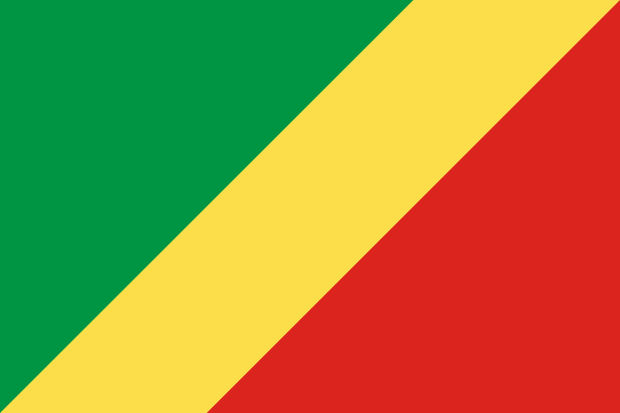
Flag is available in resolutions
| Icon 88x59 |  |
| Icon 32x21 |  |
Congo, Republic of the
The Republic of the Congo, often referred to as Congo-Brazzaville to distinguish it from its larger, more populous neighbor, the Democratic Republic of the Congo, is a Central African nation steeped in history, blessed with abundant natural resources, and facing the ongoing challenges of development. Its vast rainforests, significant oil reserves, and a complex socio-political landscape paint a compelling picture of a country striving to forge its identity on the global stage. Understanding the Republic of the Congo requires delving into its rich tapestry of geography, its tumultuous past, the diverse lives of its people, and the economic forces that shape its present and future.
Geographically, the Republic of the Congo is a land of striking contrasts. It is bordered by Cameroon to the northwest, the Central African Republic to the northeast, the Democratic Republic of the Congo to the east and south, Angola’s Cabinda Province to the southwest, and the Atlantic Ocean to the west. The country’s territory is dominated by dense tropical rainforest, a significant portion of which is part of the Congo Basin, the second-largest rainforest in the world. This verdant expanse is crisscrossed by a network of rivers, the most significant being the Congo River itself, which forms a substantial part of its eastern border. The landscape also features a coastal plain along the Atlantic, characterized by sandy beaches and mangrove swamps, and further inland, the terrain rises to form plateaus and savannas, particularly in the north. The climate is equatorial, with high temperatures and humidity year-round, and distinct wet and dry seasons that vary across the country. The immense biodiversity harbored within its rainforests is a global treasure, home to iconic species such as gorillas, chimpanzees, forest elephants, and a dazzling array of birds and insects. This natural wealth, however, also presents significant challenges in terms of conservation and sustainable resource management.
The history of the Republic of the Congo is a narrative of ancient kingdoms, colonial subjugation, and the arduous journey towards independence. Before European arrival, the region was home to various Bantu-speaking peoples who established complex societies and trade networks. Prominent among these were the Kongo Kingdom, a powerful state that flourished from the 14th to the 17th centuries, its influence extending across a vast territory. The arrival of Portuguese explorers in the late 15th century marked the beginning of a new era, characterized by the transatlantic slave trade, which profoundly disrupted existing social structures and economies. In the late 19th century, the area was colonized by France, becoming part of French Equatorial Africa. The French administration established Brazzaville as its capital, laying the foundations for the modern state. During the colonial period, the region was largely exploited for its natural resources, with little investment in local development. The path to independence was paved with nationalist movements, culminating in the country gaining self-governance in 1960. The post-independence era has been marked by political instability, including coups, civil wars, and periods of authoritarian rule. The country has transitioned from a Marxist-Leninist state to a multi-party democracy, though the legacy of political turmoil and the struggle for genuine democratic institutions continues to shape its trajectory.
The population of the Republic of the Congo is characterized by its ethnic diversity and youthful demographic. The majority of Congolese people are of Bantu origin, with numerous ethnic groups such as the Kongo, Sangha, Mboshi, Téké, and Mbochi forming distinct cultural communities. While French is the official language, reflecting the colonial past, a multitude of indigenous languages are spoken across the country, serving as vital carriers of cultural heritage. The population is predominantly concentrated in urban centers, particularly in Brazzaville and Pointe-Noire, the country’s economic hub. This urbanization, while offering opportunities, also strains infrastructure and social services. The Congolese people are known for their resilience, their strong sense of community, and their vibrant cultural traditions, expressed through music, dance, and art. The country has a relatively young population, with a significant proportion under the age of 25, a demographic characteristic that presents both opportunities for growth and challenges in terms of education, employment, and healthcare. The ongoing efforts to foster national unity and reconciliation among the diverse ethnic groups remain a crucial aspect of the country’s social development.
The economy of the Republic of the Congo is heavily reliant on its natural resources, with oil being the dominant export. The discovery and exploitation of offshore oil fields in the late 1960s transformed the nation’s economic landscape, providing a significant source of revenue. However, this reliance on a single commodity has made the economy vulnerable to fluctuations in global oil prices, leading to periods of boom and bust. Beyond oil, the country possesses substantial reserves of timber, minerals such as iron ore and potash, and significant potential for agriculture. The forestry sector, while a major employer, faces challenges related to sustainable logging practices and illegal deforestation. Efforts are underway to diversify the economy, promote non-oil sectors, and attract foreign investment. The government is also focused on improving infrastructure, including transportation networks and energy supply, to support economic growth and attract businesses. However, corruption and governance issues continue to pose significant obstacles to equitable development and the effective utilization of the country’s resources for the benefit of its citizens.
Despite its economic challenges and a history marked by conflict, the Republic of the Congo offers a compelling array of tourist attractions for the adventurous traveler. The country’s pristine natural environments are its greatest draw. The Congo Basin itself is an unparalleled destination for ecotourism, offering opportunities to explore vast, untouched rainforests. Odze National Park and Léfini Faunal Reserve are renowned for their rich biodiversity, providing chances to observe gorillas, chimpanzees, forest elephants, and a multitude of bird species in their natural habitats. The Sangha-Mbaéré Tri-national Park, shared with Cameroon and the Central African Republic, is a UNESCO World Heritage site and a crucial sanctuary for lowland gorillas and forest elephants. For those interested in cultural immersion, exploring the vibrant markets and lively streets of Brazzaville offers a glimpse into contemporary Congolese life. The city, with its colonial architecture and bustling riverfront, provides a stark contrast to the wilderness. The Macon Lake, a large freshwater lake, offers opportunities for fishing and relaxation. The coastal city of Pointe-Noire serves as the country’s economic capital and a gateway to its Atlantic coastline, with its beaches and fishing communities. The Conkouati-Douli National Park, stretching from the coast inland, encompasses diverse ecosystems, including coastal lagoons, mangrove forests, and savannas, and is home to a variety of wildlife. While tourism infrastructure is still developing, the country’s raw beauty and the genuine warmth of its people make it a unique and unforgettable destination for those seeking an off-the-beaten-path experience. The Republic of the Congo, with its profound natural heritage and resilient people, continues to navigate the complexities of its past and present, with the hope of a more prosperous and stable future.
Information about Congo, Republic of the
The information comes from the publication CIA The World Factbook.
Automated text translation, excuse errors, please!
Country Congo, Republic of the is situated in a location / continent Africa. Congo, Republic of the has an area of 342 000 km2 and 4 366 266 residents. The highest point has a height 903 above sea level. and it is called Mount Berongou. The lowest point is located at the level of 0 above sea level and it is named Atlantic Ocean. and the date of independence 15th August 1960. The capital city is Brazzaville. Congo, Republic of the has the international abbreviation CF.
Congo, Republic of the - economy
Total gross domestic product (GDP) is 18 480 000 000 $. Total gross domestic product per capita in purchasing power parity is 4 600 $. GDP grows by 4.50 % a year. Inflation (consumer price index) is equal to 6.00 % a year. Congo, Republic of the have 1 514 000 working-age population (from a total population 4 366 266 people). Congo, Republic of the issued 3.00 % GDP to healt care .The total amount of foreign debt is 4 955 000 000 USD.
Congo, Republic of the - demography
As suggested above, Congo, Republic of the has 4 366 266 people. Population growth is in the amount 2.85 % per year. Number of children born per 1000 population per year is 40.09.Every mother has average 5.59 children. The infant mortality rate is 74.22 and maternal mortality 560.00 deaths per 100,000 births. Average estimated life expectancy makes 55.27 years. Mortality is 11.25 people per 1000 population per year.
Congo, Republic of the - transport and telecommunications
Congo, Republic of the has 17 289 km of roads, 886 km of railway lines and 25 airports. The total length of waterways (navigable rivers, canals, etc.) is 1 120 km. There is registered 1 ships.
Number of active mobile phones (sim card) in the country Congo, Republic of the is 3 885 000. Number of active fixed telephone lines is 10 000. Congo, Republic of the has 245 200 internet users, who have the available 43 Internet connections. Congo, Republic of the has been assigned a domain first Choose range .cg.
Congo, Republic of the - energetics
Congo, Republic of the consumes a year 563 000 000 kWh of electricity. Annual electricity production is 502 000 000 kWh in power plants with a total installed electrical capacity 148 000 kW. Congo, Republic of the exports 0 kWh and imports 440 000 000 kWh of electricity per year Energy mix of power generation is as follows: fossil fuels: 19.6 %, nuclear energy: 0 %, renewable: 0.0 %, hydropower: 80.4 %. The country Congo, Republic of the is harvested annually 308 600 barrels of oil.
Keywords: Congo, Republic of the, all flags, economy, Flag of Congo, Republic of the, flag, list of countries, demography, flags of countries in the world, transport, list of flags, telecommunications, Flags of countries, information, national flags, energetics, world countries, flag states, politic.