Eritrea
Flag of Eritrea
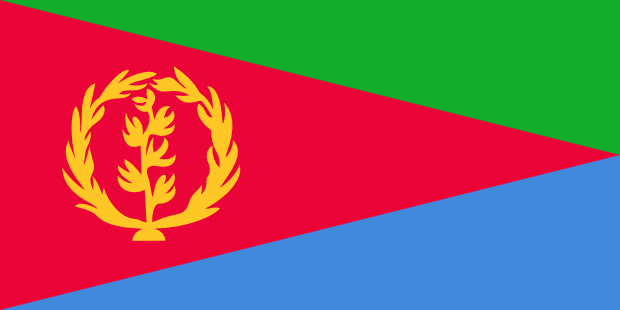
Flag is available in resolutions
| Icon 88x44 |  |
| Icon 32x16 |  |
Eritrea
Eritrea: A Land of Enduring Spirit and Untapped Potential
Nestled in the Horn of Africa, Eritrea is a nation often overlooked, yet rich in history, diverse in culture, and blessed with striking natural beauty. Its strategic location along the Red Sea coast has shaped its destiny for millennia, making it a crossroads of civilizations and a silent witness to the ebb and flow of empires. Today, Eritrea stands as a testament to the resilience of its people, grappling with the challenges of nation-building while holding onto a proud heritage and a vision for the future.
The Eritrean population is a vibrant mosaic of ethnic and linguistic groups, each contributing to the nation’s unique cultural tapestry. The Tigrinya people form the largest ethnic group, predominantly inhabiting the central highlands and speaking Tigrinya, a Semitic language. Other significant ethnic communities include the Tigre, who are largely pastoralists and nomadic, found mainly in the western lowlands and along the Red Sea coast, speaking the Tigre language. The Afar, known for their nomadic lifestyle and resilience in the harsh desert environment, inhabit the southeastern part of the country, their language also bearing the Afar name. The Saho, Rashaida, Bilen, and Nara are among the other distinct groups, each with their own traditions, customs, and languages, underscoring the deep diversity that characterizes Eritrean society. This ethnic and linguistic richness is reflected in the country’s diverse cultural practices, from the intricate patterns of traditional weaving and the rhythmic beats of local music to the varied culinary traditions that tantalize the palate. Despite these differences, a shared sense of Eritrean identity has been forged through a common history of struggle and a collective aspiration for national unity and progress. Religious diversity is also a prominent feature, with Christianity and Islam being the two dominant faiths, coexisting peacefully and influencing various aspects of daily life, from religious festivals to social customs.
Eritrea’s history is a long and complex narrative, marked by periods of foreign domination and a protracted struggle for independence. Ancient civilizations flourished in the region, with the Kingdom of Aksum, a powerful trading empire that spanned parts of modern-day Eritrea and Ethiopia, leaving behind impressive archaeological remains, including obelisks and ancient cities. For centuries, Eritrea was influenced by various powers, including the Ottoman Empire, Egypt, and Italy. The Italian colonial era, beginning in the late 19th century, had a profound impact on Eritrea’s infrastructure and administration, with the port city of Massawa becoming a significant hub. Following Italy’s defeat in World War II, Eritrea was federated with Ethiopia under a UN resolution in 1952. However, Ethiopia’s subsequent annexation of Eritrea in 1962 ignited a fierce and prolonged liberation struggle. For thirty years, Eritrean freedom fighters engaged in a relentless guerrilla war against Ethiopian forces, enduring immense hardship and sacrifice. This arduous struggle culminated in Eritrea’s hard-won independence on May 24, 1991, a date celebrated annually as Liberation Day, a momentous occasion that signifies the triumph of the Eritrean people’s unwavering determination. The post-independence period has presented its own set of challenges, including border conflicts and the ongoing process of nation-building.
Geographically, Eritrea is a land of dramatic contrasts, boasting a diverse array of landscapes that stretch from the arid coastal plains to the fertile highlands. The country’s coastline along the Red Sea, spanning approximately 1,150 kilometers, is home to the Dahlak Archipelago, a group of over 120 islands renowned for their pristine coral reefs and rich marine biodiversity, making them a potential haven for ecotourism and diving enthusiasts. The western lowlands are characterized by hot, arid conditions and are home to nomadic pastoralist communities. Moving inland, the highlands rise to considerable elevations, with Mount Emba Soira being the highest peak. These highlands enjoy a more temperate climate and are the agricultural heartland of Eritrea, supporting the cultivation of crops like sorghum, millet, teff, and pulses. The Great Rift Valley, a significant geological feature, also runs through Eritrea, contributing to its varied topography. This geographical diversity influences the country’s climate, with coastal areas experiencing extreme heat and humidity, while the highlands enjoy cooler temperatures. The presence of both fertile agricultural land and vast expanses of arid terrain necessitates diverse approaches to resource management and economic development.
The Eritrean economy, though facing significant challenges, possesses considerable untapped potential. Historically, agriculture has been the backbone of the economy, employing a large portion of the population and primarily focused on subsistence farming. However, the nation is also endowed with significant mineral resources, including gold, copper, zinc, and potash, with mining operations gradually expanding and offering promising avenues for economic growth and foreign investment. The strategic location of Eritrea along the Red Sea also presents opportunities for the development of its maritime sector, including port infrastructure and shipping services. The government has been actively seeking to diversify the economy and attract investment, with a focus on developing industries such as fisheries, tourism, and manufacturing. Despite the challenges posed by limited infrastructure and a relatively closed economy, the Eritrean people’s industrious spirit and the nation’s natural resources lay the groundwork for future economic prosperity.
While Eritrea may not be a mainstream tourist destination, it offers a unique and authentic travel experience for those seeking to explore off-the-beaten-path locales. The capital city, Asmara, is a UNESCO World Heritage site, celebrated for its remarkably preserved collection of early 20th-century modernist architecture, a legacy of the Italian colonial period. Its wide avenues, stylish cafes, and Art Deco buildings create an atmosphere that is both timeless and captivating. The ancient city of Keren, known for its bustling market and the Shrine of St. Maryam, offers a glimpse into traditional Eritrean life. For history buffs, the ruins of the ancient city of Adulis, a once-thriving Red Sea port, are a significant archaeological site. The Dahlak Archipelago, with its crystal-clear waters and abundant marine life, presents an unparalleled opportunity for diving, snorkeling, and exploring untouched natural beauty. While infrastructure for mass tourism is still developing, the allure of Eritrea lies in its raw, unspoiled landscapes, its rich cultural heritage, and the genuine warmth of its people, offering a profound and memorable journey for the intrepid traveler. The nation’s commitment to preserving its cultural heritage and natural environment, coupled with a growing interest in sustainable tourism, promises to unveil Eritrea’s wonders to a wider audience in the years to come.
Information about Eritrea
The information comes from the publication CIA The World Factbook.
Automated text translation, excuse errors, please!
Country Eritrea is situated in a location / continent Africa. Eritrea has an area of 117 600 km2 and 6 086 495 residents. The highest point has a height 3 018 above sea level. and it is called Soira. The lowest point is located at the level of -75 above sea level and it is named Within Kulula near the Danakil Depression. System of government is transitional government and the date of independence 24th May 1993. The capital city is Asmara (Asmera). Eritrea has the international abbreviation ER.
Eritrea - economy
Total gross domestic product (GDP) is 4 089 000 000 $. Total gross domestic product per capita in purchasing power parity is 700 $. GDP grows by 8.70 % a year. Inflation (consumer price index) is equal to 20.00 % a year. Eritrea have 1 935 000 working-age population (from a total population 6 086 495 people). Eritrea issued 7.00 % GDP to healt care and 6,30 % GDP to army. The public debt of the country is 118.50 % GDP. The total amount of foreign debt is 1 077 000 000 USD.
Eritrea - demography
As suggested above, Eritrea has 6 086 495 people. Population growth is in the amount 2.42 % per year. Number of children born per 1000 population per year is 32.10.Every mother has average 4.37 children. The infant mortality rate is 40.34 and maternal mortality 240.00 deaths per 100,000 births. Average estimated life expectancy makes 62.86 years. Mortality is 7.92 people per 1000 population per year.
Eritrea - transport and telecommunications
Eritrea has 4 010 km of roads, 306 km of railway lines and 13 airports. There is registered 4 ships.
Number of active mobile phones (sim card) in the country Eritrea is 241 900. Number of active fixed telephone lines is 58 000. Eritrea has 200 000 internet users, who have the available 870 Internet connections. Eritrea has been assigned a domain first Choose range .er.
Eritrea - energetics
Eritrea consumes a year 242 000 000 kWh of electricity. Annual electricity production is 277 000 000 kWh in power plants with a total installed electrical capacity 139 000 kW. Eritrea exports 0 kWh and imports 0 kWh of electricity per year Energy mix of power generation is as follows: fossil fuels: 99.3 %, nuclear energy: 0 %, renewable: 0.7 %, hydropower: 0.0 %.
Keywords: information, flag states, flags of countries in the world, national flags, telecommunications, energetics, Flag of Eritrea, demography, Eritrea, Flags of countries, economy, flag, list of flags, all flags, list of countries, transport, world countries, politic.