Lesotho
Flag of Lesotho
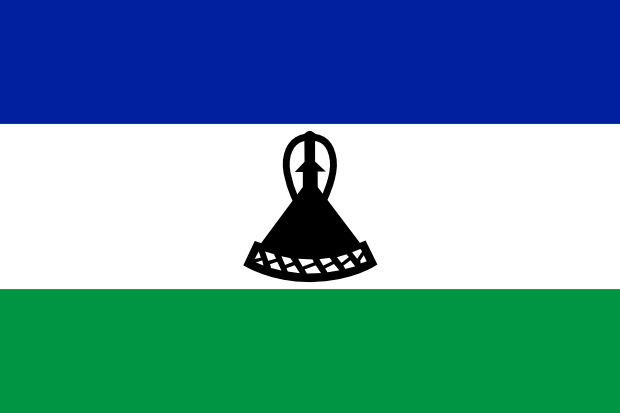
Flag is available in resolutions
| Icon 88x59 |  |
| Icon 32x21 |  |
Lesotho
Lesotho: The Kingdom in the Sky
Nestled entirely within the borders of South Africa, the Kingdom of Lesotho stands as a unique geographical and political anomaly. Often referred to as the “Kingdom in the Sky” due to its high altitude, it is the only independent country in the world to lie entirely above 1,000 meters (3,280 feet) above sea level. This elevated position shapes its climate, its landscapes, and the very essence of its culture and people. With a population that predominantly resides in rural areas and a history deeply intertwined with its mountainous terrain, Lesotho presents a captivating study of resilience, tradition, and a striving for development against significant natural challenges. The country’s identity is forged in its dramatic peaks, its flowing rivers, and the enduring spirit of its Basotho people.
The history of Lesotho is a compelling narrative of survival and nation-building, largely shaped by the charismatic leadership of Moshoeshoe I. In the early 19th century, the region was a collection of disparate chiefdoms, vulnerable to the expansionist ambitions of neighboring Zulu kingdoms and the encroaching Boer settlers. Moshoeshoe I, a skilled diplomat and military strategist, united the fragmented Sotho people, forming a new nation in response to the turmoil of the *Mfecane* (the crushing). He established his capital at Thaba-Bosiu, a formidable sandstone fortress that offered strategic defense. Recognizing the growing threat from the Boers, Moshoeshoe I sought protection from the British Crown, leading to Lesotho becoming a British protectorate in 1868, known as Basutoland. This protected status, while preserving their autonomy from Boer rule, also meant a loss of full sovereignty. For over a century, Basutoland remained under British administration, fostering a sense of national identity and paving the way for eventual independence. On October 4, 1966, Basutoland achieved full independence, becoming the Kingdom of Lesotho, with Moshoeshoe II, a descendant of Moshoeshoe I, as its first monarch. The post-independence period has been marked by political instability, military coups, and periods of democratic rule, a testament to the ongoing challenges of consolidating a nation in a complex geopolitical environment.
Geographically, Lesotho is a land of breathtaking, often stark, beauty. Its defining feature is its mountainous topography. The Drakensberg Mountains form its eastern border, with peaks soaring to over 3,000 meters (9,800 feet). The highest point in Southern Africa, Thabana Ntlenyana, reaching 3,482 meters (11,424 feet), is located in Lesotho. These mountains are the source of many of Southern Africa’s major rivers, including the Orange River, which plays a vital role in the region’s water supply. The landscape is characterized by steep escarpments, deep valleys, and rolling highlands. The country is divided into three main geographical zones: the lowlands in the west, where most of the population and agricultural activity are concentrated; the foothills, a transitional zone; and the highlands, the vast, sparsely populated mountainous interior. The climate varies significantly with altitude. The lowlands experience warm summers and mild winters, while the highlands are characterized by cold winters with significant snowfall, making them a destination for winter sports enthusiasts. The dramatic scenery, including vast plateaus, dramatic cliffs, and cascading waterfalls, provides a stunning backdrop for exploration.
The economy of Lesotho is heavily reliant on a few key sectors, often facing significant challenges. Historically, agriculture has been the backbone of the rural economy, with staple crops like maize, wheat, and sorghum being cultivated. However, farming is often subsistence-based and vulnerable to erratic rainfall and soil erosion, exacerbated by overgrazing. The country’s most significant export is water, channeled through the ambitious Lesotho Highlands Water Project (LHWP). This massive engineering feat, a joint venture with South Africa, supplies water to the Gauteng province and also generates hydroelectric power for Lesotho. Mining, particularly diamond mining, has become increasingly important in recent decades, with several large-scale diamond mines contributing significantly to export earnings and employment. The textile and apparel industry also plays a crucial role, driven by foreign investment and preferential trade agreements. Despite these efforts, Lesotho faces high rates of unemployment and poverty, with a substantial portion of its workforce migrating to South Africa for employment, particularly in the mining and agricultural sectors. Remittances from these migrant workers are a vital source of income for many families.
Lesotho offers a wealth of tourist attractions, primarily centered around its stunning natural landscapes and unique cultural experiences. The Maloti-Drakensberg Park, a UNESCO World Heritage Site, is a major draw, offering unparalleled opportunities for hiking, trekking, and mountaineering. The dramatic peaks, ancient rock art sites, and diverse flora and fauna create an unforgettable adventure. For those seeking cultural immersion, visiting traditional Basotho villages, experiencing their distinctive round houses (rondavels), and witnessing their vibrant cultural practices, such as blanket weaving and sorghum beer brewing, is a profound experience. The capital city, Maseru, while not a major tourist hub, offers insights into contemporary Basotho life, with its markets and the Royal Palace. The Katse Dam, a colossal concrete arch dam and a key component of the LHWP, is an impressive feat of engineering and a popular tourist destination, offering boat trips and stunning views. For the more adventurous, pony trekking through the highlands, led by local guides, provides an intimate way to explore the remote beauty of the country. The annual Morija Arts & Cultural Festival is a significant event, showcasing Basotho music, dance, and art, attracting visitors from around the globe. The sheer scale and pristine nature of Lesotho’s wilderness make it an ideal destination for eco-tourism and adventure seekers looking for an off-the-beaten-path experience.
The population of Lesotho, estimated to be around 2.2 million people, is predominantly of Sotho ethnicity, with a small number of Zulu and San people. The official languages are Sesotho and English, with English often used in government and business. The vast majority of the population adheres to Christianity, with a significant presence of Roman Catholic and Protestant denominations, though traditional beliefs and practices often coexist with Christian faith. The Basotho people are known for their strong sense of community, their hospitality, and their distinctive cultural traditions. The iconic Basotho blanket, a brightly colored woolen garment worn by both men and women, is not just a fashion statement but a symbol of identity and status. Traditional music and dance are integral to Basotho culture, with performances often accompanying social gatherings and ceremonies. The social fabric is deeply rooted in kinship and extended family structures. Despite the challenges of poverty and limited economic opportunities, there is a palpable sense of resilience and pride among the Basotho people, a testament to their enduring spirit in the face of adversity. Their connection to the land and their rich cultural heritage continue to shape their identity and their future aspirations.
Information about Lesotho
The information comes from the publication CIA The World Factbook.
Automated text translation, excuse errors, please!
Country Lesotho is situated in a location / continent Africa. Lesotho has an area of 30 355 km2 and 1 930 493 residents. The highest point has a height 3 482 above sea level. and it is called Thabana Ntlenyana. The lowest point is located at the level of 1400 above sea level and it is named junction of the Orange and Makhaleng řekas. System of government is constitutional monarchy and the date of independence 4th October 1966. The capital city is Maseru. Lesotho has the international abbreviation LT.
Lesotho - economy
Total gross domestic product (GDP) is 3 853 000 000 $. Total gross domestic product per capita in purchasing power parity is 2 000 $. GDP grows by 4.20 % a year. Inflation (consumer price index) is equal to 5.00 % a year. Lesotho have 854 600 working-age population (from a total population 1 930 493 people). Unemployment is at 45.00 %. Lesotho issued 13.20 % GDP to healt care and 2,60 % GDP to army. The total amount of foreign debt is 729 900 000 USD.
Lesotho - demography
As suggested above, Lesotho has 1 930 493 people. Population growth is in the amount 0.33 % per year. Number of children born per 1000 population per year is 26.65.Every mother has average 2.89 children. The infant mortality rate is 53.44 and maternal mortality 620.00 deaths per 100,000 births. Average estimated life expectancy makes 51.86 years. Mortality is 15.18 people per 1000 population per year.
Lesotho - transport and telecommunications
Lesotho has 7 091 km of roads and 24 airports.
Number of active mobile phones (sim card) in the country Lesotho is 1 051 000. Number of active fixed telephone lines is 35 600. Lesotho has 76 800 internet users, who have the available 1 581 Internet connections. Lesotho has been assigned a domain first Choose range .ls.
Lesotho - energetics
Lesotho consumes a year 293 000 000 kWh of electricity. Annual electricity production is 200 000 000 kWh in power plants with a total installed electrical capacity 76 000 kW. Lesotho exports 0 kWh and imports 121 000 000 kWh of electricity per year Energy mix of power generation is as follows: fossil fuels: 0 %, nuclear energy: 0 %, renewable: 0.0 %, hydropower: 100.0 %.
Keywords: list of flags, list of countries, transport, energetics, all flags, Flags of countries, flag, Lesotho, world countries, national flags, flags of countries in the world, economy, flag states, demography, information, Flag of Lesotho, telecommunications, politic.