Central African Republic
Flag of Central African Republic
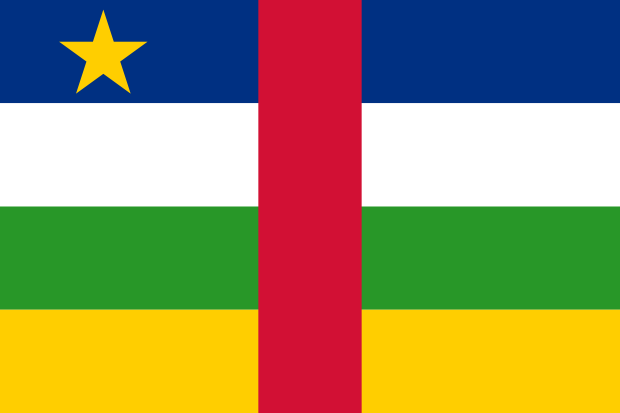
Flag is available in resolutions
| Icon 88x59 |  |
| Icon 32x21 |  |
Central African Republic
The Central African Republic: A Land of Untamed Beauty and Enduring Challenges
The Central African Republic (CAR), often referred to as Sangaris in Sango, its national language, is a landlocked nation situated in the heart of the African continent. Its vast territory, encompassing approximately 622,984 square kilometers, is characterized by a dramatic and varied landscape. From the dense rainforests of the south, teeming with biodiversity, to the sprawling savannas and arid Sahelian fringes of the north, the CAR offers a compelling, albeit often challenging, geographical tapestry. This immense land, with its rich natural resources, has a history marked by both ancient kingdoms and more recent struggles for stability and development. Understanding the CAR requires delving into its complex past, its diverse population, and the intricate interplay of its economy and environment.
The population of the Central African Republic is a mosaic of ethnic groups, each contributing to the nation’s vibrant cultural heritage. With an estimated population of around 5.9 million people, the CAR is one of the least densely populated countries in Africa. The majority of the population resides in rural areas, relying on subsistence agriculture for their livelihoods. The largest ethnic groups include the Baya, Banda, Mandjia, and Sara, each possessing distinct languages, customs, and traditions. While Sango serves as the lingua franca, French remains the official language, a legacy of its colonial past. This linguistic diversity, while enriching, can also present communication challenges in a nation striving for unity and effective governance. The CAR has experienced significant demographic shifts due to internal displacement and refugee flows stemming from prolonged periods of conflict and instability. This has placed immense strain on social services and infrastructure, particularly in urban centers like the capital city, Bangui.
The history of the Central African Republic is a long and intricate narrative, stretching back to ancient times. Archaeological evidence suggests human habitation in the region for millennia, with early inhabitants leaving behind a rich legacy of rock art and artifacts. In subsequent centuries, various kingdoms and empires rose and fell across what is now the CAR, including the Ouadda Empire and the Kanem-Bornou Empire, which exerted influence over parts of the northern territories. The arrival of European colonial powers in the late 19th century marked a pivotal turning point. The region was carved up by colonial powers, with France ultimately establishing its control over the vast territory that would become Ubangi-Shari. This colonial era, characterized by resource exploitation and the imposition of foreign administrative structures, left an indelible mark on the CAR’s political and economic trajectory. Independence was gained on August 13, 1960, under the leadership of Barthélemy Boganda, a visionary statesman who championed the idea of a united and prosperous Central African federation. However, the post-independence period has been fraught with political instability, coups détat, and periods of authoritarian rule, significantly hindering the nations development. The ongoing challenges of governance, security, and ethnic tensions have cast a long shadow over the CAR’s quest for lasting peace and prosperity.
The geography of the Central African Republic is a defining characteristic, influencing its economy, its biodiversity, and the lives of its people. The country is dominated by a vast plateau, with elevations generally ranging from 500 to 1000 meters above sea level. The southern part of the CAR is characterized by dense tropical rainforests, home to an astonishing array of flora and fauna. These forests are a vital part of the Congo Basin, one of the world’s most important biodiversity hotspots. Major rivers, such as the Ubangi and the Sanaga, crisscross the landscape, serving as crucial transportation routes and sources of water. As one moves northwards, the landscape gradually transitions into more open savannas, with scattered trees and grasslands. The northernmost regions, bordering Chad and Sudan, exhibit more arid characteristics, with semi-desert conditions prevailing in some areas. This diverse geography presents both opportunities and challenges. The fertile southern regions support agriculture, while the savannas are ideal for cattle ranching. However, the vastness of the territory and the often challenging terrain can make infrastructure development and the provision of services difficult. The country is also rich in natural resources, including diamonds, gold, uranium, and timber, which have the potential to drive economic growth, but have also been a source of conflict and exploitation.
The economy of the Central African Republic is heavily reliant on agriculture, which employs the vast majority of the population. Subsistence farming, primarily of cassava, millet, sorghum, and maize, forms the backbone of the rural economy. Cash crops such as cotton, coffee, and tobacco are also cultivated, though their production has been significantly impacted by periods of insecurity and fluctuating global prices. The extraction of natural resources, particularly diamonds and gold, represents another significant sector, though it is often characterized by informal mining practices and challenges in ensuring equitable distribution of revenue. The timber industry is also a notable contributor to the economy, with vast tracts of rainforest being exploited, raising concerns about sustainable forestry practices and environmental conservation. Despite possessing considerable mineral wealth, the CAR has struggled to translate these resources into broad-based economic development. Corruption, weak governance, and a lack of investment in infrastructure and human capital have hampered the country’s ability to harness its full economic potential. The ongoing security challenges have further exacerbated these issues, deterring foreign investment and disrupting trade routes.
Despite the numerous challenges it faces, the Central African Republic possesses a wealth of natural beauty and unique cultural experiences that hold significant potential for tourism. The country is home to several national parks and wildlife reserves, offering opportunities to witness iconic African wildlife in their natural habitat. Dzanga-Sangou National Park, located in the southwestern part of the CAR, is a UNESCO World Heritage site and a renowned destination for ecotourism. It is particularly famous for its large populations of forest elephants, western lowland gorillas, and bongo antelopes. The park’s dense rainforests and unique ecosystem offer a glimpse into one of the last remaining pristine wilderness areas in Africa. Another notable area is the Manovo-Gounda St. Floris National Park, a vast savanna landscape that was once a prime destination for safaris, though its wildlife populations have been significantly impacted by poaching and insecurity. Beyond its natural attractions, the CAR also offers a rich cultural tapestry. Traditional villages, vibrant local markets, and the diverse customs of its numerous ethnic groups provide opportunities for cultural immersion. The country’s musical heritage, characterized by lively rhythms and traditional instruments, is another captivating aspect. However, the development of a robust tourism sector in the CAR has been severely hampered by the persistent issues of insecurity, lack of infrastructure, and limited accessibility. For intrepid travelers willing to venture off the beaten path and navigate the complexities of the region, the CAR offers an unparalleled opportunity to experience a truly wild and authentic Africa. The potential for responsible and sustainable tourism, focused on conservation and community engagement, remains a promising avenue for the nation’s future.
Information about Central African Republic
The information comes from the publication CIA The World Factbook.
Automated text translation, excuse errors, please!
Country Central African Republic is situated in a location / continent Africa. Central African Republic has an area of 622 984 km2 and 5 057 208 residents. The highest point has a height 1 420 above sea level. and it is called Mont Ngaoui. The lowest point is located at the level of 335 above sea level and it is named Oubangui River. and the date of independence 13th August 1960. The capital city is Bangui. Central African Republic has the international abbreviation CT.
Central African Republic - economy
Total gross domestic product (GDP) is 3 688 000 000 $. Total gross domestic product per capita in purchasing power parity is 800 $. GDP grows by 3.10 % a year. Inflation (consumer price index) is equal to 1.70 % a year. Central African Republic have 1 926 000 working-age population (from a total population 5 057 208 people). Unemployment is at 8.00 %. Central African Republic issued 4.30 % GDP to healt care .The total amount of foreign debt is 483 900 000 USD.
Central African Republic - demography
As suggested above, Central African Republic has 5 057 208 people. Population growth is in the amount 2.14 % per year. Number of children born per 1000 population per year is 36.13.Every mother has average 4.57 children. The infant mortality rate is 97.17 and maternal mortality 890.00 deaths per 100,000 births. Average estimated life expectancy makes 50.48 years. Mortality is 14.71 people per 1000 population per year.
Central African Republic - transport and telecommunications
Central African Republic has 24 307 km of roads and 40 airports. The total length of waterways (navigable rivers, canals, etc.) is 2 800 km.
Number of active mobile phones (sim card) in the country Central African Republic is 1 124 000. Number of active fixed telephone lines is 2 300. Central African Republic has 22 600 internet users, who have the available 20 Internet connections. Central African Republic has been assigned a domain first Choose range .cf.
Central African Republic - energetics
Central African Republic consumes a year 148 800 000 kWh of electricity. Annual electricity production is 160 000 000 kWh in power plants with a total installed electrical capacity 46 000 kW. Central African Republic exports 0 kWh and imports 0 kWh of electricity per year Energy mix of power generation is as follows: fossil fuels: 45.7 %, nuclear energy: 0 %, renewable: 0.0 %, hydropower: 54.3 %.
Keywords: list of flags, all flags, list of countries, economy, Central African Republic, flag, Flags of countries, information, demography, energetics, transport, telecommunications, Flag of Central African Republic, national flags, flags of countries in the world, world countries, flag states, politic.