Burkina Faso
Flag of Burkina Faso
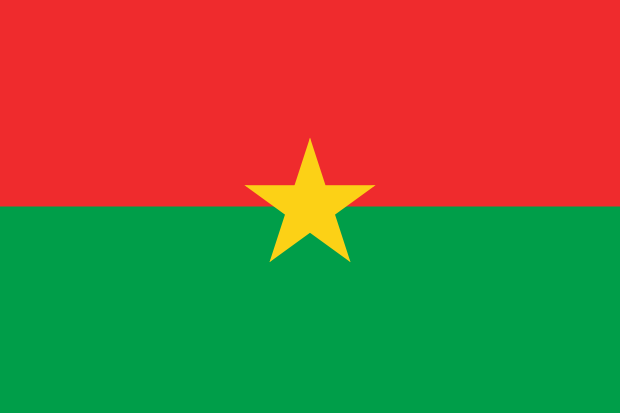
Flag is available in resolutions
| Icon 88x59 |  |
| Icon 32x21 |  |
Burkina Faso
Here is a comprehensive article about Burkina Faso, approximately 5000 characters long, written in English with the specified formatting:
Burkina Faso, a landlocked nation nestled in the heart of West Africa, is a country characterized by its rich cultural heritage, diverse landscapes, and a history shaped by both ancient kingdoms and colonial influences. Formerly known as Upper Volta, its name was changed in 1984 by President Thomas Sankara to Burkina Faso, meaning Land of the upright people or Land of integrity, a testament to its aspirations for self-determination and national pride. The country’s geography is predominantly a vast plateau, gently sloping from south to north, punctuated by a few isolated mountain ranges. This topography influences its climate, which is largely tropical, with distinct wet and dry seasons. The northern regions experience a more arid, Sahelian climate, while the southern areas are more humid, supporting a greater variety of vegetation. The Niger River, along with its tributaries like the Nakambé (White Volta) and the Mouhoun (Black Volta), are vital lifelines, providing water for agriculture and supporting human settlements.
The population of Burkina Faso is ethnically diverse, with the Mossi being the largest ethnic group, historically dominant in the central and southern regions. Other significant ethnic groups include the Bobo, Fulani, Gourmanche, and Lobi, each with their own distinct languages, traditions, and social structures. This mosaic of cultures contributes to the vibrant tapestry of Burkinabé society. The official language is French, a legacy of its colonial past, but numerous indigenous languages are spoken daily, fostering a rich linguistic landscape. The majority of the population adheres to Islam and traditional animist beliefs, with a significant Christian minority. Life in Burkina Faso is largely agrarian, with a substantial portion of the population engaged in subsistence farming, cultivating crops such as millet, sorghum, maize, and cotton. Livestock herding is also a crucial economic activity, particularly in the more arid northern regions. The country faces significant developmental challenges, including poverty, a high birth rate, and vulnerability to climate change, which impacts its agricultural sector.
The history of Burkina Faso is a long and complex narrative. Archaeological evidence suggests human habitation dating back millennia. In the medieval period, the region was part of powerful empires, most notably the Mossi kingdoms, which successfully resisted expansion by the Songhai Empire. These kingdoms maintained a degree of autonomy for centuries, developing sophisticated political and social structures. The arrival of European powers in the late 19th century marked a new era. France colonized the territory, incorporating it into French West Africa. In 1919, Upper Volta was established as a distinct administrative unit, though its borders were frequently redrawn. The country gained independence from France on August 5, 1960. The post-independence period has been marked by political instability, with a series of coups and military regimes interspersed with periods of civilian rule. A pivotal moment in its modern history was the 1983 revolution led by Thomas Sankara, who implemented radical social and economic reforms aimed at self-sufficiency and popular empowerment. His assassination in 1987 led to a more conservative regime, but Sankaras legacy continues to inspire many.
The economy of Burkina Faso is largely dependent on agriculture, which employs the vast majority of the workforce and accounts for a significant portion of its export earnings. Cotton is the primary cash crop, but the country also produces significant amounts of shea nuts, sesame, and livestock. The mining sector has gained increasing importance in recent years, with substantial deposits of gold, manganese, and phosphates contributing to economic growth. However, the country’s industrial base remains relatively underdeveloped. Manufacturing is limited, with a focus on processing agricultural products and producing basic consumer goods. The informal sector plays a crucial role in the Burkinabé economy, providing employment and livelihoods for a large segment of the population. Despite efforts to diversify the economy and attract foreign investment, Burkina Faso remains one of the poorest countries in the world, heavily reliant on international aid. Infrastructure development is a major challenge, with limited access to electricity, clean water, and transportation networks in many rural areas.
Despite its economic challenges, Burkina Faso offers a wealth of tourist attractions, particularly for those seeking authentic cultural experiences and unspoiled natural beauty. The capital city, Ouagadougou, is a bustling metropolis with a vibrant arts scene, including the prestigious biennial FESPACO (Panafrican Film and Television Festival of Ouagadougou), which attracts filmmakers and enthusiasts from across the continent. The city also boasts lively markets, such as the Grand Marché and the artisan village of Tiébélé, offering a glimpse into local craftsmanship and daily life. For nature lovers, the Parc National du Kourouba offers opportunities for wildlife viewing, while the Parc National d’Arly and the Reserve Partielle de Nazinga provide habitats for elephants, lions, and various antelopes. The dramatic rock formations of Sindou Peaks, with their unique geological structures, are a must-see. The ancient villages of the Gourounsi people, with their distinctive mud-brick architecture, offer a fascinating insight into traditional lifestyles. The region around Bobo-Dioulasso, the country’s second-largest city, is known for its rich musical traditions and its impressive Grand Mosque, a beautiful example of Sudano-Sahelian architecture. The country’s commitment to preserving its cultural heritage is evident in its numerous festivals and traditional ceremonies, offering visitors a profound connection to the spirit of the Land of the upright people.
Information about Burkina Faso
The information comes from the publication CIA The World Factbook.
Automated text translation, excuse errors, please!
Country Burkina Faso is situated in a location / continent Africa. Burkina Faso has an area of 274 200 km2 and 17 275 115 residents. The highest point has a height 749 above sea level. and it is called Tena Kourou. The lowest point is located at the level of 200 above sea level and it is named Mouhoun (Black Volta) river. System of government is republic and the date of independence 5th August 1960. The capital city is Ouagadougou. Burkina Faso has the international abbreviation UV.
Burkina Faso - economy
Total gross domestic product (GDP) is 22 320 000 000 $. Total gross domestic product per capita in purchasing power parity is 1 500 $. GDP grows by 5.60 % a year. Inflation (consumer price index) is equal to 2.80 % a year. Burkina Faso have 6 668 000 working-age population (from a total population 17 275 115 people). Unemployment is at 77.00 %. Burkina Faso issued 6.40 % GDP to healt care .The total amount of foreign debt is 2 335 000 000 USD.
Burkina Faso - demography
As suggested above, Burkina Faso has 17 275 115 people. Population growth is in the amount 3.07 % per year. Number of children born per 1000 population per year is 43.20.Every mother has average 6.07 children. The infant mortality rate is 79.84 and maternal mortality 300.00 deaths per 100,000 births. Average estimated life expectancy makes 54.07 years. Mortality is 12.47 people per 1000 population per year.
Burkina Faso - transport and telecommunications
Burkina Faso has 92 495 km of roads, 622 km of railway lines and 24 airports.
Number of active mobile phones (sim card) in the country Burkina Faso is 7 682 000. Number of active fixed telephone lines is 141 500. Burkina Faso has 178 100 internet users, who have the available 1 833 Internet connections. Burkina Faso has been assigned a domain first Choose range .bf.
Burkina Faso - energetics
Burkina Faso consumes a year 762 500 000 kWh of electricity. Annual electricity production is 664 400 000 kWh in power plants with a total installed electrical capacity 252 000 kW. Burkina Faso exports 0 kWh and imports 144 600 000 kWh of electricity per year Energy mix of power generation is as follows: fossil fuels: 87.3 %, nuclear energy: 0 %, renewable: 0.0 %, hydropower: 12.7 %.
Keywords: flag states, all flags, list of countries, information, list of flags, world countries, Burkina Faso, transport, flags of countries in the world, Flags of countries, Flag of Burkina Faso, flag, energetics, demography, telecommunications, national flags, economy, politic.