Niger
Flag of Niger
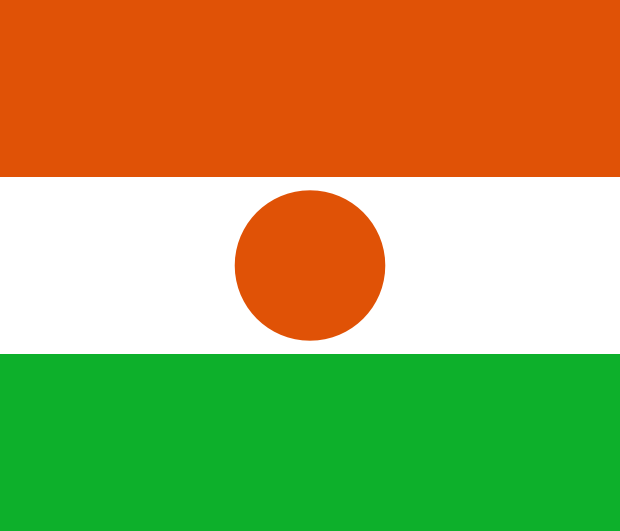
Flag is available in resolutions
| Icon 88x75 |  |
| Icon 32x27 |  |
Niger
Niger, a vast landlocked nation situated in the heart of West Africa, presents a compelling study in contrasts. Its immense territory, roughly twice the size of France, is dominated by the Sahara Desert, shaping its climate, its people, and its historical trajectory. This is a land of ancient trade routes, nomadic traditions, and a rich tapestry of ethnic groups, all striving to navigate the challenges of a harsh environment and a complex socio-economic landscape. Understanding Niger requires delving into its geographical realities, its tumultuous history, its resilient population, and its nascent efforts towards development and attracting global attention.
The geography of Niger is overwhelmingly defined by its arid and semi-arid climate. The vast majority of the country lies within the Sahara Desert, a seemingly endless expanse of sand dunes, rocky plateaus, and sparse vegetation. This harsh environment dictates much of life in Niger. The southern belt, however, offers a stark contrast. Here, the Sahel region, a transitional zone between the Sahara and the Sudanian savanna, experiences a short rainy season that allows for subsistence agriculture and pastoralism. The Niger River, the third-longest river in Africa, is the lifeblood of the nation, flowing through the southwestern part of the country. Its fertile floodplains support a significant portion of the population and are crucial for agriculture. The river’s historical importance as a transport artery and a source of water cannot be overstated, having facilitated trade and settlement for centuries. Beyond the river valley, the landscape is characterized by vast, open plains, occasional mountain ranges like the Ar Mountains in the north, and the stark beauty of the desert. The desert itself is not a uniform entity; it encompasses the erg regions with their towering sand dunes, the hammada with its rocky, barren surfaces, and the reg, characterized by gravelly plains. This diverse topography, though challenging, holds a unique, raw beauty that is increasingly being recognized.
Nigers history is a long and complex narrative, marked by the rise and fall of empires, the impact of colonialism, and the struggles of post-independence nation-building. For millennia, the region was traversed by nomadic peoples and was a crucial nexus for trans-Saharan trade. Powerful empires, such as the Songhai Empire in the 15th and 16th centuries, exerted influence over vast territories, controlling lucrative trade routes for gold, salt, and slaves. The arrival of Europeans in the 19th century ushered in a new era of colonial rule. France gradually consolidated its control over the territory, which became known as French Sudan and later as Niger Colony. The colonial period, while bringing some infrastructure development, also disrupted traditional social structures and economic systems, laying the groundwork for future challenges. Independence was achieved in 1960, but the post-colonial era has been characterized by political instability, a series of coups d’état, and periods of authoritarian rule interspersed with fragile democratic experiments. The country has also faced significant challenges related to desertification, food insecurity, and external influences, particularly from neighboring countries experiencing conflict. Despite these difficulties, Niger has a proud heritage of resilience and cultural richness, with a deep-seated history of adapting to its environment and preserving its traditions.
The population of Niger is as diverse as its history and geography. It is a young population, with a high birth rate, meaning a significant proportion of the population is under the age of 15. The majority of Nigeriens are of sub-Saharan African descent, with several major ethnic groups forming the fabric of the nation. The Hausa, who are also the largest ethnic group in neighboring Nigeria, constitute a significant portion of Niger’s population, particularly in the south. They are primarily agriculturalists and traders. The Zarma (or Djerma) are another prominent group, concentrated in the fertile Niger River valley, and are also known for their agricultural prowess and their historical role in trade. Other important ethnic groups include the Fulani (or Peul), nomadic or semi-nomadic pastoralists found across the Sahel; the Tuareg, traditionally nomadic people of the Sahara, known for their distinctive blue robes and their historical role as desert guides and traders, though their presence is more concentrated in the north; and the Kanuri, historically linked to the Kanem-Bornu Empire. These groups, while distinct in their customs and languages, often live in close proximity and have developed a complex web of interrelationships. Islam is the predominant religion, with over 98% of the population adhering to it, though traditional animist beliefs persist in some rural areas and are often blended with Islamic practices. The spoken languages reflect this ethnic diversity, with Hausa and Zarma being widely spoken, alongside French, the official language inherited from the colonial era. The nomadic lifestyle, particularly among the Tuareg and Fulani, continues to shape cultural practices and economic activities, even as urbanization and settled agriculture gain prominence.
Nigers economy is primarily based on subsistence agriculture and livestock herding, which employ the vast majority of the population. The country’s agricultural output is heavily dependent on rainfall, making it vulnerable to drought and climate change. Millet, sorghum, cowpeas, and groundnuts are the main staple crops grown in the southern regions. Livestock, particularly cattle, sheep, and goats, are essential for the livelihoods of many communities, providing meat, milk, and hides. However, the economy is also undergoing a slow diversification, with the mining sector playing an increasingly important role. Niger is rich in natural resources, most notably uranium, of which it is one of the worlds largest producers. Uranium mining, primarily in the Arlit region, is a significant source of foreign exchange for the country, though it also raises environmental and social concerns. Other mineral resources, such as gold, coal, and phosphates, are also present and are being explored for their potential. The industrial sector is relatively underdeveloped, with a focus on processing agricultural products, such as textiles and food processing. The informal sector is also substantial, providing livelihoods for many urban dwellers. Despite the presence of these resources, Niger remains one of the poorest countries in the world, facing significant challenges in terms of infrastructure development, access to education and healthcare, and poverty reduction. International aid and remittances from Nigeriens working abroad also play a role in the economy. The country is actively seeking to attract foreign investment and to develop its infrastructure, particularly in the energy sector, to fuel economic growth.
Despite the challenges, Niger possesses a unique set of tourist attractions, largely centered around its natural beauty and cultural heritage. The Ar Mountains in the north are a UNESCO World Heritage site, offering a dramatic landscape of volcanic peaks, ancient rock carvings, and oasis towns like Timia and Iferouane. These mountains are also home to the Tuareg people, offering opportunities to experience their traditional way of life. The Ténéré Desert, another UNESCO site, is famous for its vast sand dunes and the iconic Tree of Ténéré, a solitary acacia tree that was a vital landmark for travelers for decades until it was tragically destroyed by a drunk driver. The W National Park (also known as W National Park of Niger, Benin and Burkina Faso), straddling the borders with Benin and Burkina Faso, is a significant wildlife reserve, home to elephants, lions, hippos, and a variety of bird species. The Niger River itself offers opportunities for boat trips and a glimpse into the lives of the communities along its banks. The bustling markets of cities like Niamey, the capital, and Zinder, the second-largest city and a historic trading post, provide a vibrant cultural experience, showcasing local crafts, textiles, and cuisine. The ancient city of Agadez, with its impressive mud-brick mosque and labyrinthine streets, is a testament to the regions rich history as a center of trans-Saharan trade and Tuareg culture. While tourism in Niger is not as developed as in many other African nations, its raw, untamed beauty and rich cultural tapestry offer a compelling destination for adventurous travelers seeking an authentic experience. The country is working to improve its tourism infrastructure and security to encourage more visitors, recognizing its potential as a valuable contributor to the national economy and a means of showcasing its unique heritage to the world.
Information about Niger
The information comes from the publication CIA The World Factbook.
Automated text translation, excuse errors, please!
Country Niger is situated in a location / continent Africa. Niger has an area of 1 267 000 km2 and 16 344 687 residents. The highest point has a height 2 022 above sea level. and it is called Mont Bagzane. The lowest point is located at the level of 200 above sea level and it is named Niger River. System of government is republic and the date of independence Third August 1960. The capital city is Niamey. Niger has the international abbreviation NG.
Niger - economy
Total gross domestic product (GDP) is 11 780 000 000 $. Total gross domestic product per capita in purchasing power parity is 800 $. GDP grows by 2.30 % a year. Inflation (consumer price index) is equal to 2.90 % a year. Niger have 4 688 000 working-age population (from a total population 16 344 687 people). Niger issued 6.10 % GDP to healt care and 1,30 % GDP to army. The total amount of foreign debt is 1 331 000 000 USD.
Niger - demography
As suggested above, Niger has 16 344 687 people. Population growth is in the amount 3.63 % per year. Number of children born per 1000 population per year is 50.06.Every mother has average 7.16 children. The infant mortality rate is 109.98 and maternal mortality 590.00 deaths per 100,000 births. Average estimated life expectancy makes 53.80 years. Mortality is 13.76 people per 1000 population per year.
Niger - transport and telecommunications
Niger has 18 949 km of roads and 30 airports. The total length of waterways (navigable rivers, canals, etc.) is 300 km.
Number of active mobile phones (sim card) in the country Niger is 4 340 000. Number of active fixed telephone lines is 90 000. Niger has 115 900 internet users, who have the available 229 Internet connections. Niger has been assigned a domain first Choose range .ne.
Niger - energetics
Niger consumes a year 695 300 000 kWh of electricity. Annual electricity production is 210 000 000 kWh in power plants with a total installed electrical capacity 145 000 kW. Niger exports 0 kWh and imports 500 000 000 kWh of electricity per year Energy mix of power generation is as follows: fossil fuels: 100 %, nuclear energy: 0 %, renewable: 0.0 %, hydropower: 0.0 %. The country Niger is harvested annually 6 712 barrels of oil.
Keywords: Flag of Niger, world countries, energetics, list of countries, flag, economy, national flags, list of flags, Flags of countries, all flags, transport, telecommunications, flag states, Niger, flags of countries in the world, demography, information, politic.