Mozambique
Flag of Mozambique
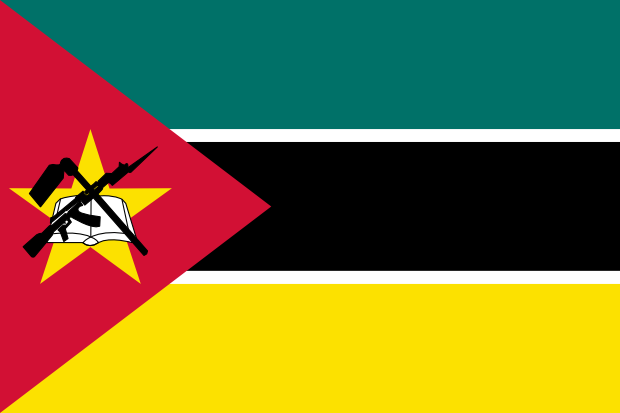
Flag is available in resolutions
| Icon 88x59 |  |
| Icon 32x21 |  |
Mozambique
Mozambique: A Tapestry of Culture, History, and Untamed Beauty
Mozambique, officially the Republic of Mozambique, is a captivating nation situated on the southeastern coast of Africa, a land where the Indian Ocean whispers tales of ancient mariners and vibrant cultures converge. Its extensive coastline, stretching over 2,470 kilometers, is a defining feature, dotted with pristine beaches, coral reefs teeming with life, and crucial port cities that have long served as gateways to the continent. Beyond its alluring coast, Mozambique unfolds into a diverse landscape, encompassing vast savannas, fertile plains, and rugged highlands. This geographical richness has profoundly shaped its history, its people, and its economic potential. The country’s strategic location has made it a crossroads for trade and migration for centuries, fostering a unique blend of indigenous African traditions, Arab influences, and Portuguese colonial heritage. Understanding Mozambique requires delving into its complex past, appreciating the resilience of its people, and marveling at the breathtaking natural beauty that defines it.
The demographic mosaic of Mozambique is as rich and varied as its landscape. With an estimated population exceeding 30 million people, it is a nation characterized by its youthfulness, a significant portion of its citizens falling within the younger age brackets. The overwhelming majority of Mozambicans are of Bantu origin, belonging to various ethnic groups such as the Makua, Tsonga, Sena, and Makonde. Each group possesses its own distinct language, customs, and traditions, contributing to the vibrant cultural tapestry of the nation. While Portuguese remains the official language, a testament to its colonial past, it is spoken by a minority. Instead, a multitude of indigenous languages, including Emakhuwa, Xichangana, and Cisena, are widely spoken across the country, reflecting the deep-rooted ethnic diversity. Islam holds a significant presence, particularly in the northern coastal regions, a legacy of historical trade links with Arab merchants. Christianity, in its various denominations, is also widely practiced, with a growing number of adherents. This religious and linguistic diversity, while sometimes presenting challenges, is ultimately a source of strength and a testament to the nation’s ability to absorb and integrate different influences. The Mozambican people are generally known for their warmth, hospitality, and resilience, qualities forged through a history marked by both hardship and triumph.
The history of Mozambique is a long and intricate narrative, stretching back millennia. Archaeological evidence suggests human habitation in the region dating back to the Stone Age. For centuries, the coastline served as a vital hub for trade along the Swahili coast, with Arab and Persian merchants establishing trading posts and influencing the local cultures. These interactions brought new languages, religions, and architectural styles, leaving an indelible mark on the region. The arrival of the Portuguese in the late 15th century, led by Vasco da Gama in 1498, marked a pivotal turning point. The Portuguese gradually asserted their dominance, establishing a colonial administration that would last for nearly five centuries. This period was characterized by the exploitation of resources, including ivory, gold, and later, forced labor for plantations. The colonial era imposed Portuguese language and culture, but it also sowed the seeds of resistance. The struggle for independence gained momentum in the mid-20th century, culminating in the armed conflict led by the Mozambique Liberation Front (FRELIMO). After years of guerrilla warfare, Mozambique finally achieved independence on June 25, 1975. The post-independence period was initially marked by a socialist government and a devastating civil war, fueled by external interventions and internal divisions, which lasted for 16 years. The cessation of hostilities in 1992 ushered in an era of peace and a transition towards a multi-party democracy. The country has since been focused on rebuilding its infrastructure, fostering economic development, and healing the wounds of its past.
Mozambique’s geography is a compelling blend of coastal splendor and inland vastness. The countrys extensive coastline along the Indian Ocean is arguably its most iconic feature. Here, powdery white-sand beaches stretch for miles, fringed by swaying palm trees and lapped by crystal-clear turquoise waters. The Bazaruto Archipelago, a protected marine national park, is a jewel in this coastal crown, renowned for its vibrant coral reefs, abundant marine life, including dugongs, whales, and dolphins, and its exceptional diving and snorkeling opportunities. Further north, the Quirimbas Archipelago offers a more remote and untouched paradise, with historic islands like Ilha de Moçambique, a UNESCO World Heritage site, bearing witness to centuries of Arab and Portuguese influence. Inland, the landscape transforms dramatically. The Zambezi River, one of Africa’s great waterways, flows through the heart of the country, creating fertile floodplains that are crucial for agriculture. To the west, the land rises into highlands and plateaus, offering cooler climates and different ecosystems. The Gorongosa National Park, once ravaged by war, is now a symbol of successful conservation efforts, showcasing a remarkable recovery of its wildlife populations, from lions and elephants to hippos and diverse bird species. The countrys natural resources are substantial, including significant reserves of coal, natural gas, and various minerals, which hold immense potential for economic growth.
The economy of Mozambique is a dynamic and evolving entity, heavily influenced by its natural resources and its ongoing recovery from past conflicts. Agriculture remains a cornerstone, employing a significant portion of the population and contributing substantially to the GDP. Staple crops like maize, cassava, and rice are grown for subsistence and local markets, while cash crops such as cashew nuts, cotton, tea, and sugarcane are important export commodities. The countrys vast coastline and rivers also support a vital fishing industry, providing both food security and export revenue. In recent years, Mozambique has emerged as a significant player in the global energy sector, with the discovery of vast offshore natural gas reserves. This has attracted substantial foreign investment and promises to transform the nations economic landscape, although careful management is required to ensure equitable distribution of wealth and avoid the resource curse. Mining is another crucial sector, with the extraction of coal, titanium, and other minerals contributing significantly to exports. The development of infrastructure, including roads, railways, and ports, is a priority for the government, aimed at facilitating trade, attracting investment, and improving connectivity within the country and with its neighbors. Despite these promising developments, Mozambique still faces challenges, including high levels of poverty, inequality, and vulnerability to climate change impacts, such as cyclones and droughts.
Mozambique offers a wealth of tourist attractions, catering to a diverse range of interests, from adventure seekers to history buffs and nature lovers. The coastal regions are undoubtedly the main draw. The pristine beaches of the southern coast, such as those near Tofo and Vilanculos, are legendary for their surfing, diving, and whale shark encounters. The Bazaruto and Quirimbas Archipelagos provide unparalleled opportunities for snorkeling and diving amidst vibrant coral gardens, with chances to spot rare marine life. For those interested in history and culture, Ilha de Moçambique is an absolute must-visit. This UNESCO World Heritage site, once the capital of Portuguese East Africa, is a living museum, with its well-preserved colonial architecture, ancient mosques, and the imposing Fort So Sebastio. Inland, Gorongosa National Park offers an extraordinary wildlife safari experience, allowing visitors to witness the remarkable recovery of its diverse fauna in a stunning natural setting. The majestic Zambezi River provides opportunities for boat trips and exploring the surrounding landscapes. Beyond these major attractions, smaller towns and villages offer glimpses into authentic Mozambican life, with bustling markets, traditional music, and warm hospitality. The country’s rich cultural heritage is also evident in its vibrant festivals, intricate Makonde wood carvings, and distinctive music and dance traditions, all of which contribute to a truly immersive travel experience. Mozambique, with its untamed beauty and captivating history, is a destination that promises unforgettable adventures and profound cultural encounters.
Information about Mozambique
The information comes from the publication CIA The World Factbook.
Automated text translation, excuse errors, please!
Country Mozambique is situated in a location / continent Africa. Mozambique has an area of 799 380 km2 and 23 515 934 residents. The highest point has a height 2 436 above sea level. and it is called Monte Binga. The lowest point is located at the level of 0 above sea level and it is named Indian Ocean. System of government is republic and the date of independence 25th June 1975. The capital city is Maputo. Mozambique has the international abbreviation MZ.
Mozambique - economy
Total gross domestic product (GDP) is 24 190 000 000 $. Total gross domestic product per capita in purchasing power parity is 1 100 $. GDP grows by 7.10 % a year. Inflation (consumer price index) is equal to 10.40 % a year. Mozambique have 9 973 000 working-age population (from a total population 23 515 934 people). Unemployment is at 21.00 %. Mozambique issued 5.70 % GDP to healt care and 0,80 % GDP to army. The public debt of the country is 34.90 % GDP. The total amount of foreign debt is 4 320 000 000 USD.
Mozambique - demography
As suggested above, Mozambique has 23 515 934 people. Population growth is in the amount 2.44 % per year. Number of children born per 1000 population per year is 39.34.Every mother has average 5.40 children. The infant mortality rate is 76.85 and maternal mortality 490.00 deaths per 100,000 births. Average estimated life expectancy makes 52.02 years. Mortality is 12.79 people per 1000 population per year.
Mozambique - transport and telecommunications
Mozambique has 30 331 km of roads, 4 787 km of railway lines and 100 airports. The total length of waterways (navigable rivers, canals, etc.) is 460 km. There is registered 2 ships.
Number of active mobile phones (sim card) in the country Mozambique is 7 855 000. Number of active fixed telephone lines is 88 100. Mozambique has 613 600 internet users, who have the available 82 804 Internet connections. Mozambique has been assigned a domain first Choose range .mz.
Mozambique - energetics
Mozambique consumes a year 10 190 000 000 kWh of electricity. Annual electricity production is 16 790 000 000 kWh in power plants with a total installed electrical capacity 2 428 000 kW. Mozambique exports 12 940 000 000 kWh and imports 7 869 000 000 kWh of electricity per year Energy mix of power generation is as follows: fossil fuels: 10.3 %, nuclear energy: 0 %, renewable: 0.0 %, hydropower: 89.7 %.
Keywords: energetics, all flags, economy, telecommunications, flag, information, world countries, Flag of Mozambique, transport, list of flags, national flags, list of countries, flag states, demography, Flags of countries, Mozambique, flags of countries in the world, politic.