Bosnia and Herzegovina
Flag of Bosnia and Herzegovina
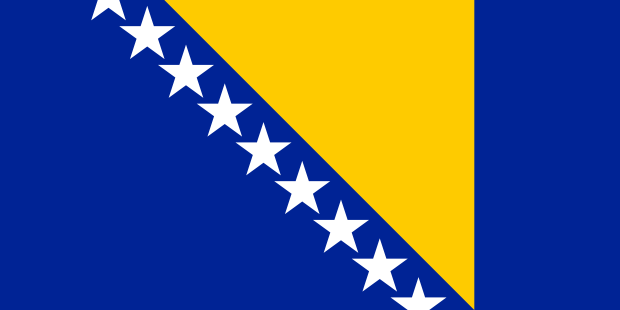
Flag is available in resolutions
| Icon 88x44 |  |
| Icon 32x16 |  |
Bosnia and Herzegovina
Bosnia and Herzegovina: A Tapestry of Cultures and Landscapes
Bosnia and Herzegovina, a landlocked nation nestled in the heart of the Balkan Peninsula, is a country of striking contrasts and profound historical significance. Its name itself, derived from the Bosna River, hints at the geographical features that define it, while its complex past has woven a rich tapestry of cultures, ethnicities, and religions. From its rugged mountains and emerald rivers to its ancient cities and resilient people, Bosnia and Herzegovina offers a captivating glimpse into a region that has long been a crossroads of civilizations.
The population of Bosnia and Herzegovina is as diverse as its landscape, a testament to centuries of migration and interaction. The primary ethnic groups are Bosniaks, Serbs, and Croats, each with their own distinct cultural heritage, language variations, and religious affiliations. Bosniaks are predominantly Muslim, Serbs are Orthodox Christian, and Croats are Roman Catholic. This tripartite division has shaped the countrys political and social fabric, often leading to both vibrant cultural exchange and, at times, deeply rooted tensions. Despite these historical divisions, a significant portion of the population identifies as simply Bosnian, reflecting a growing desire for national unity and a shared identity that transcends ethnic lines. The official languages are Bosnian, Croatian, and Serbian, which are mutually intelligible and often considered dialects of a single language. The capital city, Sarajevo, is a microcosm of this diversity, a bustling metropolis where mosques, Orthodox churches, Catholic cathedrals, and synagogues stand in close proximity, symbolizing the city’s historical role as a melting pot of faiths and cultures. The younger generations, in particular, are increasingly embracing a more inclusive vision of Bosnia and Herzegovina, one that celebrates its multifaceted identity.
The history of Bosnia and Herzegovina is a long and often tumultuous narrative, marked by periods of independent statehood, foreign domination, and devastating conflict. For centuries, the region was a part of various empires, including the Roman, Byzantine, and Ottoman Empires. The Ottoman conquest in the 15th century brought with it Islam, which profoundly influenced the region’s culture and demographics, leading to the emergence of the Bosniak Muslim population. Following the decline of the Ottoman Empire, Bosnia and Herzegovina came under Austro-Hungarian rule in the late 19th century. This period saw significant modernization and industrialization, but also fueled burgeoning nationalist sentiments among the South Slavs. The assassination of Archduke Franz Ferdinand of Austria-Hungary in Sarajevo in 1914, an event that triggered World War I, underscored the region’s volatile geopolitical importance. After the war, Bosnia and Herzegovina became part of the Kingdom of Yugoslavia, a multinational state that aimed to unite all South Slavs. During World War II, the country was occupied by Nazi Germany and its allies, and experienced brutal civil war and resistance movements. Following the war, it was incorporated into the Socialist Federal Republic of Yugoslavia under Josip Broz Tito, enjoying a period of relative peace and economic prosperity. However, the collapse of Yugoslavia in the early 1990s plunged Bosnia and Herzegovina into a devastating war (1992-1995), characterized by ethnic cleansing and widespread atrocities. The Dayton Agreement, brokered in 1995, ended the conflict but established a complex political system that divides the country into two entities: the Federation of Bosnia and Herzegovina and Republika Srpska, with the Brčko District as a self-governing unit. This post-war period has been one of reconstruction and reconciliation, a slow and challenging process of healing and rebuilding a nation scarred by conflict.
Geographically, Bosnia and Herzegovina is a land of dramatic contrasts. Its territory is predominantly mountainous, with the Dinaric Alps forming a significant portion of the landscape. These imposing peaks offer breathtaking vistas and a haven for outdoor enthusiasts, with numerous opportunities for hiking, climbing, and skiing. The country is also crisscrossed by a network of rivers, the most significant being the Bosna, Sava, and Neretva. These rivers have carved out deep valleys and gorges, contributing to the countrys stunning natural beauty. The Sava River forms part of the northern border with Croatia, while the Neretva River flows southwards, eventually emptying into the Adriatic Sea. While Bosnia and Herzegovina has a short coastline along the Adriatic Sea, measuring only about 20 kilometers, it is a strategically important and picturesque stretch of land. The western part of the country is characterized by karst topography, with underground rivers, caves, and sinkholes, adding to the geological intrigue. The climate varies across the country, with continental influences in the north and a Mediterranean climate along the coast. Winters can be cold and snowy in the mountainous regions, while summers are warm and pleasant. The natural environment remains a significant asset, with large areas covered by forests, supporting a rich biodiversity.
The economy of Bosnia and Herzegovina has been in a process of transition and reconstruction since the end of the war. Historically, the country had a strong industrial base, particularly in mining, metallurgy, and manufacturing. While these sectors still play a role, the economy is increasingly diversifying. Key industries include agriculture, forestry, energy production (hydroelectric power is significant), and a growing tourism sector. The country is rich in natural resources, including coal, iron ore, bauxite, and lead. However, the legacy of the war and the complex political structure have presented challenges to economic development, including high unemployment rates and a need for significant foreign investment. Efforts are underway to modernize infrastructure, reform state-owned enterprises, and attract foreign direct investment to create jobs and stimulate growth. The service sector, particularly tourism, is emerging as a vital contributor to the economy, capitalizing on the country’s natural beauty, historical sites, and unique cultural heritage. The agricultural sector remains important, with the production of fruits, vegetables, grains, and livestock.
Bosnia and Herzegovina boasts a wealth of tourist attractions, offering a compelling blend of history, culture, and natural beauty. The capital city, Sarajevo, is a must-see, often referred to as the “Jerusalem of Europe” due to its religious diversity. Its Old Town, Baščaršija, is a labyrinth of cobblestone streets, bustling markets, and historic mosques and churches. The Latin Bridge, where the assassination of Archduke Franz Ferdinand took place, is a poignant historical landmark. Sarajevo’s resilient spirit is palpable, and its museums, such as the National Museum of Bosnia and Herzegovina, offer deep insights into the country’s past. Further south, the city of Mostar is renowned for its iconic Stari Most (Old Bridge), a UNESCO World Heritage site that was meticulously rebuilt after its destruction during the war. The bridge, with its elegant arch, spans the turquoise waters of the Neretva River and is a symbol of reconciliation and resilience. The surrounding Old Town of Mostar is equally charming, with its Ottoman-era architecture and vibrant atmosphere. Beyond these prominent cities, Bosnia and Herzegovina offers numerous other attractions. The Plitvice Lakes National Park, although technically in neighboring Croatia, is easily accessible from Bosnia and Herzegovina and is a breathtaking natural wonder. Within Bosnia and Herzegovina itself, the Kravica Waterfalls offer a stunning natural spectacle, a series of cascades plunging into clear pools, perfect for swimming in the summer months. The mountainous regions provide ample opportunities for adventure tourism, with national parks like Sutjeska and Kozara offering hiking trails, wildlife viewing, and opportunities to explore pristine natural landscapes. The country’s rich history is also evident in its numerous medieval fortresses, ancient Roman ruins, and Ottoman-era caravanserais, scattered throughout the countryside, each telling a story of bygone eras. The warmth and hospitality of the Bosnian people are often cited as one of the country’s greatest assets, making visitors feel welcome and immersed in the local culture. From the vibrant energy of Sarajevo to the serene beauty of its natural landscapes, Bosnia and Herzegovina is a destination that promises a truly unforgettable experience.
Information about Bosnia and Herzegovina
The information comes from the publication CIA The World Factbook.
Automated text translation, excuse errors, please!
Country Bosnia and Herzegovina is situated in a location / continent Europe. Bosnia and Herzegovina has an area of 51 197 km2 and 3 879 296 residents. The highest point has a height 2 386 above sea level. and it is called Maglic. The lowest point is located at the level of 0 above sea level and it is named Adriatic Sea. System of government is Federal Republic and the date of independence First March 1992. The capital city is Sarajevo. Bosnia and Herzegovina has the international abbreviation BK.
Bosnia and Herzegovina - economy
Total gross domestic product (GDP) is 32 040 000 000 $. Total gross domestic product per capita in purchasing power parity is 8 200 $. GDP grows by 1.70 % a year. Inflation (consumer price index) is equal to 3.70 % a year. Bosnia and Herzegovina have 2 600 000 working-age population (from a total population 3 879 296 people). Unemployment is at 43.30 %. Bosnia and Herzegovina issued 10.90 % GDP to healt care .The public debt of the country is 43.30 % GDP. The total amount of foreign debt is 10 540 000 000 USD.
Bosnia and Herzegovina - demography
As suggested above, Bosnia and Herzegovina has 3 879 296 people. Population growth is in the amount -0.00 % per year. Number of children born per 1000 population per year is 8.89.Every mother has average 1.24 children. The infant mortality rate is 8.47 and maternal mortality 8.00 deaths per 100,000 births. Average estimated life expectancy makes 78.96 years. Mortality is 8.91 people per 1000 population per year.
Bosnia and Herzegovina - transport and telecommunications
Bosnia and Herzegovina has 22 926 km of roads, 601 km of railway lines and 25 airports.
Number of active mobile phones (sim card) in the country Bosnia and Herzegovina is 3 171 000. Number of active fixed telephone lines is 955 900. Bosnia and Herzegovina has 1 422 000 internet users, who have the available 146 152 Internet connections. Bosnia and Herzegovina has been assigned a domain first Choose range .ba.
Bosnia and Herzegovina - energetics
Bosnia and Herzegovina consumes a year 10 170 000 000 kWh of electricity. Annual electricity production is 15 040 000 000 kWh in power plants with a total installed electrical capacity 4 341 000 kW. Bosnia and Herzegovina exports 5 877 000 000 kWh and imports 2 887 000 000 kWh of electricity per year Energy mix of power generation is as follows: fossil fuels: 44.5 %, nuclear energy: 0 %, renewable: 0.0 %, hydropower: 55.5 %.
Keywords: transport, national flags, demography, flag states, Bosnia and Herzegovina, Flags of countries, flag, flags of countries in the world, telecommunications, all flags, list of flags, energetics, Flag of Bosnia and Herzegovina, economy, world countries, list of countries, information, politic.