Serbia
Flag of Serbia
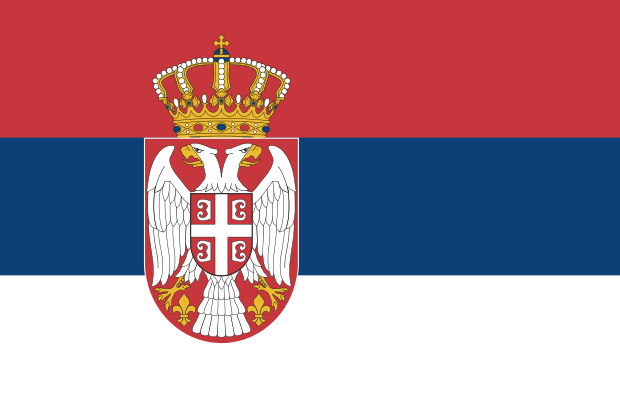
Flag is available in resolutions
| Icon 88x59 |  |
| Icon 32x21 |  |
Serbia
The Republic of Serbia, a landlocked nation situated at the crossroads of Southeastern and Central Europe, boasts a rich tapestry of history, a diverse geography, and a resilient population. Nestled in the heart of the Balkan Peninsula, Serbia’s strategic location has made it a pivotal point for cultural exchange and historical conflict throughout the ages. Its territory is predominantly characterized by rolling plains in the north, transitioning into a more mountainous and rugged terrain in the south and west. The mighty Danube River, a vital artery of European trade and culture, flows through the country, shaping its landscape and influencing its development. Serbia’s capital and largest city, Belgrade, is a vibrant metropolis, a testament to the nation’s enduring spirit and its ability to blend ancient traditions with modern aspirations. The Serbian people, known for their warmth, hospitality, and strong sense of national identity, have navigated numerous political and social transformations, emerging as a proud and independent nation.
The historical narrative of Serbia is deeply intertwined with the complex geopolitical landscape of the Balkans. Emerging as a medieval kingdom in the 12th century, Serbia experienced its golden age under rulers like Stefan Nemanja and Stefan Dušan, who expanded its territory and fostered a flourishing of art and culture. The Battle of Kosovo in 1389, a pivotal moment in Serbian history, marked the beginning of Ottoman rule, which lasted for nearly five centuries. This long period of foreign domination profoundly shaped Serbian identity, fostering a spirit of resistance and a longing for independence. The 19th century witnessed the gradual re-establishment of Serbian autonomy, culminating in the formation of the Kingdom of Serbia in 1882. The country played a significant role in the Balkan Wars of the early 20th century and was a key participant in World War I, with the assassination of Archduke Franz Ferdinand in Sarajevo, then part of Austria-Hungary but with strong Serbian ties, serving as the immediate trigger for the global conflict. Following World War I, Serbia became a constituent part of the Kingdom of Serbs, Croats, and Slovenes, later renamed Yugoslavia. The socialist Federal Republic of Yugoslavia, led by Josip Broz Tito, was a major force during the Cold War, pursuing a non-aligned foreign policy. The dissolution of Yugoslavia in the 1990s was a tumultuous period, marked by a series of wars in the former republics. Serbia, as the successor state, faced significant challenges, including international sanctions and the NATO bombing campaign in 1999. Despite these adversies, Serbia has been steadfast in its pursuit of a stable and prosperous future, actively working towards integration into European structures.
Geographically, Serbia offers a remarkable diversity of landscapes. The northern part of the country, known as Vojvodina, is a fertile plain, part of the Pannonian Basin, ideal for agriculture. Here, vast expanses of arable land are crisscrossed by rivers and canals, supporting a rich agricultural output. The southern and western regions, on the other hand, are dominated by mountain ranges such as the Dinaric Alps and the Balkan Mountains. These areas are characterized by dramatic gorges, dense forests, and pristine natural beauty. The Djerdap Gorge, also known as the Iron Gates, carved by the Danube River, is one of Europe’s most spectacular natural wonders, a testament to the raw power of nature. Serbia is also home to numerous rivers, with the Danube, Sava, and Morava being the most prominent. These waterways have historically served as crucial trade routes and have shaped the settlement patterns of the Serbian people. The country’s climate is continental, with hot summers and cold winters, offering a distinct seasonal rhythm to its natural environment. This varied geography not only provides a stunning backdrop for tourism but also supports a diverse range of flora and fauna, contributing to Serbia’s ecological richness.
The Serbian economy, while undergoing a continuous process of transformation and modernization, is built upon a foundation of both traditional industries and emerging sectors. Historically, agriculture has been a cornerstone of the Serbian economy, with the fertile plains of Vojvodina producing significant quantities of grain, corn, sugar beets, and sunflowers. The livestock sector also plays an important role. In recent decades, Serbia has been actively developing its industrial base. Key sectors include manufacturing, particularly in the automotive industry, food processing, and textiles. The mining sector is also significant, with Serbia possessing substantial reserves of copper, lead, zinc, and coal. The country has also been investing in the development of its service sector, with tourism, information technology, and telecommunications showing considerable growth. Serbia’s strategic location and its efforts towards European integration have attracted foreign investment, further bolstering its economic development. The country is working to improve its infrastructure, streamline its business environment, and enhance its competitiveness on the global stage, aiming to create a dynamic and sustainable economic future.
Serbia’s rich history and diverse landscape translate into a wealth of tourist attractions, catering to a wide range of interests. The capital city, Belgrade, is a vibrant hub, boasting a formidable fortress, Kalemegdan, that offers panoramic views of the confluence of the Sava and Danube rivers. The city’s lively nightlife, numerous museums, and eclectic architecture, a blend of Austro-Hungarian grandeur and socialist-era structures, make it a captivating destination. Beyond Belgrade, the country offers a journey through time and nature. The ancient city of Novi Sad, with its Petrovaradin Fortress overlooking the Danube, is a cultural gem and the host of the renowned EXIT music festival. For those seeking spiritual solace and historical immersion, the monasteries of the Fruška Gora region, often referred to as the “Serbian Mount Athos,” offer a glimpse into medieval religious art and architecture. The southern part of Serbia is equally compelling, with the stunning natural beauty of the Tara National Park, known for its pristine forests and the Drina River canyon. The Djerdap National Park, with its dramatic Iron Gates gorge, provides opportunities for boat trips and hiking amidst breathtaking scenery. For a taste of traditional Serbian life, the ethno-villages scattered across the countryside offer an authentic experience of rural customs and cuisine. The countrys thermal spas, like those in Vrnjačka Banja, are renowned for their healing properties and offer a relaxing escape. Serbia’s historical sites, from Roman ruins to medieval fortresses and Ottoman-era mosques, tell the story of its multifaceted past, making it a truly rewarding destination for any traveler.
Information about Serbia
The information comes from the publication CIA The World Factbook.
Automated text translation, excuse errors, please!
Country Serbia is situated in a location / continent Europe. Serbia has an area of 77 474 km2 and 7 276 604 residents. The highest point has a height 2 169 above sea level. and it is called Midzor. The lowest point is located at the level of 28 above sea level and it is named Timok River. System of government is republic and the date of independence 5th June 2006. The capital city is Belgrade (Beograd). Serbia has the international abbreviation RI.
Serbia - economy
Total gross domestic product (GDP) is 79 880 000 000 $. Total gross domestic product per capita in purchasing power parity is 10 800 $. GDP grows by 1.80 % a year. Inflation (consumer price index) is equal to 11.20 % a year. Serbia have 2 920 000 working-age population (from a total population 7 276 604 people). Unemployment is at 23.40 %. Serbia issued 9.90 % GDP to healt care .The public debt of the country is 45.10 % GDP. The total amount of foreign debt is 31 530 000 000 USD.
Serbia - demography
As suggested above, Serbia has 7 276 604 people. Population growth is in the amount -0.46 % per year. Number of children born per 1000 population per year is 9.17.Every mother has average 1.40 children. The infant mortality rate is 6.40 and maternal mortality 12.00 deaths per 100,000 births. Average estimated life expectancy makes 74.56 years. Mortality is 13.81 people per 1000 population per year.
Serbia - transport and telecommunications
Serbia has 41 913 km of roads, 3 379 km of railway lines and 30 airports. The total length of waterways (navigable rivers, canals, etc.) is 587 km.
Number of active mobile phones (sim card) in the country Serbia is 10 182 000. Number of active fixed telephone lines is 3 030 000. Serbia has 4 107 000 internet users, who have the available 1 102 000 Internet connections. Serbia has been assigned a domain first Choose range .rs.
Serbia - energetics
Serbia consumes a year 35 500 000 000 kWh of electricity. Annual electricity production is 36 060 000 000 kWh in power plants with a total installed electrical capacity 8 359 000 kW. Serbia exports 2 017 000 000 kWh and imports 1 900 000 000 kWh of electricity per year Energy mix of power generation is as follows: fossil fuels: 66.1 %, nuclear energy: 0 %, renewable: 0.0 %, hydropower: 26.6 %. The country Serbia is harvested annually 13 160 barrels of oil.
Keywords: Flags of countries, Flag of Serbia, list of countries, flag states, transport, energetics, list of flags, flag, demography, Serbia, telecommunications, information, all flags, economy, flags of countries in the world, national flags, world countries, politic.