Albania
Flag of Albania
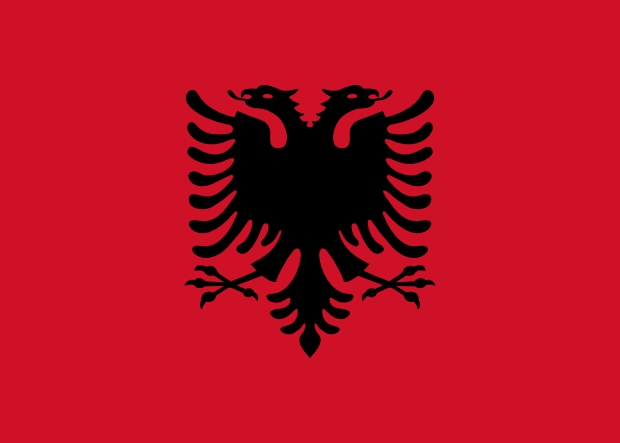
Flag is available in resolutions
| Icon 88x63 |  |
| Icon 32x23 |  |
Albania
Albania: A Land of Eagles and Ancient Histories
Nestled in the heart of the Balkans, Albania, officially the Republic of Albania, is a country that whispers tales of ancient civilizations, rugged natural beauty, and a resilient spirit. Often overshadowed by its more prominent Mediterranean neighbors, this captivating nation offers a unique blend of history, culture, and breathtaking landscapes, making it an increasingly attractive destination for those seeking an authentic and less-trodden European experience. From its dramatic coastlines along the Adriatic and Ionian Seas to its imposing mountain ranges, Albania is a land of contrasts, where the echoes of Illyrians, Romans, Byzantines, and Ottomans resonate through its ancient ruins and vibrant modern cities.
The Albanian populace, numbering around 2.8 million, is characterized by a deep sense of national pride and a strong connection to their heritage. The vast majority of Albanians identify as ethnically Albanian, with a significant minority including Greeks, Vlachs, Roma, and others, contributing to the countrys diverse cultural tapestry. The Albanian language, an Indo-European language with its own unique branch, serves as a unifying force, spoken by nearly all inhabitants. Religious diversity is also a notable feature, with Islam being the predominant religion, followed by significant Christian communities (Orthodox and Catholic). This religious coexistence, often marked by tolerance and mutual respect, is a testament to Albanias historical interactions and its modern commitment to secularism. The Albanian people are known for their hospitality, often referred to as „besa“ – a sacred code of honor that emphasizes loyalty, protection, and welcoming guests. This deep-seated tradition is palpable in their interactions with visitors, creating a warm and inviting atmosphere that belies the countrys sometimes challenging past.
Albanias history is a long and complex saga, stretching back millennia. The region was originally inhabited by the Illyrians, an ancient Indo-European people who established a significant presence in the western Balkans. Their legacy can be seen in archaeological sites scattered throughout the country, offering glimpses into their sophisticated culture and societal structures. The Roman Empire later conquered the Illyrians, integrating the territory into its vast domain. Roman influence is still evident in well-preserved ruins, such as the ancient city of Butrint, a UNESCO World Heritage site, which showcases a remarkable continuum of habitation from the Greek, Roman, Byzantine, and Venetian periods. Following the decline of the Roman Empire, the region came under the sway of various powers, including the Byzantine Empire and later the Bulgarian and Serbian empires. However, it was the Ottoman Empire that left the most profound and enduring mark on Albania. For nearly five centuries, from the 15th to the early 20th century, Albania was part of the Ottoman realm, a period that shaped its religion, culture, architecture, and social fabric. Despite Ottoman rule, a strong sense of Albanian identity persisted, culminating in the declaration of independence in 1912. The 20th century brought further upheaval. Albania experienced periods of monarchy, a brief Italian occupation during World War II, and then emerged as a staunchly communist state under the iron fist of Enver Hoxha. Hoxhas regime, characterized by extreme isolationism and a cult of personality, left an indelible scar on the nation, impacting its economic development and international relations. Following the collapse of communism in 1991, Albania embarked on a challenging transition to democracy and a market economy, a journey marked by both progress and setbacks.
Geographically, Albania is a land of striking diversity and dramatic contrasts. Its western border is defined by the Adriatic and Ionian Seas, offering a stunning coastline dotted with pristine beaches, secluded coves, and charming fishing villages. The Albanian Riviera, in particular, is gaining international recognition for its turquoise waters and unspoiled beauty, rivaling more established Mediterranean destinations. Inland, the landscape dramatically shifts to rugged mountains, forming a significant portion of the countrys topography. The Albanian Alps, also known as the Accursed Mountains, in the north, are a paradise for hikers and nature enthusiasts, with towering peaks, glacial lakes, and remote valleys. These mountains have historically served as natural barriers, influencing settlement patterns and preserving distinct cultural traditions in their secluded communities. The country is also crisscrossed by numerous rivers, the most significant being the Drin, which flows through the northern part of the country, and the Vjosa, one of Europes last wild rivers, flowing through the south. Lakes, such as Lake Skadar (shared with Montenegro) and Lake Ohrid (shared with North Macedonia), add to the countrys natural allure, offering ecological significance and recreational opportunities. The climate varies across the country, with a Mediterranean climate along the coast, characterized by hot, dry summers and mild, wet winters, while the interior experiences a more continental climate with colder winters and hotter summers.
Albanias economy has undergone a significant transformation since the fall of communism. Historically, the country was largely agrarian, with a focus on agriculture and mining. Under communist rule, heavy industry was developed, often inefficiently and with significant environmental consequences. Since the transition to a market economy, Albania has seen growth in sectors such as services, tourism, and remittances from Albanians working abroad. However, challenges remain, including high unemployment, particularly among youth, and the need for further structural reforms to attract foreign investment and foster sustainable development. Key industries today include agriculture, which remains important, producing fruits, vegetables, and olives; mining, with significant deposits of chromium, copper, and nickel; and a growing energy sector, with a reliance on hydropower. The tourism industry, however, is emerging as a major driver of economic growth, capitalizing on the countrys natural beauty and rich history.
Albanias tourism potential is immense, offering a diverse range of attractions for every type of traveler. The historical sites are a major draw. Butrint, a UNESCO World Heritage site, is a must-see, showcasing millennia of civilization. The ancient city of Apollonia, once a thriving Greek colony, and the Roman amphitheater in Durrës, one of the largest in the Balkans, are further testaments to Albanias rich past. For those seeking natural beauty, the Albanian Riviera beckons with its stunning beaches and crystal-clear waters. Ksamil, with its idyllic islands, and Dhërmi, with its charming village and beautiful coastline, are popular choices. The northern mountains offer unparalleled opportunities for hiking and exploring remote villages. Theth and Valbona National Parks are renowned for their dramatic landscapes and trekking routes. Beyond the natural and historical, Albanias vibrant cities offer a glimpse into modern Albanian life. Tirana, the capital, is a dynamic metropolis undergoing rapid transformation, boasting colorful buildings, lively cafes, and a burgeoning arts scene. Shkodër, in the north, is a cultural hub with a rich history, dominated by the imposing Rozafa Castle, offering panoramic views. Gjirokastër, a UNESCO World Heritage city, is known for its unique Ottoman-era architecture, characterized by stone houses with slate roofs, earning it the moniker „City of Stone.“ Berat, also a UNESCO World Heritage site, is famous for its „City of a Thousand Windows,“ a picturesque hillside town with well-preserved Ottoman houses cascading down its slopes. The Albanian cuisine, influenced by Mediterranean and Balkan traditions, is another highlight, featuring fresh ingredients, grilled meats, seafood, and flavorful stews.
In conclusion, Albania is a country poised for discovery. It is a land where ancient history intertwines with a vibrant present, where rugged natural beauty meets warm hospitality, and where the resilience of its people shines through. From the sun-drenched beaches of the Riviera to the majestic peaks of the Accursed Mountains, and from the echoes of Illyrian fortresses to the bustling streets of Tirana, Albania offers an unforgettable journey for those willing to venture off the beaten path and embrace the magic of this captivating Balkan gem. Its story is still being written, and its potential for growth and recognition is undeniable, promising a bright future for this land of eagles.
Information about Albania
The information comes from the publication CIA The World Factbook.
Automated text translation, excuse errors, please!
Country Albania is situated in a location / continent Europe. Albania has an area of 28 748 km2 and 3 002 859 residents. The highest point has a height 2 764 above sea level. and it is called Maja e Korabit (Golem Korab). The lowest point is located at the level of 0 above sea level and it is named Adriatic Sea. System of government is republic and the date of independence 28th November 1912. The capital city is Tirana (Tirane). Albania has the international abbreviation AL.
Albania - economy
Total gross domestic product (GDP) is 25 230 000 000 $. Total gross domestic product per capita in purchasing power parity is 7 800 $. GDP grows by 2.00 % a year. Inflation (consumer price index) is equal to 3.50 % a year. Albania have 1 053 000 working-age population (from a total population 3 002 859 people). Unemployment is at 13.30 %. Albania issued 6.90 % GDP to healt care and 1,49 % GDP to army. The public debt of the country is 59.70 % GDP. The total amount of foreign debt is 5 700 000 000 USD.
Albania - demography
As suggested above, Albania has 3 002 859 people. Population growth is in the amount 0.28 % per year. Number of children born per 1000 population per year is 12.38.Every mother has average 1.48 children. The infant mortality rate is 14.12 and maternal mortality 27.00 deaths per 100,000 births. Average estimated life expectancy makes 77.59 years. Mortality is 6.25 people per 1000 population per year.
Albania - transport and telecommunications
Albania has 18 000 km of roads, 339 km of railway lines and 5 airports. The total length of waterways (navigable rivers, canals, etc.) is 41 km. There is registered 17 ships.
Number of active mobile phones (sim card) in the country Albania is 3 100 000. Number of active fixed telephone lines is 338 800. Albania has 1 300 000 internet users, who have the available 15 505 Internet connections. Albania has been assigned a domain first Choose range .al.
Albania - energetics
Albania consumes a year 4 521 000 000 kWh of electricity. Annual electricity production is 5 209 000 000 kWh in power plants with a total installed electrical capacity 1 610 000 kW. Albania exports 1 906 000 000 kWh and imports 1 005 000 000 kWh of electricity per year Energy mix of power generation is as follows: fossil fuels: 9.9 %, nuclear energy: 0 %, renewable: 0.0 %, hydropower: 90.1 %. The country Albania is harvested annually 15 520 barrels of oil.
Keywords: telecommunications, Flags of countries, national flags, demography, list of flags, transport, world countries, energetics, list of countries, economy, Flag of Albania, information, flags of countries in the world, all flags, flag, flag states, Albania, politic.