Faroe Islands
Flag of Faroe Islands
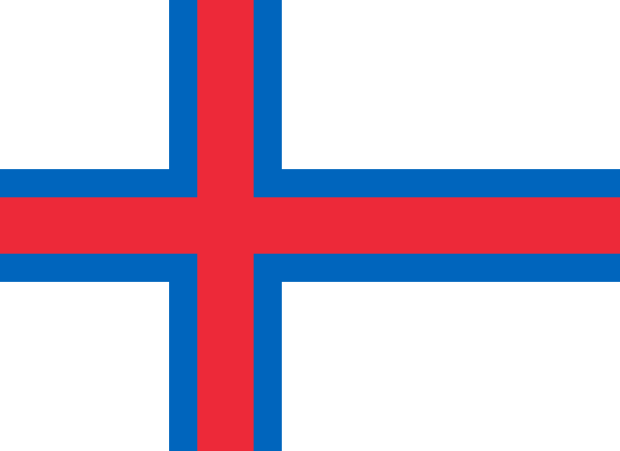
Flag is available in resolutions
| Icon 88x64 |  |
| Icon 32x23 |  |
Faroe Islands
The Faroe Islands: A Realm of Dramatic Landscapes and Enduring Traditions
Nestled in the North Atlantic Ocean, approximately halfway between Norway and Iceland, lie the Faroe Islands, an archipelago of 18 volcanic islands that present a breathtaking spectacle of raw, untamed nature. This remote Danish autonomous territory, often shrouded in mist and bathed in ethereal light, offers a unique glimpse into a world where human existence is intimately intertwined with the formidable power of the elements. With a population that has maintained a strong sense of identity and a history steeped in Viking sagas and resilient survival, the Faroes are a destination that captivates the imagination and leaves an indelible mark on the soul of every visitor.
The geography of the Faroe Islands is nothing short of dramatic. Characterized by steep, treeless mountains that plunge directly into the sea, deep fjords, and a coastline sculpted by relentless waves, the islands present a landscape of stark beauty and rugged grandeur. The highest peak, Slttaratindur, reaches 1,882 feet, offering panoramic views that stretch across the archipelago on clear days. The islands are of volcanic origin, with layers of basalt forming the distinctive, often flat-topped mountains. Vegetation is sparse, dominated by a vibrant green carpet of grass and moss, a testament to the abundant rainfall and the absence of trees, which cannot withstand the harsh winds. The climate is oceanic, meaning mild winters and cool summers, with a constant presence of wind and fog that contribute to the islands’ mystical aura. Each island possesses its own unique character, from the bustling capital of Tórshavn on Streymoy to the remote and solitary island of Mykines, a haven for puffins and seabirds. The sheer isolation of the islands has fostered a remarkable biodiversity, particularly in its birdlife, making it a paradise for ornithologists and nature enthusiasts alike.
The history of the Faroe Islands is as rich and compelling as its landscapes. Settled by Norsemen in the 9th century, the islands have a long and fascinating past, marked by periods of independence, union with Norway, and eventually, incorporation into the Kingdom of Denmark. Archaeological evidence suggests a monastic presence prior to the Norse settlement, but it was the Vikings who truly established a lasting society. The Faroese language, a descendant of Old Norse, is a living testament to this heritage, remarkably preserved through centuries of relative isolation. The islands’ legal and political system, the Lgting, is one of the oldest parliamentary institutions in the world, dating back to the 11th century. For centuries, the Faroese people relied heavily on fishing and sheep farming for their survival, a testament to their resilience and adaptability in a challenging environment. The islands experienced periods of significant hardship, including famine and disease, but their spirit of self-reliance and community has always prevailed. The gradual modernization of the islands in the 20th century brought new opportunities and challenges, but the Faroese have managed to navigate this evolution while steadfastly holding onto their cultural identity and traditions.
The population of the Faroe Islands, though small, is characterized by a strong sense of community and a deeply rooted cultural heritage. Approximately 54,000 people call these islands home, with the majority residing in Tórshavn and its surrounding areas. The Faroese people are known for their warmth, hospitality, and a pragmatic approach to life shaped by their environment. Family and community play a central role in Faroese society, and there is a palpable sense of shared responsibility and mutual support. The Faroese language, a unique North Germanic language, is a cornerstone of their identity, and its preservation is a source of national pride. Traditional Faroese culture is rich in folklore, music, and dance, with the chain dance, a communal form of storytelling and celebration, being a particularly iconic element. Despite their remoteness, the Faroese are a progressive society, embracing modern technology and education while remaining committed to their ancestral ways. The emphasis on sustainability and environmental stewardship is also a defining characteristic, reflecting a deep respect for the natural world that sustains them.
The economy of the Faroe Islands has undergone a significant transformation over the decades, moving from a near-total reliance on fishing to a more diversified model. Fishing and aquaculture remain the backbone of the Faroese economy, with salmon farming emerging as a particularly successful industry. The pristine waters surrounding the islands provide an ideal environment for high-quality fish production, which is a major export. However, recognizing the need for economic resilience, the Faroese have actively pursued diversification. Tourism has become an increasingly important sector, attracting visitors drawn to the islands’ unique natural beauty and cultural experiences. Other growing industries include renewable energy, particularly wind and tidal power, and information technology. The Faroese government has also invested in developing a robust knowledge-based economy, fostering innovation and entrepreneurship. This strategic approach to economic development has allowed the islands to maintain a high standard of living and a strong social welfare system, demonstrating their capacity for adaptation and forward-thinking.
The tourist attractions of the Faroe Islands are deeply intertwined with its natural wonders and cultural heritage. For nature lovers, the islands offer unparalleled opportunities for hiking, birdwatching, and simply immersing oneself in the dramatic scenery. Iconic sights include the village of Gásadalur with its stunning Múlafossur waterfall plunging directly into the ocean, the sea stacks of Drangarnir, and the rugged cliffs of Vestmanna, where boat tours offer close encounters with nesting seabirds. The charming capital city of Tórshavn, with its colorful wooden houses, historic Tinganes peninsula, and vibrant harbor, provides a pleasant urban contrast to the wild landscapes. Visitors can explore traditional Faroese villages, experience the local cuisine, which often features lamb and seafood, and learn about the islands’ rich history and folklore. The remote island of Mykines, accessible by ferry or helicopter, is a must-visit for its abundant puffin colonies during the summer months. The Faroe Islands are not a destination for those seeking bustling resorts or conventional tourist amenities; instead, they offer an authentic and profound connection with nature and a unique cultural immersion that leaves a lasting impression. The islands’ commitment to preserving their natural environment ensures that these breathtaking vistas will continue to inspire and awe visitors for generations to come.
Information about Faroe Islands
The information comes from the publication CIA The World Factbook.
Automated text translation, excuse errors, please!
Country Faroe Islands is situated in a location / continent Europe. Faroe Islands has an area of 1 393 km2 and 49 483 residents. The highest point has a height 882 above sea level. and it is called Slaettaratindur. The lowest point is located at the level of 0 above sea level and it is named Atlantic Ocean. The capital city is Torshavn. Faroe Islands has the international abbreviation FO.
Faroe Islands - economy
Total gross domestic product (GDP) is 1 471 000 000 $. Total gross domestic product per capita in purchasing power parity is 30 500 $. GDP grows by 2.90 % a year. Inflation (consumer price index) is equal to 2.30 % a year. Faroe Islands have 34 710 working-age population (from a total population 49 483 people). Unemployment is at 6.80 %. The total amount of foreign debt is 888 800 000 USD.
Faroe Islands - demography
As suggested above, Faroe Islands has 49 483 people. Population growth is in the amount 0.45 % per year. Number of children born per 1000 population per year is 13.14.Every mother has average 2.40 children. The infant mortality rate is 5.94 .Average estimated life expectancy makes 79.85 years. Mortality is 8.67 people per 1000 population per year.
Faroe Islands - transport and telecommunications
Faroe Islands has 463 km of roads and 1 airports. There is registered 37 ships.
Number of active mobile phones (sim card) in the country Faroe Islands is 59 400. Number of active fixed telephone lines is 20 200. Faroe Islands has 37 500 internet users, who have the available 7 595 Internet connections. Faroe Islands has been assigned a domain first Choose range .fo.
Faroe Islands - energetics
Faroe Islands consumes a year 268 800 000 kWh of electricity. Annual electricity production is 280 300 000 kWh in power plants with a total installed electrical capacity 100 100 kW. Faroe Islands exports 0 kWh and imports 0 kWh of electricity per year Energy mix of power generation is as follows: fossil fuels: 64.9 %, nuclear energy: 0 %, renewable: 4.1 %, hydropower: 31.0 %.
Keywords: list of countries, flag states, flags of countries in the world, energetics, all flags, Flags of countries, national flags, world countries, list of flags, demography, flag, economy, telecommunications, Flag of Faroe Islands, information, Faroe Islands, transport, politic.