Finland
Flag of Finland
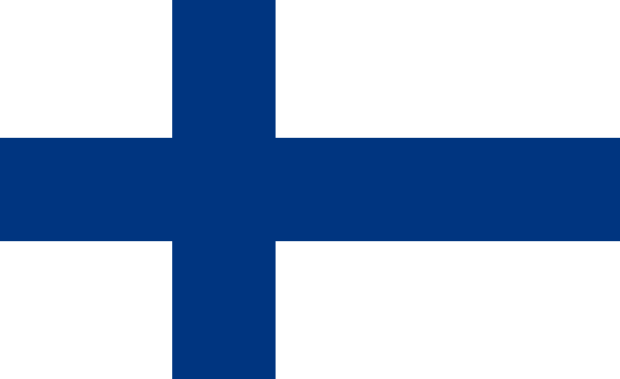
Flag is available in resolutions
| Icon 88x54 |  |
| Icon 32x20 |  |
Finland
Finland: A Land of a Thousand Lakes and Enduring Spirit
Finland, officially the Republic of Finland, is a Nordic country situated in Northern Europe. It is one of the most northerly countries in the world, bordering Sweden to the west, Norway to the north, Russia to the east, and Estonia to the south across the Gulf of Finland. Its capital and largest city is Helsinki. Finland is renowned for its pristine natural beauty, characterized by vast forests, numerous lakes, and a rugged coastline. It is a land that has, over centuries, forged a unique identity shaped by its geography, its challenging climate, and the resilient spirit of its people.
The Finnish population, while relatively small, is known for its homogeneity and its strong sense of national identity. As of recent estimates, the population hovers around 5.5 million people. The majority of Finns are ethnic Finns, speaking Finnish, a Finno-Ugric language unrelated to the Indo-European languages spoken by most of its European neighbors. A significant minority, about 5.2%, are Swedish-speaking Finns, a legacy of Swedens historical rule over the territory. The Finnish population is highly educated and urbanized, with a significant portion residing in the southern parts of the country, particularly in the Greater Helsinki metropolitan area. The Finnish society is often characterized by its emphasis on equality, social welfare, and a deep respect for nature. This reverence for the environment is not merely a cultural trait but a practical necessity, given the countrys abundant natural resources and its dependence on them for both sustenance and recreation. Life in Finland, especially outside the major cities, often involves a close connection to the natural world, with activities like hiking, fishing, and enjoying the sauna being integral parts of the Finnish lifestyle. The country also boasts a high quality of life, consistently ranking among the top nations for happiness, safety, and overall well-being, factors that contribute to its attractive, albeit often cold, living environment.
Finlands history is a tapestry woven with threads of conquest, independence, and resilience. For centuries, the land that is now Finland was under the dominion of powerful neighbors. From the 12th century until the early 19th century, it was a part of the Kingdom of Sweden. This period left an indelible mark on Finnish culture, language (with the significant Swedish-speaking minority), and legal systems. In 1809, Finland was ceded to the Russian Empire as an autonomous Grand Duchy. During the Russian period, a strong sense of Finnish national identity began to flourish, fueled by a growing literary and cultural movement. The Finnish language was promoted, and national symbols, like the Kalevala epic, gained prominence. This burgeoning nationalism culminated in Finland declaring its independence on December 6, 1917, amidst the turmoil of the Russian Revolution. The early years of independence were not without their challenges, including a brief and brutal civil war in 1918 between the Whites (conservatives) and the Reds (socialists). During World War II, Finland found itself caught between the warring powers, fighting two separate wars against the Soviet Union: the Winter War (1939-1940) and the Continuation War (1941-1944). Despite immense hardship and territorial losses, Finland managed to maintain its independence, a feat often attributed to the strategic brilliance of its military leaders, particularly Marshal Mannerheim, and the unwavering determination of its people. The post-war period saw Finland adopt a policy of neutrality and develop a unique relationship with its powerful eastern neighbor, a balancing act known as Finlandization. This era shaped Finlands foreign policy for decades, allowing it to focus on internal development and economic growth. In 1995, Finland joined the European Union, marking a significant step in its integration with Western Europe.
The geography of Finland is dominated by its characteristic land of a thousand lakes. In reality, there are far more – over 188,000 lakes are scattered across the country, covering approximately 10% of its total area. This abundance of water shapes the landscape, creating a mosaic of islands, peninsulas, and coastal archipelagos. The southern and western parts of the country are characterized by plains and rolling hills, while the northern regions, known as Lapland, are more rugged, featuring fells (low mountains) and vast wilderness areas. Finlands coastline stretches for over 1,250 kilometers along the Baltic Sea, featuring a complex system of islands and skerries. The climate in Finland is largely boreal, with cold, snowy winters and mild, short summers. The northernmost parts of the country experience the phenomenon of the midnight sun in summer, where the sun does not set for weeks, and the polar night in winter, where the sun remains below the horizon. This dramatic seasonal variation has a profound impact on the flora and fauna, with hardy coniferous forests dominating the landscape. The northern lights, or Aurora Borealis, are also a spectacular natural phenomenon visible in the winter months in the northern skies. The countrys natural resources, particularly timber and minerals, have played a crucial role in its economic development. Forests cover about 75% of Finlands land area, making it one of the most heavily forested countries in Europe.
Finlands economy has undergone a remarkable transformation over the past century, evolving from an agrarian society to a highly industrialized and technologically advanced nation. Historically, forestry and agriculture were the cornerstones of the Finnish economy. The vast forests provided timber for construction, paper, and pulp industries, which remain important sectors today. However, in the latter half of the 20th century, Finland strategically diversified its economy, investing heavily in education and research and development. This led to the emergence of a robust high-tech sector, particularly in telecommunications, information technology, and electronics. The most famous example is Nokia, which, though its mobile phone division has since been sold, was once a global leader in mobile technology and a symbol of Finnish innovation. Today, Finland is a leader in areas such as gaming, software development, and clean technologies. The country also has a strong manufacturing base, producing machinery, vehicles, and metals. The service sector is increasingly dominant, contributing a significant portion to the GDP. Finlands commitment to sustainability is also reflected in its industrial landscape, with a strong emphasis on renewable energy sources and eco-friendly production methods. The country has a highly skilled workforce and a competitive business environment, making it an attractive destination for foreign investment. Despite its economic successes, Finland has also faced challenges, including periods of economic recession and the need to adapt to global market shifts. However, its proactive approach to innovation and its commitment to social welfare have generally allowed it to navigate these challenges effectively.
Finland offers a wealth of tourist attractions, catering to a diverse range of interests, from nature lovers to city explorers. The capital city, Helsinki, is a vibrant hub of culture and design. Visitors can explore its impressive architecture, including the stunning Helsinki Cathedral and the Uspenski Cathedral, wander through the bustling Market Square, and immerse themselves in the citys numerous museums and galleries, such as the Ateneum Art Museum and the National Museum of Finland. The design district in Helsinki is a must-visit for anyone interested in contemporary Finnish design. Beyond Helsinki, Finlands natural beauty beckons. Lapland, in the north, is a magical destination, especially during winter, offering opportunities to experience the Northern Lights, visit Santa Claus Village in Rovaniemi, and enjoy activities like reindeer sleigh rides and husky safaris. In the summer, Lapland transforms into a land of endless daylight, perfect for hiking and exploring its vast wilderness. The Finnish Lakeland region, with its countless lakes and forests, is ideal for outdoor enthusiasts. Activities such as boating, fishing, swimming, and canoeing are popular. The archipelago off the southwest coast, a UNESCO World Heritage site, offers picturesque islands and charming coastal towns. For those interested in history and culture, visiting old wooden towns like Porvoo or Rauma provides a glimpse into Finlands past. The sauna, an integral part of Finnish culture, is an experience not to be missed. Many hotels and cottages offer traditional Finnish saunas, providing a relaxing and authentic cultural immersion. The numerous national parks, such as Koli National Park with its iconic views, offer breathtaking landscapes and well-maintained hiking trails. Finlands commitment to preserving its natural heritage ensures that these attractions remain unspoiled for generations to come.
Information about Finland
The information comes from the publication CIA The World Factbook.
Automated text translation, excuse errors, please!
Country Finland is situated in a location / continent Europe. Finland has an area of 338 145 km2 and 5 262 930 residents. The highest point has a height 1 328 above sea level. and it is called Haltiatunturi. The lowest point is located at the level of 0 above sea level and it is named Baltic Sea. System of government is republic and the date of independence 6th December 1917. The capital city is Helsinki. Finland has the international abbreviation FI.
Finland - economy
Total gross domestic product (GDP) is 198 200 000 000 $. Total gross domestic product per capita in purchasing power parity is 36 700 $. GDP grows by 2.90 % a year. Inflation (consumer price index) is equal to 3.30 % a year. Finland have 2 682 000 working-age population (from a total population 5 262 930 people). Unemployment is at 7.80 %. Finland issued 11.70 % GDP to healt care and 2,00 % GDP to army. The public debt of the country is 48.60 % GDP. The total amount of foreign debt is 577 000 000 000 USD.
Finland - demography
As suggested above, Finland has 5 262 930 people. Population growth is in the amount 0.07 % per year. Number of children born per 1000 population per year is 10.36.Every mother has average 1.73 children. The infant mortality rate is 3.40 and maternal mortality 5.00 deaths per 100,000 births. Average estimated life expectancy makes 79.41 years. Mortality is 10.33 people per 1000 population per year.
Finland - transport and telecommunications
Finland has 78 141 km of roads, 5 919 km of railway lines and 148 airports. The total length of waterways (navigable rivers, canals, etc.) is 7 842 km. There is registered 97 ships.
Number of active mobile phones (sim card) in the country Finland is 8 390 000. Number of active fixed telephone lines is 1 250 000. Finland has 4 393 000 internet users, who have the available 4 700 000 Internet connections. Finland has been assigned a domain first Choose range .fi.
Finland - energetics
Finland consumes a year 77 660 000 000 kWh of electricity. Annual electricity production is 76 160 000 000 kWh in power plants with a total installed electrical capacity 16 320 000 kW. Finland exports 5 218 000 000 kWh and imports 15 720 000 000 kWh of electricity per year Energy mix of power generation is as follows: fossil fuels: 52.5 %, nuclear energy: 16.4 %, renewable: 12.0 %, hydropower: 19.1 %.
Keywords: energetics, flags of countries in the world, Flags of countries, information, flag states, all flags, transport, national flags, Flag of Finland, economy, world countries, Finland, demography, list of flags, list of countries, telecommunications, flag, politic.